The Evolving Conflict Between AI Detection Tools and Human Authorship in the Age of Large Language Models

The intersection of artificial intelligence and digital discourse reached a new point of contention on September 13, 2026, when a high-profile exchange on the social media platform X brought the reliability of AI detection software under intense public scrutiny. The debate was ignited when venture capitalist David Sacks posted commentary regarding recent industry shifts toward "pacing the frontier" in AI development. Shortly after the post appeared, users utilized Pangram—an AI-detection service—to analyze the text, resulting in a categorical classification of the content as "entirely AI-generated." This prompted a swift rebuttal from Sacks, who publicly dismissed such detection mechanisms as "bogus."
This incident underscores a burgeoning technical and philosophical crisis: as Large Language Models (LLMs) become deeply integrated into the creative process, the binary distinction between human-authored and machine-generated text is rapidly dissolving. The controversy surrounding Pangram’s assessment of Sacks’s post highlights the limitations of current detection architectures, which often struggle to distinguish between human-led structural planning and synthetic prose.
The Mechanism of Modern Detection: Understanding Pangram
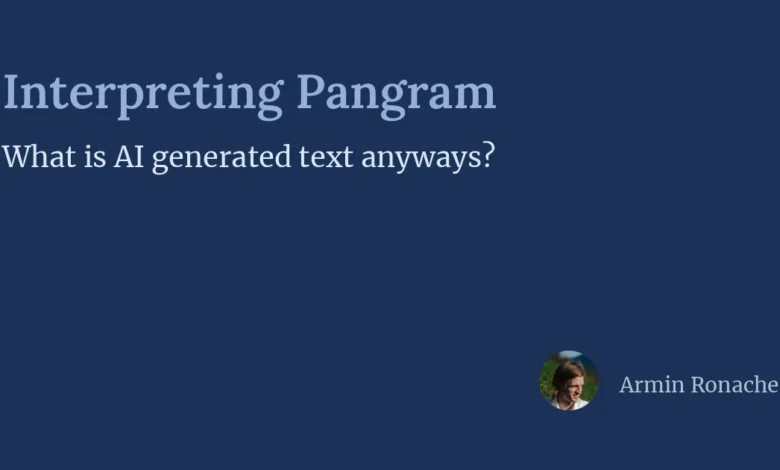
Pangram represents a new wave of diagnostic tools designed to identify synthetic text. According to documentation published in the academic paper (arXiv:2607.27183), the platform employs a specialized model trained on a bifurcated dataset: one consisting of verified human-authored content and another of LLM-generated text. To improve accuracy, the developers reportedly use LLMs to perform partial edits on human drafts, creating a "grey area" of co-authored text that the model is specifically designed to recognize.
The developers behind Pangram claim a high degree of precision, citing a false-positive rate of 0.0041% and a missed-detection rate of 0.34%. However, these metrics are frequently challenged by real-world application. Critics, including those who have integrated LLMs as writing assistants, argue that the tools frequently misidentify nuanced, human-edited content as "100% AI," creating a discrepancy between the detector’s output and the author’s perceived intent.
Chronology of the Controversy
The timeline of the September 14, 2026, discourse demonstrates how quickly automated verification tools have become part of the public vetting process:
- September 13, 2026: David Sacks posts commentary regarding the "Pacing the Frontier" initiative, referencing statements made by Anthropic CEO Dario Amodei and OpenAI CEO Sam Altman.
- Minutes later: Users deploy the Pangram tool to analyze the post, which returns an "entirely AI generated" verdict.
- Same day: Sacks responds via X, labeling the detection technology as fundamentally flawed.
- September 14, 2026: Independent testing by technology observers demonstrates that even when human authors use LLMs solely for structural outlines—subsequently rewriting every sentence by hand—detectors continue to flag the final output as synthetic.
The "Slop" Phenomenon and the Limits of Structure
The technical challenge for developers is that LLMs often impose a distinct "latent structure" on information. When a human author uses an AI tool to brainstorm the skeleton of an article or a tweet, the underlying logic, flow, and thematic progression are often influenced by the model’s training data.
In a controlled experiment, an observer attempted to recreate Sacks’s style by prompting an LLM to generate a tweet based on the "Pacing the Frontier" discourse. When the LLM produced the output, it was flagged as 100% AI. Even after the observer manually re-authored the entire text—stripping away all machine-generated sentences while retaining the original structure—the detector still classified the work as "100% slop." This finding suggests that modern detection tools are not just looking at word choice (lexical patterns) but are increasingly sensitive to the "informational architecture" of the content.
Industry Implications: The Transparency Dilemma
The rise of such detection software creates a precarious environment for journalists, academics, and public figures who use AI to streamline their workflows. For many, AI is a tool for clarity and efficiency, not a replacement for original thought. The "100% AI" label, when applied to a heavily human-edited piece, carries a stigma of intellectual dishonesty.
"The issue is not whether a machine touched the text," says one industry analyst, "but whether the detector provides a meaningful assessment of authorship." If a tool classifies a piece as synthetic because the author utilized an AI to organize their thoughts, it may lead to a culture of forced obfuscation, where writers feel compelled to hide their tools to maintain credibility.
Conversely, the necessity for such tools is rooted in the overwhelming volume of synthetic content flooding the internet. As LLMs become more capable of generating human-like nuance, the risk of automated misinformation campaigns grows. Detecting synthetic content is a primary line of defense for platforms trying to maintain a semblance of human-to-human interaction.
The Regulatory and Ethical Landscape
The discussion around "pacing the frontier"—the subject of the original Sacks post—is itself an example of the complex relationship between technology and regulation. When industry leaders like Amodei and Altman discuss slowing down development, they frame it as a safety imperative. However, as the debate on X highlighted, there is deep skepticism regarding the motives behind these announcements. Critics argue that "pacing" is a form of regulatory capture that protects incumbent firms from fast-following competitors, effectively using "safety" as a barrier to entry.
The fact that an AI detector was used to analyze a critique of AI regulation is perhaps the most significant irony of the event. It highlights that the debate over AI is no longer just about the safety of the models themselves, but about the integrity of the communication channels through which these issues are discussed.
Moving Forward
The future of authorship in the age of generative AI will likely move away from binary "human vs. machine" labels toward a more nuanced model of "AI-assisted authorship." Platforms are already experimenting with disclosure labels, such as the "AI transparency" tags seen on various blogs, which provide readers with context regarding how much a machine was involved in the drafting process.
As Pangram and its competitors continue to evolve, they face a difficult path. To remain relevant, they must move beyond detecting structural templates and begin to understand the nuances of human-in-the-loop editing. Until then, the friction between automated detection and human creativity will persist, serving as a reminder that as we delegate more of our cognitive load to machines, the definition of what constitutes an "original thought" will remain one of the most debated topics of the decade.
For the average user, the takeaway is clear: as long as LLMs remain central to the information ecosystem, the "AI-generated" tag will continue to be a blunt instrument, one that often fails to account for the intentional, human-driven process of editing and refinement. Whether this necessitates a more sophisticated generation of detectors or a cultural shift in how we perceive AI-assisted work remains to be seen.