How Company 3 and AWS Transformed Cloud Infrastructure Management through Automated Image Pipelines

In the high-stakes world of digital post-production and visual effects, the difference between a seamless render and a missed deadline often lies in the efficiency of the underlying compute environment. For Company 3, a global leader providing post-production, visual effects, and color grading services, the ability to rapidly provision secure, high-performance studio environments for artists is a core business requirement. However, as the studio’s infrastructure grew in complexity, their reliance on manual version management for Amazon Machine Images (AMIs) became a significant bottleneck. This article details the technical evolution from manual, error-prone workflows to an automated, scalable architecture powered by AWS EC2 Image Builder and the AWS Cloud Development Kit (CDK), a transformation that has set a new standard for infrastructure management in the entertainment industry.
The Complexity of Scale in Creative Media
Company 3 operates a sophisticated global network where creative talent—ranging from colorists to VFX artists—requires immediate access to rendering environments tailored to specific projects. To manage these environments, the company’s New Technology team, led by Director of New Technology Phil Wortas and Senior New Technology Engineer Matthew Galloway, utilized Amazon EC2 Image Builder. This service allows for the automated creation and deployment of customized server images.
At the height of their initial deployment phase, the team faced a structural dilemma. While Image Builder provides a robust framework for image creation, it requires strict adherence to semantic versioning for components and recipes. Because these resources are immutable, any modification to a component necessitates the creation of a new version, which in turn must be reflected in the associated Amazon Resource Names (ARNs) throughout the entire infrastructure code. In a large-scale environment with dozens of interdependent components, tracking these changes manually proved to be an unsustainable, high-risk process.
Chronology of a Technical Bottleneck
The challenge began to crystallize as the team scaled their infrastructure. In the early stages, the lack of native automation for version propagation forced engineers to treat every minor change as a major manual update.
- Phase One: The Manual Era. Engineers manually updated version strings across multiple CDK stacks. This was inherently fragile; a single missed update would lead to deployment failures or, worse, inconsistent environment configurations across different regions.
- Phase Two: The Hash-based Workaround. Recognizing the inefficiency, the team implemented a stopgap measure involving the appending of MD5 hashes to component names. While this forced the CDK to recognize changes and trigger updates, it resulted in cumbersome, non-standard naming conventions that diverged from best practices.
- Phase Three: The Custom Resource Experiment. To move away from naming hacks, the team collaborated with AWS Solutions Architects to implement CDK Custom Resources. This successfully automated some aspects of version propagation but introduced significant technical debt. The resulting architecture was a "black box" of specialized code that required deep, tribal knowledge to maintain, creating a barrier to onboarding new engineering talent.
Data-Driven Efficiency: Quantifying the Shift
The transition from manual L1 (Layer 1) constructs to modern L2 (Layer 2) constructs represents a fundamental shift in developer productivity. Prior to the adoption of L2 constructs, a standard Image Pipeline required over 50 lines of imperative code. This included the manual definition of IAM roles, the creation of instance profiles, and the explicit linking of logging buckets and infrastructure configurations.
With the introduction of L2 constructs, the same architecture can now be defined in fewer than 10 lines of declarative code. This represents a reduction in code volume of approximately 80 percent, but the impact extends beyond simple line counts. By defaulting to AWS-recommended security configurations—such as the requirement for IMDSv2 (Instance Metadata Service Version 2) and the automatic application of least-privilege IAM policies—the new approach significantly reduces the "security tax" typically associated with building complex infrastructure.
Official Developments and Industry Impact
The technical hurdles faced by Company 3 were not unique; they were representative of a wider industry challenge regarding the automation of immutable infrastructure. In November 2025, AWS addressed these pain points by launching native auto-versioning capabilities for EC2 Image Builder. By allowing developers to use wildcard placeholders (such as "1.2.x") in their version definitions, the service now automatically resolves to the latest compatible build, effectively eliminating the need for manual reference updates.
Furthermore, the release of Layer 2 constructs for EC2 Image Builder (RFC 0789) provided the abstraction layer the industry had been seeking. These constructs handle the heavy lifting of resource association, ensuring that pipelines are built according to established security and performance benchmarks.
"The evolution of EC2 Image Builder’s CDK support demonstrates a clear commitment to customer-centric engineering," noted observers in the AWS DevOps community. By observing the collaborative problem-solving between Company 3 and AWS, it is evident that the partnership served as a primary catalyst for these platform-wide improvements.
Broader Implications for Cloud Infrastructure
The implications of this shift are profound for any organization managing large-scale server images. The transition from "managing versions" to "managing intent" allows Platform Engineers to pivot away from low-level administrative tasks and toward value-added engineering.
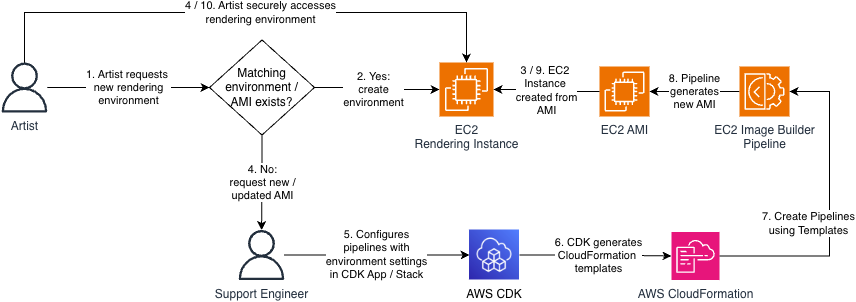
For a studio like Company 3, this means that when an artist or a support engineer requests a new software tool or a specialized rendering environment, the underlying infrastructure adapts automatically. The system now tracks versions, handles dependencies, and ensures security compliance without requiring a manual audit of the code stack. This agility is a competitive advantage in the entertainment industry, where the ability to spin up a new, highly optimized studio environment in minutes rather than days can define the success of a feature film production.
Moreover, the standardization provided by L2 constructs acts as a bridge for team scaling. New engineers no longer need to spend weeks deciphering complex, custom-built resource meshes; they can leverage standard, readable CDK code that aligns with AWS best practices. This democratization of infrastructure-as-code is a necessary step toward the maturation of cloud-native media workflows.
Looking Ahead
The journey of Company 3 serves as a case study in the necessity of feedback loops between enterprise customers and cloud providers. The "workaround" phase, while difficult, was a vital period of experimentation that surfaced the real-world limitations of existing tools. By documenting these challenges and working directly with AWS developers, Company 3 helped pave the way for a more robust, automated ecosystem that now benefits the entire AWS community.
As the industry continues to move toward more complex, automated rendering pipelines, the shift toward managed abstractions will likely accelerate. Organizations currently relying on manual configurations or legacy L1 constructs are encouraged to audit their current pipelines against the new L2 standards. The documentation provided by AWS—including the new auto-versioning guides and the alpha-stabilized L2 construct library—offers a clear roadmap for modernization.
Ultimately, the transformation of Company 3’s infrastructure proves that when technical friction is removed, the focus returns to the primary objective: enabling creators to deliver high-quality content without being hindered by the machinery of the cloud. The infrastructure of the future is not just code; it is an intelligent, self-managing layer that anticipates the needs of the applications it supports, and for the visual effects industry, that future has already arrived.
Related posts: