WhatsApp Revolutionizes Global Account Security with Seamless Passkey Integration

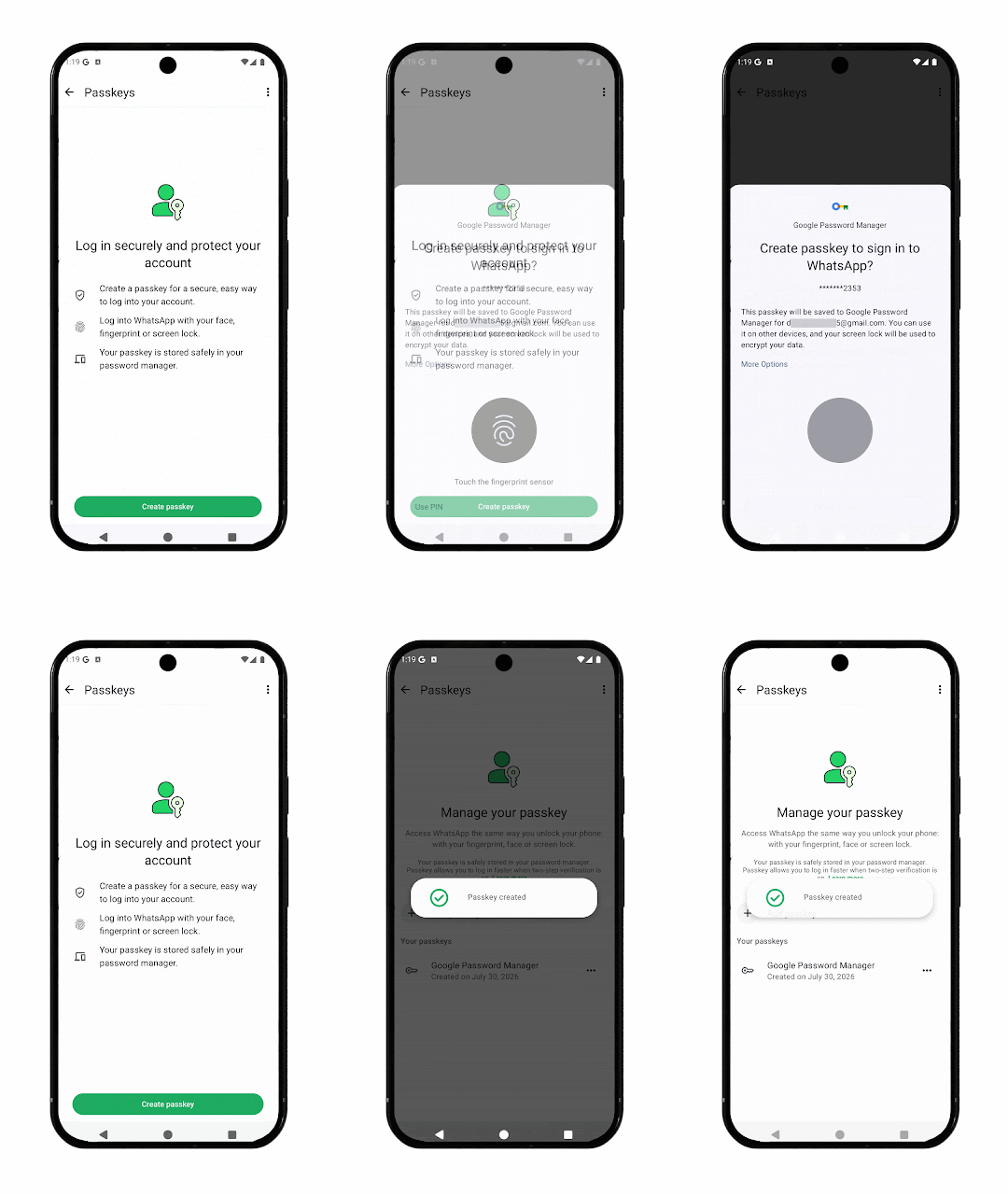
WhatsApp, the world’s most widely used messaging platform, has officially transitioned into a new era of digital security by integrating passkey technology into its authentication framework. Serving billions of users across vastly different socio-economic backgrounds and technical environments, the Meta-owned platform has successfully replaced cumbersome, often insecure, and inconsistent One-Time Password (OTP) systems with a streamlined, biometric-based login experience. This shift represents one of the most significant implementations of FIDO2-standard authentication to date, setting a benchmark for how massive, consumer-facing applications can balance top-tier security with user-friendly accessibility.

The Evolution of Authentication at Scale
The journey toward passwordless authentication began in earnest for WhatsApp in 2023, as the engineering team sought to address the inherent vulnerabilities of SMS-based verification. Historically, SMS OTPs—while ubiquitous—are susceptible to interception, phishing, and service outages, particularly in regions with unstable telecommunications infrastructure. For a service that functions as a primary communication tool for billions, account takeovers represent not just a technical failure, but a profound breach of personal privacy.
By adopting passkeys, WhatsApp has effectively leveraged public-private key cryptography to secure user accounts. In this model, the "key" is stored locally on the user’s device, guarded by their biometric signature (such as a fingerprint or facial recognition) or a device-specific PIN. When a user attempts to sign in, the device performs a local cryptographic handshake with the server, eliminating the need for a shared secret like a password or a transmission of vulnerable codes over the airwaves.

Chronology of the Implementation
The integration of passkeys was not an overnight endeavor; it required a deliberate, phased approach to ensure that a platform with such massive scale would not experience service interruptions.
In early 2023, WhatsApp initiated the project, recognizing that the Android Credential Manager API provided the necessary abstraction to manage a diverse array of hardware and software configurations. Throughout the year, the engineering team worked closely with Google to navigate the complexities of fragmented Android ecosystems, ranging from legacy devices to the latest flagship smartphones.

By late 2023, the feature began rolling out to users globally. The rollout was marked by extensive A/B testing, which allowed the team to refine the user interface. Developers observed that when users were presented with overly complex setup prompts, adoption rates plateaued. Consequently, the team pivoted to a "single-screen" approach, which integrated the passkey creation into the natural flow of the app’s account management settings, leading to significantly higher engagement.
Technical Architecture and Backend Orchestration
The backend implementation, spearheaded by WhatsApp’s engineering team, utilizes the Erlang programming language, which is well-regarded for its high concurrency and fault tolerance—essential traits for a messaging service of this magnitude. To handle the complex WebAuthn/FIDO2 ceremonies, the team utilized the Rust-based webauthn-rs library. This combination allows for a high-performance, secure bridge between the user’s client-side request and the server’s verification process.

The server architecture is divided into two distinct, yet interconnected, sequences: Registration and Authentication.
- Registration: This phase involves the server issuing a challenge to the client. Once the client proves identity via a biometric gesture, the server verifies the attestation, binds the public key to the user account, and stores it within a secure database.
- Authentication: During sign-in, the server sends a unique challenge that only the device holding the corresponding private key can sign. This ensures that even if a server were compromised, the stolen data would be useless without the physical device and its associated biometric lock.
One of the most innovative aspects of this architecture is how it handles multi-device synchronization. Unlike traditional WebAuthn flows, which often rely on Bluetooth-based QR code scanning between devices—a process found to be unintuitive for the average user—WhatsApp’s system is platform-agnostic. Users can maintain passkeys across different ecosystems, such as Google Password Manager or iCloud Keychain. When a user switches devices, the platform simply requests a new passkey generation, effectively decoupling security from a single hardware unit.

Addressing the Edge Cases of Global Scale
Engineering for billions requires accounting for variables that smaller applications rarely encounter. The WhatsApp team had to account for "the happy path" versus the "edge-case reality." Developers faced significant hurdles, including:
- Devices without screen locks: A subset of the user base does not utilize biometric or PIN protection, requiring the app to provide clear, helpful guidance on setting up device security before a passkey can be established.
- Inconsistent Credential Provider Behavior: Different OEMs (Original Equipment Manufacturers) implement the Android Credential Manager slightly differently, necessitating robust error-handling code to ensure a uniform experience.
- Outdated Google Play Services: Ensuring that older devices, which may not receive regular OS updates, could still participate in the new security standard was a primary design constraint.
Implications for the Digital Security Landscape
The broader impact of WhatsApp’s move is difficult to overstate. By normalizing passkeys, the company is effectively training billions of users to adopt a more secure authentication standard, potentially reducing the global frequency of phishing-related account takeovers. Data from the industry suggests that phishing-resistant MFA (Multi-Factor Authentication) methods can reduce the success rate of account attacks by over 90%.

For developers, the WhatsApp case study serves as a masterclass in modernizing legacy systems. The recommendation to move away from SMS OTPs and toward standardized APIs like the Android Credential Manager is being echoed across the tech industry. Furthermore, the shift demonstrates that "security" does not have to be synonymous with "friction." By utilizing native OS features, WhatsApp has managed to make its security measures feel faster and more seamless than the insecure methods they replaced.
Official Perspectives and Future Outlook
Mayank Manuja, an Android Engineer at WhatsApp, has noted that the most exciting aspect of this project is the scale. "Even a small improvement to WhatsApp touches billions of users worldwide," he stated, highlighting the responsibility that comes with managing such a vast, diverse user base.

Looking forward, WhatsApp is exploring ways to extend the utility of passkeys. The goal is to move beyond simple sign-in processes to secure more sensitive in-app actions, such as authorizing encrypted backups or validating changes to account settings. By doing so, the platform aims to create a holistic security ecosystem where the user is protected at every touchpoint.
As the industry watches, the collaboration between Google and WhatsApp serves as a blueprint for future large-scale technology deployments. The key takeaway for developers is clear: prioritize the abstraction of complex security protocols behind user-friendly, native interfaces. As biometric hardware continues to proliferate globally, the barrier to entry for passkeys will continue to drop, eventually rendering the vulnerable, text-based password relics of a bygone era.

For those looking to implement similar systems, the technical path is well-documented. The Android developer community now offers comprehensive guides and sample code—such as the "Shrine" sample—that demonstrate how to implement these flows effectively. As digital literacy continues to grow and hardware capabilities improve, the transition to a passwordless future appears not just inevitable, but increasingly rapid, with WhatsApp leading the charge for the world’s connected population.