Navigating the New EU AI Act Transparency Requirements and Global Disclosure Standards

The European Union’s regulatory landscape for artificial intelligence shifted decisively on August 2, 2026, as new transparency obligations under the EU AI Act officially entered into force. While industry discussions have been dominated by concerns regarding the potential for punitive fines and operational friction, the reality of the mandate is more nuanced. The legislation is designed to address a fundamental challenge in the digital age: ensuring that users can distinguish between human-authored content and machine-generated output. This move represents a significant step in the global effort to establish a standardized framework for AI accountability, impacting not only European firms but any international organization that serves citizens within the EU.
A Chronology of Implementation
The road to the current requirements began with the European Commission’s broader ambition to regulate AI systems based on their risk profile. While the AI Act covers various aspects of safety and security, Article 50(4) specifically targets transparency. Following the initial legislative approval, a multi-year lead-in period allowed companies to prepare for the August 2026 deadline. The implementation phase was marked by the development of the "Code of Practice," a collaborative document drafted by the Commission, stakeholders, and industry experts to define what constitutes "clear and distinguishable" labeling. By mid-2026, the Commission finalized its guidance on specific iconography and user experience (UX) standards to ensure that compliance would be consistent across diverse platforms.
Defining the Scope of Transparency
The legal obligation to disclose the use of AI is not universal; it is targeted at specific interactions where the risk of user deception is highest. According to the legislation, providers and deployers of AI systems must ensure that users are informed that they are interacting with an AI system or viewing AI-generated content. This applies primarily to:

- Systems that generate content that mimics human speech, writing, or creative output.
- Systems that generate or manipulate image, audio, or video content, particularly when the output is intended to resemble real people, places, or events.
- Content that is used to influence public opinion or decision-making, particularly in sensitive areas such as health, finance, environmental policy, and political discourse.
Crucially, the regulation places responsibility on both the developers of the AI and the entities deploying it. A company cannot circumvent its obligations by outsourcing the generation of content to a third-party AI tool; the entity that publishes or presents the output is held accountable for its proper disclosure.
The Problem with Ambiguity: Moving Beyond Sparkles
For several years, the "sparkle" icon has become the de facto symbol for AI-powered features across the software industry. However, regulatory bodies and UX research institutions have identified this symbol as insufficient for the purposes of the new law. The European Commission has highlighted that the sparkle icon is frequently used to denote general "intelligence" or "assistive features" rather than explicit AI generation.

The current guidelines emphasize that transparency must be "clear and distinguishable." An icon alone is rarely sufficient. The commission has provided an official set of icons to be used as a foundation, but these must be accompanied by plain-language text, such as "AI-generated" or "AI-assisted." Furthermore, the label must persist if the content is downloaded, shared, or reposted, preventing the "stripping" of disclosures during viral distribution. Compliance is not achieved by burying a disclosure in a Terms of Service page or a footer; it must be presented in a way that the average user would immediately notice.
The Threshold of Editorial Responsibility
A central point of contention for businesses has been the definition of "AI-generated." Does a document drafted by AI but polished by a human require a disclosure? The European Commission has provided a distinction based on the concept of "substantive editorial control."

Minor assistive tasks, such as automated spellchecking, grammar correction, formatting adjustments, or basic translation services, are not classified as AI-generated content for the purposes of this mandate. These are considered standard productivity tools. Conversely, if an AI is responsible for the creative substance—such as drafting an article, creating a composite image, or generating a summary of a complex report—the disclosure is mandatory.
The Commission has explicitly stated that a "human skim" does not qualify as editorial review. To be exempt from labeling, the content must undergo a substantive rewrite or refinement where a named human author or legal entity takes full responsibility for the output. This creates a clear, binary line: if the machine does the "heavy lifting" of creation, the user must be informed. If the human remains the primary architect, the disclosure is not required.

Global Patterns and Comparative Regulations
The EU’s stance is part of an emerging global consensus rather than an isolated incident. Several jurisdictions have begun implementing similar transparency measures. In the United States, for instance, various state-level regulations have been enacted to address "synthetic performers" and the use of AI in political advertising. In the Asian market, various regional guidelines are evolving to address the risks of deepfakes and the spread of misinformation.
This international synchronization suggests that companies would be wise to adopt a "highest common denominator" approach to compliance. Rather than building different interfaces for different regions, organizations are increasingly adopting universal labeling patterns that meet the most stringent requirements, such as those set forth by the EU.

Implications for Industry and UX Design
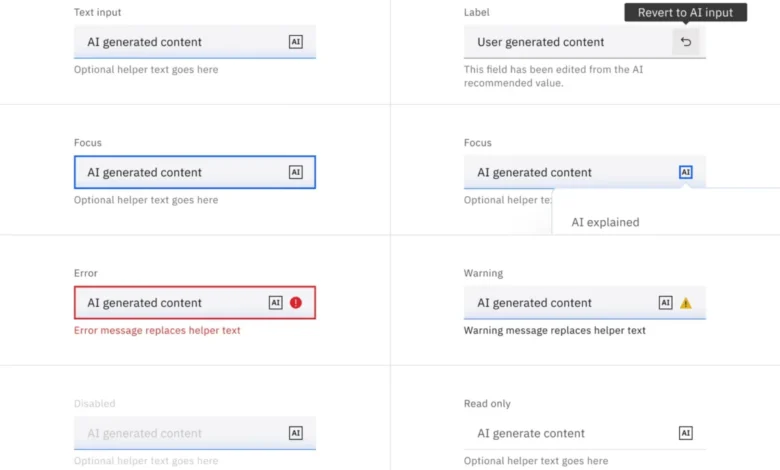
The impact of these rules on UX design is profound. Product teams are now tasked with integrating transparency into the user journey without disrupting the aesthetic or functionality of the application. This has led to the rise of specialized design patterns, such as those documented in the Carbon Design System, which offer standardized ways to present AI labels, explainability panels, and icon variants.
From a business perspective, the requirement to label AI content may initially seem like an impediment, but it also serves as a mechanism for building user trust. As public skepticism toward "AI slop"—low-quality or deceptive automated content—continues to rise, clear disclosure allows brands to demonstrate integrity. By proactively identifying AI-generated content, companies can distinguish their high-quality, human-led work from automated output, potentially enhancing their reputation for transparency.

Economic and Legal Risks
While critics of the legislation often point to the potential for "huge fines," the enforcement mechanism is designed to be proportional. The primary risk to businesses is not just the immediate financial penalty, but the long-term cost of remediation. If a product’s design does not account for these labels, a redesign of the entire interface architecture could be required after deployment, which is significantly more expensive than integrating transparency during the design phase.
Moreover, the legal risk extends to liability. If an AI generates a harmful or inaccurate claim that influences a user’s health or financial decisions, the lack of a proper disclosure could exacerbate legal exposure. Transparency, in this context, functions as a form of risk management.

Future Outlook
As we move further into 2026 and beyond, the focus will likely shift from the legal definition of "transparency" to the technical implementation of "provenance." Technologies like C2PA (Coalition for Content Provenance and Authenticity) are gaining traction, providing a way to cryptographically sign content to prove its origin. While the current EU guidelines focus on the visual labeling of content, the next phase of the regulatory evolution will likely involve the standardization of metadata to ensure that transparency is baked into the file itself.
For developers, designers, and business leaders, the message is clear: the era of "hidden AI" is coming to an end. The new regulations do not seek to stifle innovation but to provide the guardrails necessary for a sustainable AI-integrated economy. Organizations that embrace these transparency requirements now will be better positioned to navigate the complex regulatory environment of the future, ensuring that their products remain compliant, trustworthy, and user-friendly in an increasingly automated world.

By viewing these guidelines as a framework for better user experience, companies can turn a compliance burden into a competitive advantage. The future of the digital interface lies in the ability to provide powerful AI capabilities while maintaining the clarity and honesty that users demand. Those who master this balance will lead the next generation of digital products, setting the standard for the human-AI partnership.