The Great AI Power Struggle: Why Communities Are Rising Up Against the Data Center Boom

Across the United States, a quiet but potent clash is unfolding between the relentless demand for artificial intelligence infrastructure and the health, safety, and sovereignty of local communities. As tech giants scramble to secure land and power for massive data centers, they are increasingly meeting resistance from residents who view these facilities not as engines of progress, but as localized threats to their environment and quality of life. While the industry pitches a narrative of economic revitalization and technological leadership, a majority of Americans remain skeptical, driven by growing concerns over energy consumption, water usage, and the long-term ecological footprint of the digital age.
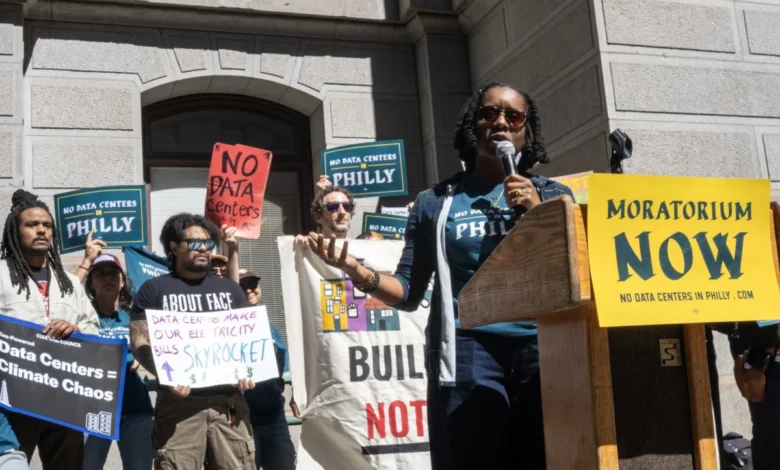
The tension is perhaps most visible in Philadelphia, where grassroots organizations like Philly Thrive are spearheading a movement to block data center development. For residents who have spent generations living in the shadow of heavy industry, the arrival of AI infrastructure feels less like a new dawn and more like a familiar, unwanted ghost.
The Shadow of Industrialization: A Legacy of Skepticism
To understand the fervor of the anti-data center movement in Philadelphia, one must examine the city’s complex industrial history. For decades, neighborhoods like Grays Ferry were defined by the presence of the Philadelphia Energy Solutions (PES) oil refinery, once the largest of its kind on the East Coast. The refinery was a constant, looming presence—both economically and environmentally—until a catastrophic explosion in 2019 forced its closure.

For lifelong residents like Shawmar Pitts, the refinery was not merely a landmark; it was an invisible architect of their physical health. Pitts, now a managing co-director of Philly Thrive, recalls a turning point in 2018 when he encountered the organization at a community event. As he reviewed literature detailing the health risks associated with living in proximity to major industrial emissions, he was struck by the prevalence of chronic conditions among his own friends and family.
"I’m looking at all the sicknesses on this paper, and I’m looking at my mother, my sister, my neighbor," Pitts noted. "Every house had someone on that list." This realization, crystallized by the loss of neighbors to rare illnesses, transformed Pitts from a concerned resident into a dedicated activist. Today, that lived experience informs the skepticism he brings to the table regarding the proposed construction of data centers in Philadelphia’s neighborhoods, including the Grays Ferry area and parts of Northeast Philadelphia.
The Data Center Gold Rush: A Timeline of Growth and Pushback
The current wave of opposition is a reaction to a sudden and rapid acceleration in data center demand. Following the explosion of interest in generative AI in late 2022, the need for massive computing power surged, prompting cloud service providers and tech conglomerates to scout sites across the U.S. that offer proximity to fiber optic networks and, crucially, access to the electrical grid.
- 2019: The PES refinery in Philadelphia suffers a major explosion, leading to its permanent closure and a shift in how the city views land use in post-industrial zones.
- 2022-2023: The global AI boom creates an unprecedented need for hyperscale data centers, leading to a scramble for real estate and utility capacity.
- 2024: Major power grid operators, including PJM Interconnection, begin raising alarms about the strain placed on regional electrical systems by massive, new industrial loads.
- 2026 (July): New York Governor Kathy Hochul issues an executive order pausing new data center permits, marking a significant victory for local activists.
- 2026 (September): The No Data Centers in Philly campaign holds a major rally at City Hall, signaling that the debate has moved from local planning boards to the forefront of municipal politics.
This chronology mirrors a national trend. From Denver and Indianapolis to Asheville and Reno, city councils have responded to the public outcry by implementing moratoriums. These pauses are intended to serve as a cooling-off period, allowing municipalities to conduct independent impact assessments rather than relying solely on the projections provided by developers.

The Energy Equation: Natural Gas and the Climate Toll
The primary concern for many activists and environmentalists is the sheer volume of energy these facilities consume. BloombergNEF recently projected that by 2035, U.S. data centers could consume more natural gas than Germany and Japan combined. This projection is double what the firm anticipated less than a year prior, illustrating the extreme, non-linear growth of the AI sector.
While natural gas is often marketed as a "bridge fuel" that burns cleaner than oil or coal, its lifecycle emissions are significant. Each cubic foot of gas burned releases approximately 60 grams of carbon dioxide. Beyond the direct CO2 output, the industry’s demand for electricity is so intense that it threatens to overwhelm the grid, forcing utility companies to keep older, dirtier power plants online longer than intended.
Furthermore, data centers often house hundreds of large diesel-powered backup generators. While these are ostensibly for emergency use during grid failures, environmental advocates like attorney Annie Fox of the Clean Air Council argue that in practice, they are often tested or triggered during peak heat waves when the grid is most strained. These localized emissions contribute to air quality degradation in communities that are already disproportionately affected by respiratory and cardiovascular issues.
The Economic Promise vs. The Local Reality
Data center developers frequently tout job creation and tax base expansion as their primary contributions to the community. However, critics argue that the actual economic impact is minimal. Once the construction phase—which utilizes heavy machinery and specialized labor—is complete, a typical data center requires a very small permanent staff.

"We don’t want the pollution, we don’t want the noise, and we know they’re not going to bring us more jobs," said Sonya Sanders, board president of Philly Thrive. For residents like Sanders, whose husband died of a rare cancer that she attributes to years of industrial exposure, the promise of a few maintenance roles is a poor trade-off for the potential health risks and the consumption of essential public resources like water and electricity.
There is also a growing concern regarding data surveillance and sovereignty. As Donna Greenberg, a rally attendee, noted, the integration of data centers into local neighborhoods brings with it a discomfort regarding the centralization of information and the power dynamics between massive tech firms and local residents.
Policy Responses and the Path Forward
The legislative landscape is beginning to shift. The move by Governor Hochul in New York serves as a template for what activists hope will become a broader movement. By asserting that progress should not come at the expense of "a higher utility bill, deleted water supply, or noise pollution," Hochul’s administration has validated the concerns of citizens who feel their communities are being treated as mere locations for industrial footprint expansion.
However, the industry argues that the rapid development of data centers is a strategic national imperative. With the U.S. competing for dominance in the global AI race, tech firms contend that delaying infrastructure development could lead to a loss of economic competitiveness. The challenge for policymakers, therefore, is to balance the macro-level demand for AI infrastructure with the micro-level need for community health and environmental justice.

Conclusion: A New Standard for Infrastructure
The movement against data centers in Philadelphia and across the country is not merely a "Not In My Backyard" (NIMBY) phenomenon. It is a fundamental questioning of how we prioritize infrastructure in the 21st century. As the climate becomes more volatile and the demand for digital compute power continues to scale, the conversation is shifting toward accountability.
Whether it is through stricter emissions regulations, requirements for on-site renewable energy generation, or meaningful community benefit agreements, the era of "build first, ask later" appears to be drawing to a close. For activists like Shawmar Pitts, the goal is simple: to ensure that the mistakes of the past—where industrial profit was prioritized over the lives of local residents—are not repeated in the name of the future. As city officials in Philadelphia and elsewhere continue to weigh these proposals, they do so under the watchful eye of a public that is increasingly unwilling to sacrifice its health for the sake of the cloud.
Related posts: