Architecting Production-Ready Authentication in Go: Lessons from Wapi Streaming Backend

Authentication Engineering Fundamentals and the Illusion of Simplicity
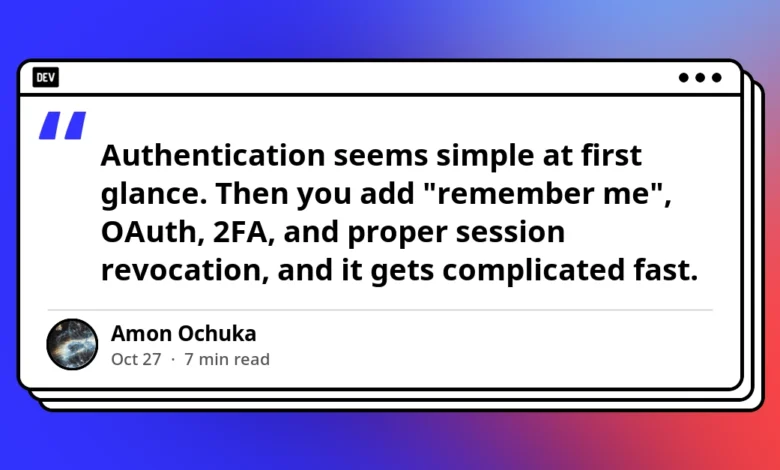
At first glance, implementing user authentication in a modern software application appears deceptively straightforward: accept user credentials, verify them against a database, and issue a session identifier. However, production-grade systems quickly demand complex architectural patterns once requirements expand to include persistent sessions, social logins, multi-factor verification, and strict token revocation policies. For modern web and mobile services, identity management serves as the primary perimeter defense against automated threats, credential stuffing, and unauthorized data access.
This architectural complexity is evident in the backend infrastructure of Wapi, a live-streaming platform tailored for African content creators and consumers. Built using the high-performance Go programming language and the Gin web framework, Wapi’s authentication subsystem addresses numerous enterprise-grade security concerns. These include stateless token validation, cryptographic refresh token rotation, time-based one-time passwords (TOTP), and adaptive rate limiting. Designing such a system requires a deep understanding of cryptographic principles, state management trade-offs, and the specific threat models facing digital media platforms in emerging markets.
The Evolution of Token Strategies: Access Tokens and Cryptographic Rotation
Modern API-driven architectures frequently rely on a dual-token mechanism to balance security and user experience. Short-lived access tokens—typically valid for minutes rather than hours—authenticate individual API requests without requiring frequent database lookups. Conversely, long-lived refresh tokens allow clients to obtain new access tokens transparently, sparing users from repeated login prompts. Wapi implements this classic pattern with a critical security enhancement known as refresh token rotation.
Under a standard refresh token implementation, a compromised token remains valid until its long expiration date, allowing malicious actors persistent access. Refresh token rotation alters this dynamic by invalidating and replacing the refresh token upon every single use. If a legitimate user and an attacker attempt to use the same refresh token, the system detects the anomaly. Because the second presentation of an already-consumed token indicates either a transmission retry or active token theft, the security protocol revokes the entire user session, forcing a complete re-authentication.
This strategy shifts the burden of proof onto cryptographic verification while mitigating the impact of compromised client storage. Cybersecurity analysts note that token rotation significantly reduces the window of vulnerability in mobile-heavy environments where devices are frequently lost, stolen, or exposed to insecure local networks.
Implementing JSON Web Tokens (JWT) Without Compromising Security
JSON Web Tokens (JWTs) have become an industry standard for stateless authentication due to their self-contained nature. A JWT contains cryptographically signed claims regarding user identity and permissions, allowing backend services to verify authorization without querying a central database for every HTTP request. Within a Go and Gin framework, this validation typically occurs inside custom middleware. The middleware extracts the Bearer token from the incoming Authorization header, cryptographically verifies the signature using a shared secret or public key, extracts the user identifier, and injects it into the request context for downstream handlers.
Despite their utility, JWTs present inherent design challenges, most notably their statelessness. Because the issuing server does not maintain a record of active tokens, a standard JWT cannot be revoked before its scheduled expiration. If a user’s account is compromised or abruptly terminated due to a policy violation, a valid JWT remains accepted by downstream services until its timestamp expires.
To resolve this limitation without sacrificing performance, backend engineers must implement hybrid validation models. Systems can maintain a revocation blacklist in an in-memory cache or distributed store such as Redis, or they can cross-reference the JWT’s session identifier against active database sessions during high-security operations. While this reintroduces a degree of statefulness, it restores administrative control over active credentials.
Comprehensive Session Management and Metadata Tracking
Tokens alone cannot satisfy modern compliance and user experience requirements. Users increasingly demand visibility into where their accounts are active, alongside the ability to remotely terminate unauthorized sessions. Wapi addresses this by exposing dedicated endpoints that allow users to list active sessions, revoke individual tokens, or perform a global logout across all connected devices.
To support granular session management, backend architectures must track refresh tokens and session identifiers within a persistent database alongside contextual metadata. This metadata typically includes the originating device, user agent string, client IP address, initial creation timestamp, and last-used timestamp. Transforming raw cryptographic hashes into human-readable descriptions—such as "Chrome on Windows, last active two hours ago"—empowers users to identify suspicious account activity proactively.
Furthermore, security best practices dictate that database records should never store plaintext refresh tokens. Systems must store cryptographic hashes of the tokens using robust hashing algorithms. If a database breach occurs, the stolen hashes remain useless to attackers attempting to forge valid authentication sessions.
Securing Multi-Factor Authentication via TOTP and Cryptographic Challenges
Implementing Multi-Factor Authentication (MFA) represents one of the most effective measures an organization can take to prevent unauthorized account access. Wapi incorporates Time-based One-Time Passwords (TOTP), ensuring compatibility with standard authenticator applications such as Google Authenticator, Authy, and password managers like 1Password.
The TOTP lifecycle involves four distinct operational phases:
- Generation: The server generates a cryptographically secure secret key associated with the user account.
- Provisioning: The server transmits this secret to the client, typically rendered as a QR code for easy scanning.
- Verification: The user’s authenticator app computes a dynamic six-digit code based on the current Unix timestamp and the shared secret, which the server validates.
- Enforcement: Subsequent high-privilege actions or logins require a valid TOTP code in addition to primary credentials.
Specialized considerations are vital during the MFA login challenge. The temporary session token issued after primary credential verification must be single-purpose, feature a very short expiration window, and remain strictly invalid for accessing standard API endpoints. Additionally, because a six-digit numeric code yields only one million possible combinations, unthrottled verification endpoints are highly vulnerable to automated brute-force attacks. Consequently, MFA verification requires dedicated, aggressive rate limiting tied to both the IP address and the specific user session.
Finally, resilient systems must account for account recovery scenarios where users lose access to their primary authenticator devices. Best practices dictate the generation of single-use backup recovery codes during the initial setup phase. These backup codes must be stored securely as cryptographic hashes and invalidated immediately upon use.
OAuth 2.0 Integration and Secure Credential Exchange
Social login providers like Google and Facebook streamline user onboarding, but improper implementation can introduce severe security vulnerabilities. Wapi utilizes the standard OAuth 2.0 authorization code flow, ensuring that user credentials never pass through the platform’s proprietary servers.
However, a common security pitfall in OAuth implementations involves handling the redirect URI following successful authentication. Transmitting access tokens or sensitive authorization parameters directly within the redirect URL query string exposes those credentials to browser history logs, web server access logs, and HTTP Referer headers.
To eliminate this vector, Wapi routes the browser back to the frontend application carrying only a short-lived, single-use authorization code. The frontend client then exchanges this code for access and refresh tokens through a secure, server-to-server POST request. Because the transient code expires within seconds and can only be used once, any accidental exposure in transit results in an unusable credential.
Adaptive Rate Limiting and Distributed Abuse Prevention
Authentication endpoints represent primary targets for credential stuffing, automated botnets, and denial-of-service attempts. Securing these pathways requires strict, multi-layered rate limiting calibrated to the sensitivity of specific actions.
Wapi enforces differentiated thresholds across various authentication routes:
- Signup, login, and password reset endpoints are restricted to approximately 10 requests per minute per IP address.
- OAuth initiation routes are capped at 5 requests per minute per IP address.
- MFA verification endpoints enforce significantly stricter limitations—such as 5 attempts per 15-minute window—keyed jointly to the IP address and the user or session identifier.
While in-memory rate limiters built upon packages like golang.org/x/time/rate are sufficient for single-instance applications, horizontal scaling introduces architectural challenges. When deploying multiple backend instances behind a load balancer, local memory counters operate in isolation, multiplying the effective rate limit by the number of active servers.
To maintain precise enforcement across distributed environments, engineering teams must transition rate-limiting counters to a centralized, high-speed data store such as Redis, utilizing sliding window or token bucket algorithms. Furthermore, because mobile audiences frequently share carrier-grade Network Address Translation (NAT) gateways—where thousands of legitimate users share a single public IP address—relying solely on IP-based rate limiting can result in collateral service disruptions. Incorporating user-level and session-level identifiers into the rate-limiting keys ensures robust defense without penalizing legitimate user bases.
Systemic Implications and Industry Best Practices
Building a resilient, production-ready authentication infrastructure is not an exercise in deploying isolated security features, but rather a methodology of layering defensive perimeters. As demonstrated by backend architectures like Wapi’s Go-based system, robust identity management combines short-lived stateless JWTs, cryptographically rotated refresh tokens, granular session revocation, standardized OAuth flows, and context-aware rate limiting.
As digital platforms expand across diverse geographical and regulatory landscapes, the integrity of the authentication layer remains the foundational guarantor of user trust and data privacy. Organizations that prioritize comprehensive session visibility, proactive threat mitigation, and strict cryptographic hygiene significantly reduce their exposure to modern cyber threats while delivering a seamless, reliable user experience.