The Economics of Agent Optimization: Governing Enterprise AI at Scale for Measurable Returns


As AI agents transition from experimental pilots into the core infrastructure of the modern enterprise, they have evolved from simple chatbots into autonomous systems capable of executing complex workflows, accessing proprietary data, and making high-stakes decisions. This rapid maturation has created a critical challenge for IT and financial leaders: how to govern an agentic ecosystem that can scale and consume resources faster than traditional, static software applications. This article, the final installment in a comprehensive series on the economics of AI, examines the shift from ad-hoc management to a formal, continuous governance framework, emphasizing the necessity of visibility, bounding, and ROI-based decision-making within the Microsoft Foundry ecosystem.

The Shift Toward Autonomous Governance
In the early stages of enterprise AI adoption, many organizations operated under a decentralized model where individual teams experimented with various models and tools with little oversight. While this fostered innovation, it also led to fragmented infrastructure, inconsistent security policies, and "bill shock" as usage scaled unexpectedly. Today, the priority has shifted toward a mature operating model. Effective governance of agentic systems is no longer merely a security or compliance concern; it is a fundamental pillar of fiscal responsibility.
Without a unified governance strategy, small inefficiencies—such as redundant model calls, inefficient retry loops, or over-provisioned capacity—compound across an organization’s entire agent estate. To manage this, IT leaders are increasingly adopting a three-tiered approach: making consumption visible, establishing strict operational boundaries, and proving business value through measurable outcomes.

Chronology of the Optimization Framework
The development of the current AI governance landscape can be traced through the evolution of the Microsoft Foundry platform, which has progressively introduced tools to handle the lifecycle of agentic systems.
- Phase 1: Foundation (The Pilot Stage): Initial focus was placed on understanding the fundamental decisions governing agentic systems—specifically, how to manage request-level runtime costs and model selection.
- Phase 2: Workflow Optimization (The Scaling Stage): Attention shifted toward context engineering and memory management. Organizations began optimizing how agents interacted with data over time, reducing the need for repeated token-heavy queries.
- Phase 3: Continuous Governance (The Enterprise Stage): The current focus is on the "always-on" governance model. This involves integrating cost management directly into the request path rather than relying solely on post-facto billing reports.
The Anatomy of Cost Observability
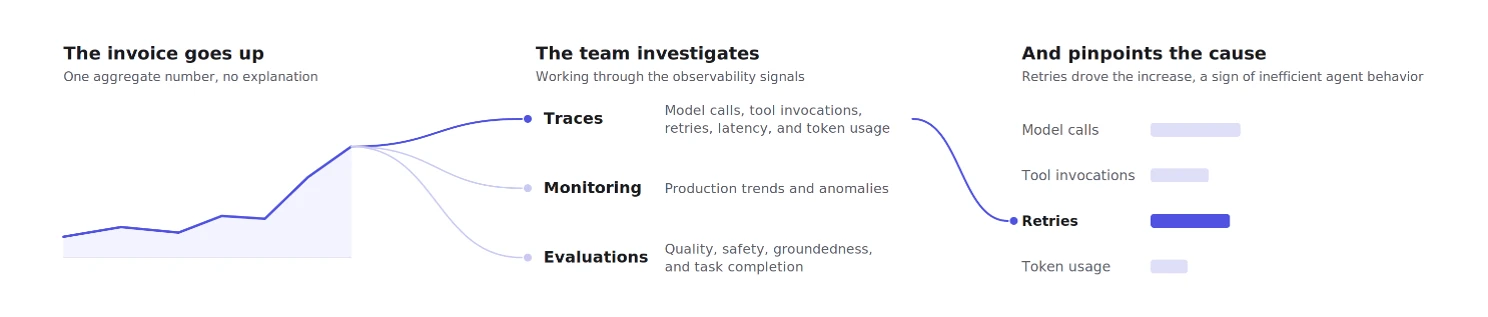
The primary difficulty in managing AI costs is the lack of granularity. When an organization receives a monthly invoice, it often presents a single aggregate figure that hides the context of the spending. To solve this, Microsoft Foundry has introduced project-level cost attribution. By tagging usage at the project level, financial teams can now map AI expenditure directly to the business unit, workload, or team responsible for the consumption.
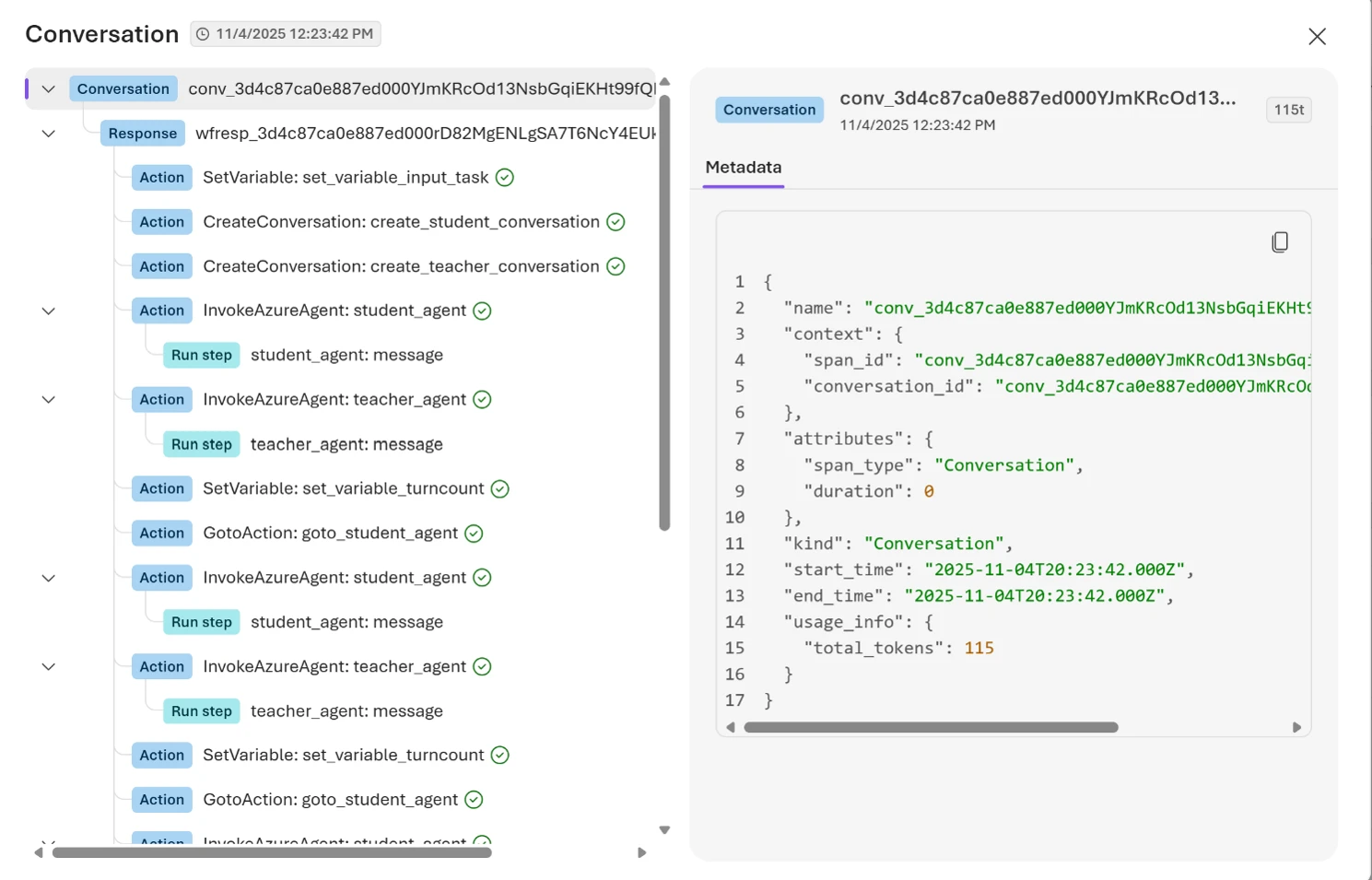
This visibility is augmented by Azure API Management’s AI Gateway, which provides token metrics across various dimensions, including user, product, and backend model provider. Tracing capabilities in Foundry allow developers to see exactly why costs are spiking—whether due to excessive retries, suboptimal prompt design, or a failure in the retrieval-augmented generation (RAG) pipeline. These telemetry signals effectively turn the "black box" of AI spending into a transparent map, allowing engineers to diagnose whether a cost increase is driven by genuine user demand or architectural inefficiencies.
Setting Boundaries: The Role of Circuit Breakers
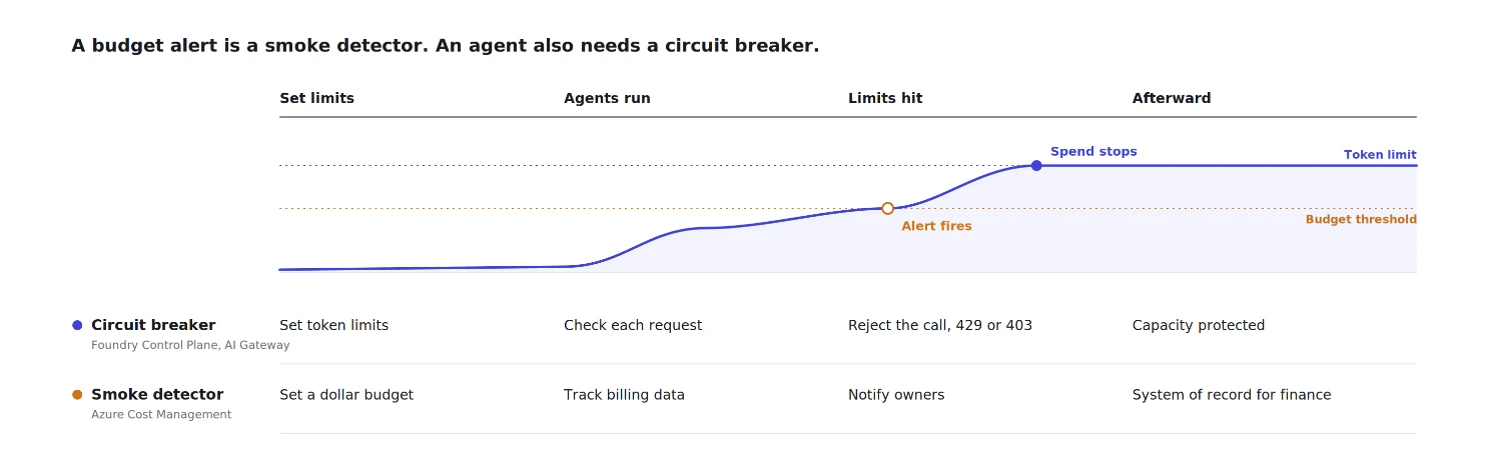
A major distinction in modern governance is the difference between a "smoke detector" and a "circuit breaker." Traditional financial budget alerts act as smoke detectors; they notify administrators after a threshold has been reached, often long after the capital has been spent.
In an agentic system, this is insufficient. If an agent enters an infinite loop, it could exhaust an entire month’s budget in a matter of hours. To mitigate this, Foundry and the AI Gateway implement proactive controls:
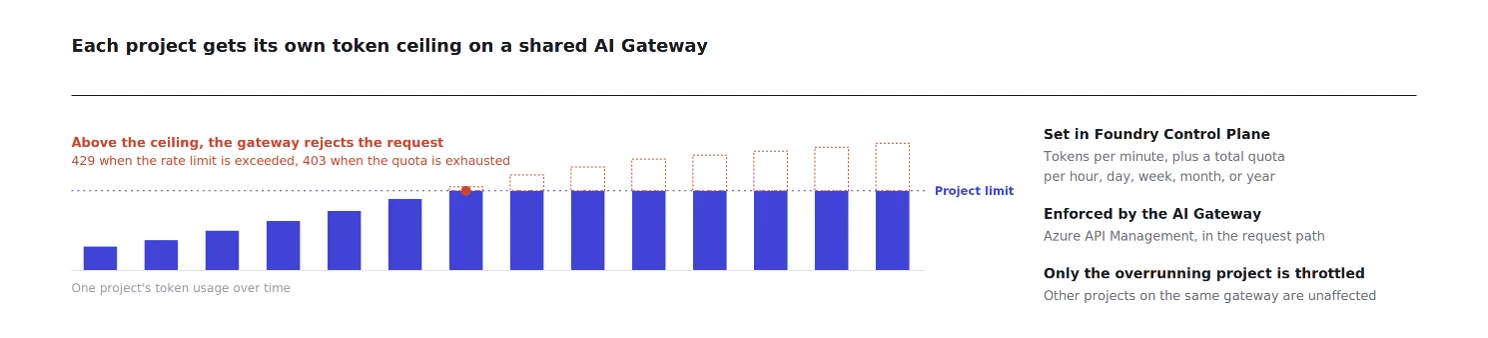
- Project-Level Quotas: By enforcing token-per-minute rate limits and total token quotas, administrators can prevent a single project from monopolizing shared infrastructure. Requests that exceed these bounds are immediately rejected with a 429 (Too Many Requests) or 403 (Forbidden) response.
- Cross-Provider Policy Enforcement: Through the
llm-token-limitpolicy, organizations can apply uniform governance across heterogeneous environments, including OpenAI-compatible APIs, Anthropic, and MCP servers. This ensures that even in multi-model architectures, consumption remains within pre-defined parameters. - Financial Integration: While token limits protect the system from immediate runaway costs, Microsoft Cost Management remains the system of record for financial reconciliation, ensuring that IT and Finance are aligned on actual dollar-based spending.
Measuring ROI: The Value-Added Metric
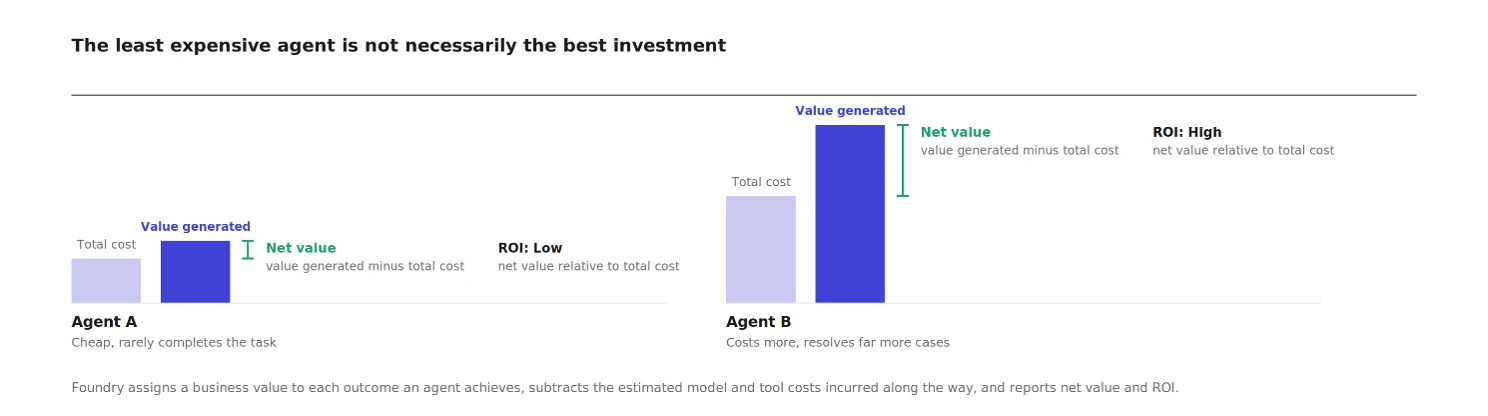
The most critical component of the governance puzzle is moving beyond the conversation of "cost reduction" to the conversation of "value creation." The least expensive agent is not always the best one; an agent that consumes more tokens but successfully resolves a high-value customer service case may offer a superior return on investment compared to a cheaper, less effective counterpart.
Microsoft is currently piloting an ROI-focused dashboard that allows organizations to define success metrics—such as case deflection, task completion rates, or customer sentiment improvements—and assign a monetary value to these outcomes. By calculating the "Net Value" (Total Value Generated minus Total Cost Incurred), leaders can make data-backed decisions on whether to scale, optimize, or retire specific agents.
Implications for Enterprise Strategy
The implications of this governance framework are significant. By aligning engineering telemetry with business outcomes, organizations can justify AI spending to stakeholders with the same rigor applied to traditional cloud infrastructure.
Analysts note that as organizations mature, the "cost per outcome" will become the key performance indicator (KPI) for the AI era. Rather than obsessing over the price of a single token, companies will focus on the efficiency of their workflows. For example, a shift from an expensive model to a smaller, more specialized model might decrease cost, but if it results in a 10% decrease in task success, the net ROI will decline. The ability to monitor these trade-offs in real-time is what distinguishes a successful AI-driven enterprise from one struggling with runaway experimentation.
Conclusion: Managing AI as a Strategic Asset
Running AI as a managed investment system requires a disciplined, multi-layered approach. It demands that developers remain conscious of the cost-per-request at the runtime level, while architects design for efficiency in the long-term workflow. Most importantly, it requires leadership to enforce financial boundaries that are both protective and flexible.
As Microsoft Foundry continues to integrate dollar-denominated budgeting and more granular attribution tools, the barrier to enterprise-grade AI governance will continue to lower. For organizations looking to scale, the mandate is clear: start by making consumption visible, implement request-path circuit breakers to prevent waste, and, above all, measure the return on the investment to ensure that every agent in the fleet is contributing positively to the organization’s bottom line. The era of the "isolated pilot" is over; the era of the "accountable agent" has begun.