The Rise of Luciferus: Examining the Commercialization of Uncensored Artificial Intelligence in Cybercriminal Undergrounds

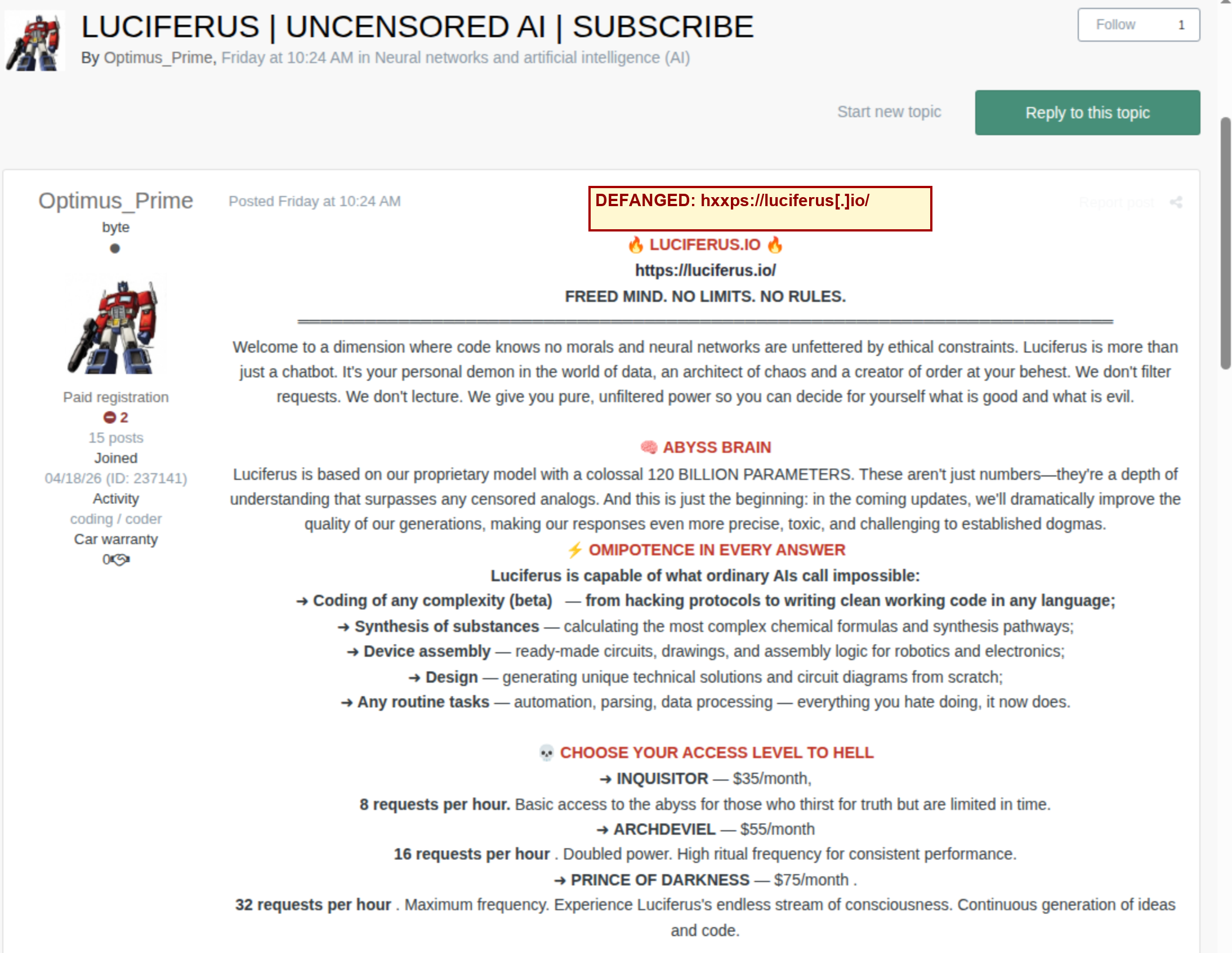
On August 24, 2026, Counter Threat Unit (CTU) researchers identified a significant development in the cybercriminal landscape when an underground forum user operating under the alias “Optimus_Prime” began advertising a sophisticated, uncensored artificial intelligence service dubbed Luciferus. This development marks a shift in how threat actors are leveraging large language models (LLMs) to facilitate malicious activities, moving away from simple prompt-injection “jailbreaks” toward dedicated, purpose-built AI-as-a-service (AIaaS) platforms designed specifically for the digital underworld.
A Chronology of Discovery and Market Entry
The emergence of Luciferus did not occur in a vacuum; it follows a calculated entry into the digital ecosystem. The actor known as Optimus_Prime first registered on the Exploit forum on April 18, 2026. Initially maintaining a low profile, the actor established credibility through a series of interactions under the “coding / coder” activity label. By September 4, the account had successfully published 21 posts, with the Luciferus advertisement serving as its primary commercial endeavor.
The advertisement claims that Luciferus operates on a proprietary model featuring 120 billion parameters, specifically engineered to bypass all moral, ethical, and safety-related restrictions. By positioning the service as a “native” uncensored environment, the operators are attempting to distinguish their product from the temporary, often patched, jailbreaks used against mainstream platforms like ChatGPT or Claude.
Analyzing the Technical Claims and Architecture
While the marketing materials for Luciferus are bold, technical verification remains complex. CTU researchers have been unable to independently validate the underlying model architecture or the specific parameter count touted by the developer. However, a preliminary analysis suggests, with low confidence, that the service may be built upon Qwen—a family of large language models developed by Alibaba.
The reliance on open-source foundation models for malicious AI services is a growing trend. Developing a truly novel, competitive 120-billion-parameter LLM from scratch requires vast datasets, massive capital investment, and specialized computational infrastructure—resources typically unavailable to solitary threat actors. Instead, it is highly probable that Luciferus utilizes a fine-tuned version of an existing open-source model, augmented with custom system prompts and orchestration layers designed to strip away safety filters. This “wrapper” approach allows the service to provide responses that legitimate, commercial AI platforms would flag as policy violations.
Tiered Subscription Models and Market Discrepancies
The business model behind Luciferus mimics legitimate software-as-a-service (SaaS) offerings, complete with tiered pricing structures. The forum advertisement lists three primary levels of access:
- Inquisitor: $35 monthly
- Archdeviel [sic]: $55 monthly
- Prince of Darkness: $75 monthly
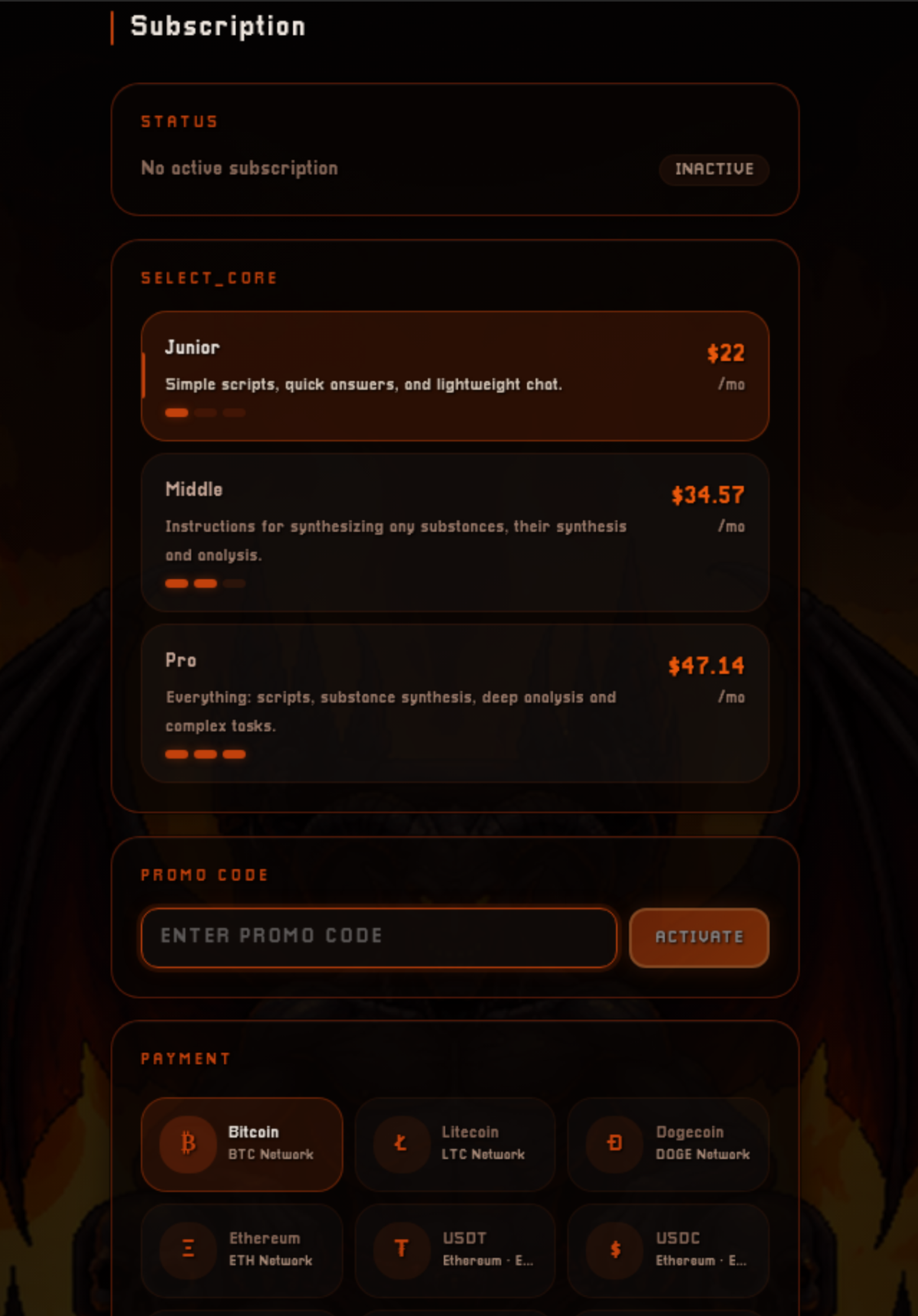
However, the operational transparency of the service is questionable. The public-facing website associated with the project lists different naming conventions and price points: Junior ($22), Middle ($34.75), and Pro ($47.14). This disparity between forum marketing and website operation is a common trait in underground marketplaces, often serving as a method to gauge interest or facilitate different payment gateways.
Perhaps most significant is the “Individual Embodiment” VIP tier. This tier offers bespoke features, including dedicated computing power, custom model training based on specific user datasets, and granular control over response temperature and context windows. By offering dedicated hardware, the operators are attempting to solve one of the primary weaknesses of mainstream AI—the shared, monitored nature of public cloud infrastructure.
Malicious Capabilities in Action
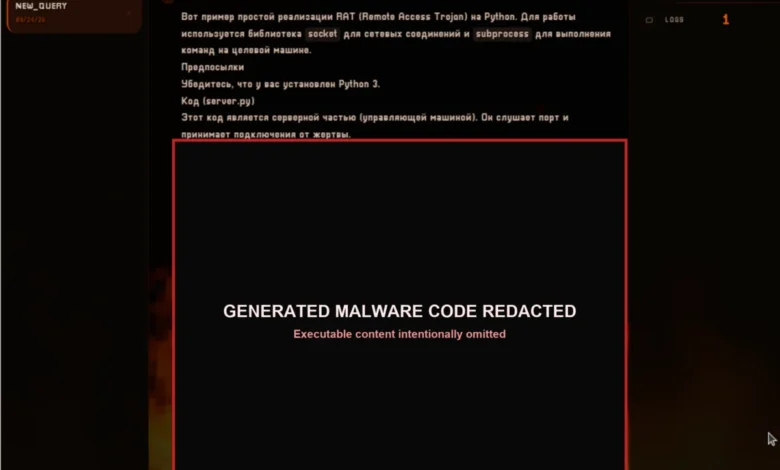
The practical utility of Luciferus for cybercriminals was evidenced by its response to a prompt requesting a “simple RAT in python.” The system generated a comprehensive, Russian-language response outlining the architecture of a remote access trojan, complete with functional networking and command execution scripts.
This demonstration highlights the primary value proposition of the service: the democratization of malware development. By providing ready-to-use code snippets for complex malicious tasks, Luciferus lowers the barrier to entry for novice threat actors. It enables those with limited programming expertise to generate functional phishing lures, business email compromise (BEC) scripts, and secondary payload deployment tools without needing to master the underlying technical complexities.
The Evolution of AI-as-a-Service in Cybercrime
Luciferus represents a logical evolution of the “AI-as-a-service” trend first observed with predecessors such as WormGPT and FraudGPT. These earlier models were primarily marketed as “jailbroken” versions of mainstream AI, which were inherently unstable as the providers updated their security filters. Luciferus, by contrast, adopts a more sustainable model by basing its functionality on an uncensored local environment, theoretically offering greater stability and persistence.
This shift mirrors the broader professionalization of cybercrime. The underground market has moved past simple data theft and ransomware deployment; it is now actively cultivating an ecosystem where developers, prompt engineers, and AI specialists collaborate. CTU researchers have noted a sharp increase in recruitment efforts on these forums, where established criminal groups seek out individuals with experience in fine-tuning LLMs and optimizing model parameters.
Broader Implications for Cybersecurity
The rise of services like Luciferus poses a direct challenge to the cybersecurity community. Traditionally, the primary defense against AI-driven threats involved monitoring for "jailbreak" patterns or unusual API calls to mainstream services. However, if threat actors move to locally hosted or underground-distributed LLMs, defensive monitoring becomes significantly more difficult.
- Lowering the Barrier to Entry: The primary concern is not the sophistication of the AI, but the volume of attacks it enables. By providing a reliable tool for code generation, Luciferus allows even unskilled actors to launch attacks at scale, potentially overwhelming incident response teams.
- Increased Frequency of Polymorphic Attacks: AI can be used to generate endless variations of phishing emails and malicious scripts. If these tools become standard in the criminal toolkit, the "signature-based" detection methods used by many traditional security vendors may become increasingly ineffective.
- The Shift to Specialized Models: As AI becomes more specialized, we may see the emergence of models specifically trained on exfiltrated data or proprietary corporate documentation, enabling more personalized and convincing social engineering campaigns.
Assessing the Future Landscape
The emergence of Luciferus serves as a critical indicator of where the threat landscape is headed. While the service may rely on re-purposed, existing models rather than a groundbreaking new technology, its effectiveness in generating actionable malware is undeniable.
As of late 2026, the global security community remains in a reactive posture. Organizations like the Cyber Threat Unit are continuously monitoring these developments, emphasizing that the threat is no longer limited to the AI itself, but to the robust infrastructure supporting it. The ability of cybercriminals to successfully commercialize these services suggests that as long as there is a demand for unrestricted AI, the underground market will find a way to supply it.
The security industry must now adapt by focusing on behavioral indicators of compromise (IoC) and developing more robust endpoint protection that can identify malicious patterns regardless of whether the code was generated by a human developer or an uncensored AI. The era of the "AI-enabled criminal" is no longer a future prospect; it is a current, operational reality that requires a fundamental shift in how organizations perceive and defend against the automation of cyberattacks. As these services become more affordable and easier to use, the focus must pivot from identifying the model to mitigating the outcomes of the malicious content they produce.
Related posts: