GitHub Overhauls Repository Ownership, Securing Thousands of Projects in Under 45 Days


In a significant internal initiative, GitHub has successfully addressed a critical challenge stemming from its vast ecosystem of over 14,000 internal repositories: a pervasive lack of clear ownership for a substantial majority. As of early 2025, the company managed more than 11,000 non-archived repositories within its primary internal GitHub organization, with the vast majority operating without a defined owner. This organizational blind spot, particularly for repositories not directly tied to production services, presented escalating risks and inefficiencies, most notably highlighted during a recent secret scanning remediation effort. Over a concentrated period of less than 45 days, GitHub implemented a comprehensive solution, validating ownership for every active repository, archiving approximately 8,000 inactive ones, and fundamentally altering repository creation workflows to mandate ownership from inception. The effort has not only dramatically enhanced the company’s security posture but also streamlined operational processes and provided a clearer, more accurate inventory of its internal code assets.
The Pervasive Problem of Unowned Repositories
GitHub, as a leading platform for software development, naturally generates a high volume of internal codebases. While robust ownership tracking existed for repositories linked to production services through its internal Service Catalog, a vast segment of its internal GitHub organization remained outside this structured framework. This "ownership gap" encompassed a diverse array of repositories, including those for internal teams, documentation, one-off projects, personal experiments, and various internal tools not directly supporting a deployed service.
Historically, the Service Catalog served as GitHub’s primary mechanism for tracking service-level metadata, including the associated repository, owning team, executive sponsor, and support information. This model was highly effective for service-centric workflows such as incident response, on-call routing, vulnerability management, and compliance scoping. However, its many-to-one relationship – where a service could only link to a single repository – meant that while one could easily find a repository’s owners by starting from a service, the reverse lookup was often impossible for non-service-backed repositories. This structural limitation created a significant challenge for internal teams needing to interact with these unowned codebases.
The implications of this ambiguity became acutely apparent during a company-wide secret scanning remediation effort. While the technical capability to rotate a compromised secret existed, performing such an action without a clear understanding of the repository owner was inherently risky and frequently disruptive. The absence of a reliable mechanism to route remediation work often led to delays, increased manual effort, and potential security vulnerabilities remaining exposed for longer than necessary. Teams found themselves resorting to time-consuming manual processes: sifting through commit histories, scrutinizing README files, circulating inquiries on Slack channels, or making educated guesses based on repository names—an unsustainable approach for a company of GitHub’s scale and security demands. The sheer volume of over 11,000 non-archived repositories, predominantly without designated owners, underscored the urgent need for a systemic solution.
Designing a First-Class Ownership Model
Recognizing repository ownership as a fundamental property, GitHub embarked on designing a new model. After evaluating several options, including dedicated ownership files within each repository or a centralized external repository, the team opted for GitHub custom properties. This choice was strategic, offering a native, structured, and organization-wide queryable solution for managing ownership. Custom properties provided the flexibility to enforce enterprise and organization policies and rulesets selectively, based on the defined ownership type.

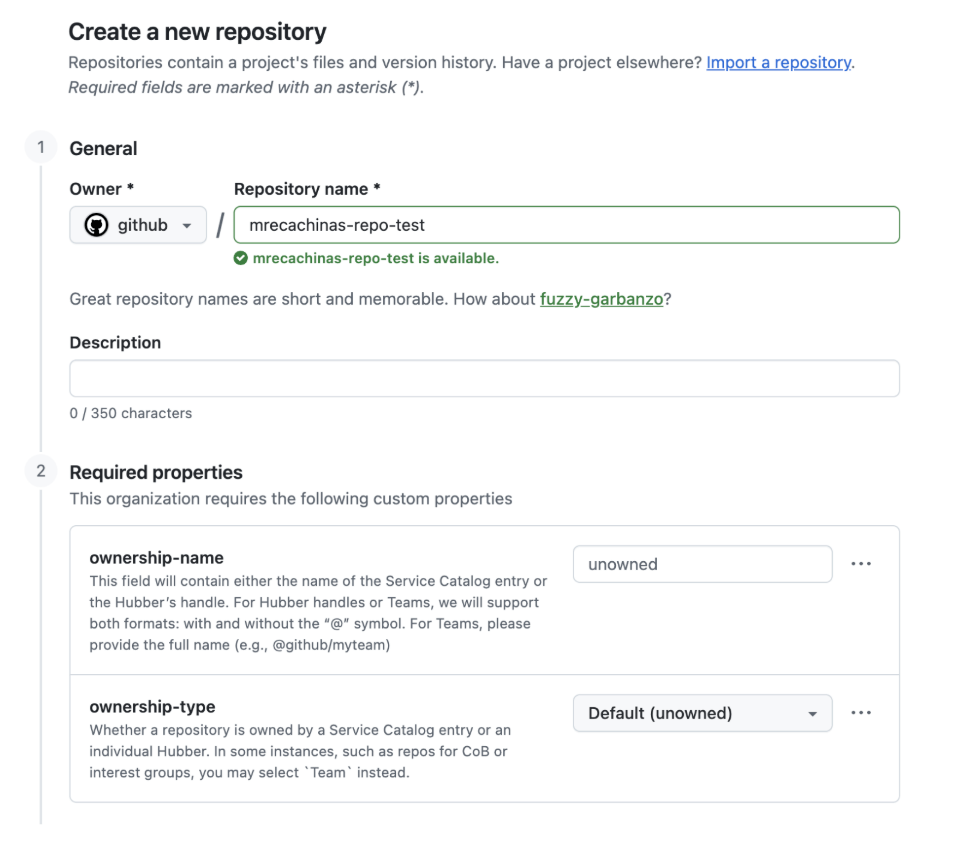
Two key custom properties were established: ownership-type and ownership-name. The ownership-type property would categorize the nature of ownership (e.g., Service Catalog, Team, Individual), while ownership-name would specify the actual owner (e.g., the service name, team slug, or individual’s GitHub handle). This dual-property approach allowed for granular control and clear attribution.
To ensure a smooth transition and minimize immediate disruption, GitHub initiated "day-one coverage" by building a periodic synchronization mechanism from its existing Service Catalog to the newly defined repository custom properties. This automated process identified every repository backing a known service, setting its ownership-type to "Service Catalog" and automatically populating the ownership-name. This initial step successfully brought approximately 1,500 service-backed repositories under the new ownership model, laying a foundational layer and allowing the team to focus on the remaining categories of unowned repositories.
The Agile Rollout: From Chaos to Clarity
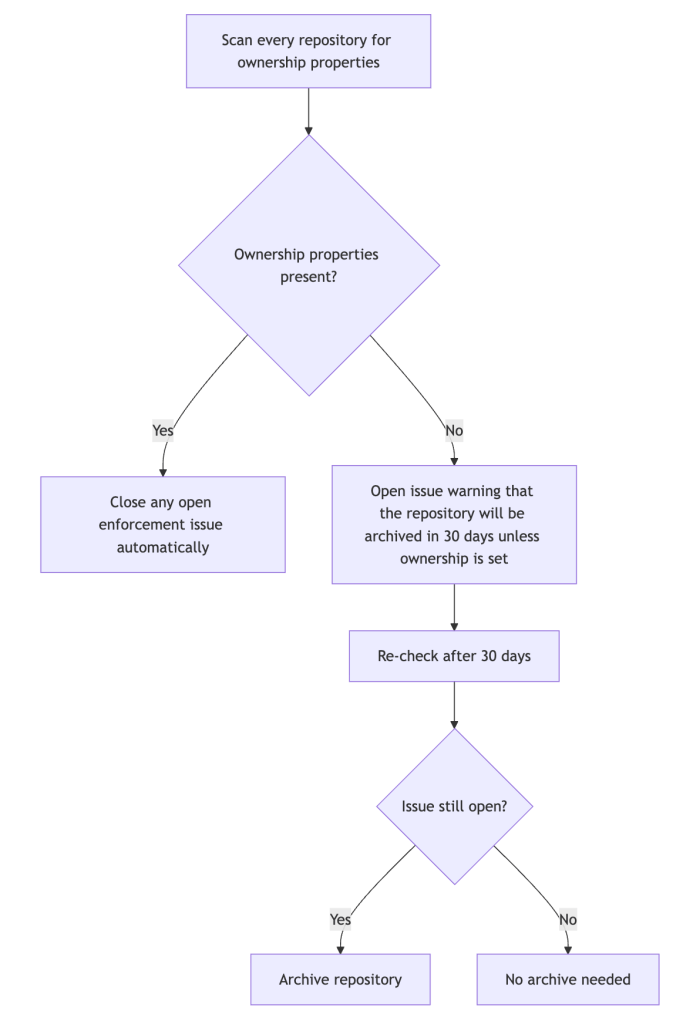
The operational backbone of the new enforcement mechanism was a custom GitHub App, backed by a Kubernetes CronJob. This architecture was chosen for its ability to securely access critical internal systems, including the Service Catalog and the GitHub API, which a simpler GitHub Actions workflow could not adequately provide. The enforcement logic was designed to periodically scan repositories for ownership, open warning issues for those lacking it, and ultimately archive unresolved cases.
The initial rollout, however, provided an immediate and valuable lesson in operating at a global scale. The first run of the CronJob was deliberately scheduled for a Saturday morning, under the assumption that organizational activity would be minimal. This proved to be a significant miscalculation. As the GitHub App began creating ownership warning issues across thousands of repositories, notifications quickly cascaded to employees worldwide, irrespective of their local time zones. The company’s internal Slack channels soon buzzed with inquiries and concerns from developers discovering new issues in their repositories, threatening archival within 30 days. This immediate, global reaction underscored the widespread impact of the initiative and the need for meticulous communication and user education.
Following the initial 30-day grace period, the enforcement system automatically archived any repository that still lacked defined ownership. The decision to implement archival, rather than deletion, was a critical strategic choice. Archiving renders a repository read-only, halts GitHub Actions workflows, but preserves all data. This non-destructive, reversible approach allowed for broad application without the need for exhaustive, case-by-case debate over every edge case. If a team later determined an archived repository was still needed, a straightforward process was established for them to unarchive it, set ownership, and resume work. This safety net facilitated a more aggressive and efficient cleanup of the repository landscape. Once the initial bulk archiving was complete, the enforcement loop was significantly tightened, reducing the grace period from 30 days to a mere one hour. This ensured that any new repository that somehow bypassed the creation-time ownership requirement would be flagged almost immediately, maintaining the integrity of the new system.
Navigating the Sharp Edges: Incidents and Iterations
No large-scale system rollout is without its challenges, and GitHub’s ownership initiative was no exception. Two minor internal incidents provided crucial insights, leading to significant refinements in the system’s design and operational resilience.
The first incident highlighted a critical gap in the notification mechanism. A repository, mistakenly archived due to a lack of ownership, was part of a monitoring workflow configured in Datadog to open issues within it. When Datadog attempted to create an issue in the now read-only repository, it failed. This failure triggered an alert within GitHub’s internal monitoring service, which then automatically paged the owning team of the monitoring service, leading to an escalation. The core problem identified was that while ownership issues were being created in repositories, the relevant stakeholders were not being directly notified in an actionable manner. To rectify this, the team enhanced the notification system: ownership issues now explicitly @-mentioned repository administrators and, as a fallback, assigned all users with write access to the repository. This ensured that critical alerts about ownership status could not be overlooked and immediately reached individuals empowered to resolve them.
The second incident exposed a potential data reliability vulnerability. While the system was designed to be robust against a complete outage of the Service Catalog, it had not fully accounted for scenarios involving stale or corrupted data from this upstream source. The concern was that erroneous data could lead the ownership application to incorrectly believe a batch of legitimate repositories had lost their Service Catalog entries, potentially triggering mass archiving of perfectly valid projects. To mitigate this significant risk, a "low water mark" threshold was introduced. Before performing any actions during each run, the application would tally the number of archives it was about to perform and issues it was about to open. If these numbers exceeded a pre-defined, conservative threshold, the application would automatically bail out of the current run, trigger a Datadog monitor, and alert the engineering team, preventing a potentially catastrophic mass archiving event. Furthermore, in scenarios where the Service Catalog was unreachable, the job was configured to skip Service Catalog validation entirely, relying only on independently verifiable ownership information. These robust safeguards demonstrated GitHub’s commitment to data integrity and operational safety.
Results By the Numbers: A Transformed Landscape
The results of this intensive, 45-day effort were transformative. GitHub successfully reduced its inventory of active internal repositories from over 11,000, most of which lacked clear ownership, to approximately 3,000. Crucially, every single one of these active repositories now possesses a validated owner, or it faces immediate archival. The number of archived repositories soared from roughly 3,000 at the outset to an impressive 11,000. This meant that around 8,000 repositories, previously active but unowned, were identified as inactive or obsolete and subsequently archived.
The impact of this cleanup extended beyond mere numbers. Many of the newly archived repositories had seen no commits in years, representing abandoned experiments, completed hackathon projects, or even single-person prototypes dating back to 2008. Archiving these dormant assets significantly reduced GitHub’s internal attack surface, simplified its code inventory, and ensured that the active repository landscape accurately reflected current operational reality. The initiative delivered a cleaner, more secure, and more manageable environment for developers and security teams alike.
Making Ownership Stick: Long-Term Durability and Enforcement
Achieving 100% ownership coverage was only the first step; maintaining it was paramount. GitHub implemented several measures to ensure the long-term durability of the new ownership model. Most critically, ownership properties were integrated and enforced across every repository creation workflow. Whether a new repository was initiated via the dedicated creation page, through internal tooling, or via automation, defining ownership-type and ownership-name became mandatory. This proactive enforcement prevented the re-emergence of unowned repositories at the source.
Furthermore, the enforcement loop, which had been tightened to one hour post-cleanup, continued to monitor existing repositories. Any repository that subsequently lost its ownership designation would be flagged almost immediately, ensuring swift corrective action.
The design also considered the varying durability characteristics of different ownership types. Repositories owned via the Service Catalog inherently follow the service lifecycle; when a service is deprecated, its associated repositories are typically archived, which aligns with the intended behavior. Team ownership requires at least two members, leveraging the inherent stability and shared responsibility of team structures. For individual Hubber (employee) ownership, the system acknowledges that such repositories are often personal experiments or short-term projects. If an individual leaves the company, their personal repositories are typically archived, which is appropriate. For any repository deemed critical enough to outlast an individual’s tenure, the expectation is that ownership would reside with a team or a service, ensuring institutional continuity.
Broader Implications and Industry Leadership
GitHub’s successful repository ownership overhaul carries significant implications for its internal operations and sets a powerful example for the broader software development industry. From a security perspective, the initiative has fundamentally strengthened the company’s defensive posture. With clear ownership for every active repository, incident response times can be dramatically reduced, vulnerability remediation workflows are streamlined, and compliance audits become more straightforward. The ability to quickly identify and contact the responsible party for any given codebase is invaluable in an era of increasing supply chain attacks and stringent regulatory requirements.
Operationally, the clarity brought by validated ownership enhances efficiency across the board. Development teams can more easily discover and understand internal projects, collaboration is facilitated by clear points of contact, and resource allocation becomes more informed. The reduction of the attack surface by archiving thousands of dormant repositories also contributes to better overall system hygiene and reduces the cognitive load on security and operations teams.
For the developer experience, while the initial rollout presented some friction, the long-term benefits are substantial. Developers spend less time searching for information or guessing who to contact, leading to more productive and less frustrating workflows. It fosters a culture of accountability and good stewardship over code assets.
This initiative also positions GitHub as a leader in demonstrating best practices for managing large-scale, complex codebases. By leveraging its own platform’s capabilities—specifically custom properties—GitHub illustrates how organizations can effectively tackle internal challenges with scalable, integrated solutions. The lessons learned from the "sharp edges" incidents and the subsequent refinements underscore a mature approach to engineering and risk management.
For other organizations grappling with similar issues of unowned or poorly managed repositories, GitHub’s experience provides a clear roadmap. The recommended approach involves defining custom properties for ownership, integrating these properties into all repository creation workflows, establishing periodic enforcement mechanisms (like a GitHub App and CronJob), and creating a clear, reversible archival process for inactive or unowned repositories. Crucially, robust notification systems and data validation safeguards are essential to ensure the stability and reliability of such an undertaking. As the digital landscape continues to evolve, clear, validated code ownership is no longer a luxury but a fundamental requirement for security, efficiency, and responsible software development.