
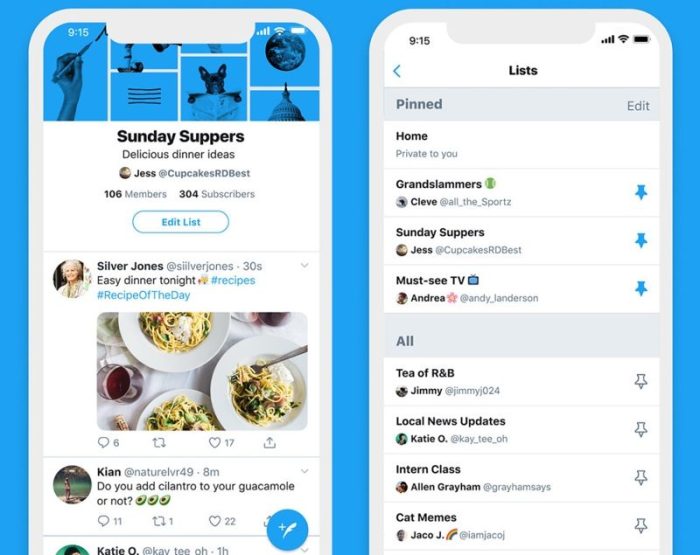
Twitter lists alternative timeline swipe feeds pinned follow people feature update is a fascinating look at potential improvements to the Twitter experience. Imagine a timeline tailored to your interests, swiping through curated content, and easily pinning the most important posts. This update explores alternative timeline designs, focusing on user-driven curation, and the integration of swipe feeds and a revamped follow feature.
It’s a deep dive into how Twitter might evolve to better serve its users.
This comprehensive look at potential Twitter updates dives into the nitty-gritty of alternative timelines, swipe feeds, and pinned content. We analyze the pros and cons of different approaches, considering user experience, personalization, and engagement. The potential impact on user interaction and information consumption is a key aspect of this discussion.
Alternative Timeline Features: Twitter Lists Alternative Timeline Swipe Feeds Pinned Follow People Feature Update

Twitter’s current list system offers a degree of curated content, but it lacks the dynamic and personalized experience of a truly alternative timeline. A dedicated alternative timeline feature could revolutionize how users consume information, fostering a more engaging and relevant experience. This feature would go beyond simple filtering and provide a more sophisticated way to discover and engage with content tailored to individual interests.A well-designed alternative timeline would allow users to explore content beyond their immediate connections, while still maintaining a sense of community and shared interest.
This approach would be particularly valuable in navigating the ever-increasing volume of information on the platform.
Comparison of Twitter’s List System and Alternative Timelines
Twitter’s existing list system allows users to categorize and follow specific groups of accounts. However, it’s a static structure, not dynamically updating with new content. An alternative timeline, in contrast, would be a real-time feed, constantly updating with content from sources relevant to a user’s chosen interests. The alternative timeline would also likely offer more sophisticated filtering options, allowing users to prioritize specific topics, accounts, or even types of tweets.
Conceptual Framework for a User-Driven Alternative Timeline
This new timeline would be user-defined, allowing users to tailor their experience to their specific interests. The core idea is to move beyond simply following people and instead focus on specific topics, themes, or even particular perspectives. Users could curate their alternative timelines by adding s, hashtags, or even by selecting accounts that embody the desired perspectives.
Algorithms for Alternative Timelines
The success of an alternative timeline hinges on its algorithm. Different algorithms could be employed, considering factors like user engagement, content relevance, and the overall Twitter ecosystem. One approach might be to prioritize tweets from accounts a user follows, combined with tweets containing relevant s or hashtags, in real-time. Another approach could leverage machine learning to identify patterns and relationships in a user’s activity and suggest accounts or topics they might find engaging.
“A well-designed algorithm would strike a balance between personalization and discoverability, ensuring users see content relevant to their interests while also being exposed to new perspectives.”
Integration with Existing Twitter Functionalities
A crucial aspect of any new feature is seamless integration with existing platforms. The alternative timeline should integrate seamlessly with Twitter’s existing functionalities, including lists, hashtags, and direct messages. This would allow users to easily import their existing lists, use hashtags as filtering parameters, and potentially discover new accounts and interests through direct message interactions.
Comparison of Alternative Timeline Approaches
| Approach | Ease of Use | Discoverability | Personalization |
|---|---|---|---|
| -based filtering | High | Moderate | High |
| Machine Learning-driven recommendations | High | High | High |
| Hybrid approach (combining s and ML) | High | High | High |
Swipe Feeds and User Interaction
Swipe feeds, a concept borrowed from other social media platforms, present a compelling alternative to Twitter’s traditional linear timeline. By allowing users to actively navigate content through swiping gestures, Twitter could potentially enhance engagement and offer a more personalized experience. This dynamic approach could encourage deeper exploration of diverse perspectives and information streams.Swipe feeds, in essence, provide a more interactive and curated browsing experience compared to a static timeline.
Twitter’s tweaking their timeline with new lists, alternative feeds, swipe features, and pinned follow people options. It’s all about finding better ways to manage your online feed, which is definitely a step in the right direction. Speaking of cool tech, have you seen this amazing 3D printed food? It’s seriously impressive! Well that’s one delicious use of a 3D printer.
Back to Twitter, these updates could significantly impact how we consume information, potentially making it easier to stay up-to-date with what matters most.
Imagine a user effortlessly moving through a selection of tweets, prioritized based on their interests or recent interactions. This could lead to a more focused and engaging user experience, potentially increasing the overall value users derive from the platform.
Design Considerations for Swipe Feeds
Swipe feeds present several design considerations, crucial for ensuring a positive user experience. Prioritizing relevant content is paramount, and this necessitates sophisticated algorithms. These algorithms need to consider factors like user interests, interactions with content, and trending topics. A key challenge is striking a balance between personalized recommendations and maintaining a diverse range of viewpoints.
Prioritizing Relevant Content
Several methods can be employed to curate swipe feeds, offering diverse and personalized content experiences. For instance, a feed could prioritize tweets from accounts a user follows frequently, or tweets related to topics the user has shown interest in. This could be achieved through user interaction data, including likes, retweets, and replies. Moreover, incorporating real-time trending topics could enhance the discoverability of important conversations.
A feed might also highlight tweets from trusted sources or experts in a particular field, providing more credibility and context.
Impact on User Engagement and Information Consumption
Swipe feeds could significantly influence user engagement and information consumption patterns. By allowing users to actively curate their content experience, Twitter could potentially increase user time spent on the platform. This active engagement could lead to more meaningful interactions, fostering a stronger sense of community and connection among users. However, the potential for information overload and the risk of encountering biased or irrelevant content also need careful consideration.
User Privacy and Data Security
Ensuring user privacy and data security is paramount in implementing swipe feeds. The algorithms used to prioritize content must be transparent and avoid creating echo chambers or reinforcing existing biases. Clear policies regarding data collection and usage must be communicated to users. User controls, such as the ability to customize their swipe feed preferences or opt out of certain recommendations, are essential.
Swipe Feed Models
| Swipe Feed Model | Functionality | Expected User Reactions |
|---|---|---|
| Interest-Based | Prioritizes tweets based on user interests, derived from interactions and account followings. | Positive if relevant content is presented, potential for information overload if not curated effectively. |
| Trending Topic | Highlights tweets related to trending topics, offering real-time insights into current events and conversations. | Positive if trending topics are genuinely relevant, potential for repetitive or less engaging content. |
| Relationship-Oriented | Prioritizes tweets from accounts a user interacts with frequently, promoting engagement within existing social circles. | Positive if strengthens connections and provides meaningful interaction, potential for missing broader perspectives. |
| Mixed Model | Combines elements from different models, offering a diverse and personalized experience. | Potential for a balanced approach, but requires careful algorithm design to avoid overwhelming the user. |
Pinned Content and Follow Feature Updates
Twitter’s evolution demands a reimagining of core features, and the pinned content and follow features are prime candidates for enhancement. This update focuses on practical implementations, emphasizing user experience and tailored functionality. Effective pinning strategies will optimize user engagement, while a refined follow system will provide a more granular and personalized experience.A comprehensive approach is necessary to address the pinning and following features.
This includes various implementation methods, tailored strategies for different use cases, and a user-centric design for the updated follow feature, integrating real-time notification systems for dynamic interaction.
Pinned Content Implementation Methods, Twitter lists alternative timeline swipe feeds pinned follow people feature update
Different pinning strategies cater to diverse needs. A straightforward approach is to allow users to pin a single tweet, or a set of tweets. This simplicity is attractive for personal accounts, or for users wanting to highlight key announcements. Alternatively, a more nuanced approach enables users to pin multiple pieces of content—perhaps a combination of tweets, articles, or images—offering greater flexibility.
Furthermore, the pinning feature could incorporate a ‘featured’ section for trending or noteworthy content, separate from individual user selections.
Twitter’s latest updates to lists, alternative timelines, swipe feeds, pinned follow people, and the feature itself are all pretty interesting. While I’m still figuring out the best way to use these new features, I’m also excited about how Google Messages will soon help you easily declutter your inbox. Google Messages will soon help you easily declutter your inbox This could be a game-changer for managing all those notifications.
Ultimately, all these new features aim to improve the user experience, and I’m curious to see how these updates shape the future of social media feeds.
Comparison of Pinning Strategies
The effectiveness of pinning strategies depends heavily on the context. For personal accounts, simple, single-tweet pinning might be ideal, promoting a personal narrative. Businesses, on the other hand, might find the multi-content pinning method more beneficial, allowing for promotional campaigns, product launches, or event announcements. Trending topics can be highlighted through a featured section, increasing exposure and fostering community engagement.
Careful consideration must be given to how pinning affects the overall user experience, ensuring clarity and avoiding clutter.
Integration of Pinned Content into the User Interface
Visual cues are critical for successful integration. A clear visual distinction between pinned content and standard tweets is essential. This could be achieved through visual styling, such as a prominent header or a dedicated section at the top of the timeline. Furthermore, users could opt for different pinning positions (e.g., top, bottom of the timeline, or within a specific column), offering greater customization.
Updated Follow Feature Structure
The “follow” feature needs a significant upgrade, introducing advanced filtering and personalization. Users should be able to create custom categories for following accounts, such as “news,” “politics,” or “technology.” This granular filtering will enable users to stay updated on specific topics without being overwhelmed by irrelevant content. Further personalization could be achieved through the ability to prioritize accounts within categories, ensuring relevant updates are delivered first.
Real-Time Notification System
A dynamic real-time notification system is crucial for the follow feature. Users should receive immediate alerts for updates from followed accounts, such as new tweets, replies, or mentions. These notifications should be customizable, allowing users to choose which types of updates they want to receive. The system should also incorporate a ‘mute’ or ‘unfollow’ option for accounts generating excessive notifications, ensuring a positive user experience.
Integration and User Experience
Integrating alternative timelines, swipe feeds, pinned content, and follow updates into Twitter requires a thoughtful approach to maintain a seamless user experience. The key is to make these features intuitive and accessible, minimizing cognitive load for users while maximizing the value they offer. Users should easily discover and engage with these features without feeling overwhelmed or confused.
Seamless Integration
The new features should be integrated into the existing Twitter platform in a way that feels natural and intuitive. For example, alternative timelines could be accessed via a dedicated tab or a dropdown menu within the main navigation. Swipe feeds could be integrated into the existing thread view, with a clear visual cue to differentiate them from standard timelines.
Pinned content could appear prominently at the top of timelines or within dedicated sections, easily identifiable by visual cues. Follow updates should appear in a dedicated notification area or within the user’s profile, with clear labeling and prioritization. This unified approach will ensure that all features work together cohesively, improving user experience and maximizing the utility of the platform.
Twitter’s new lists, alternative timelines, swipe feeds, pinned follow people feature update is pretty exciting. It’s definitely a step in the right direction for a more personalized experience, but it’s interesting to consider how these changes might impact the broader social media landscape. For example, looking at how Facebook data transfer events, Google Calendar, and Photobucket integration might work together, especially with the recent migration of data and the various complexities of different platforms, as detailed in this post about facebook data transfer events google calendar photobucket , could offer some interesting comparisons and insights.

Ultimately, these features all contribute to a more customized and engaging Twitter experience.
Impact on User Experience
The impact on user experience will vary based on user segments and needs. Casual users might find the swipe feeds refreshing and engaging, enabling them to quickly scan through content relevant to their interests. Power users who follow many accounts may appreciate the alternative timelines, offering curated perspectives and specialized feeds. This variety of options caters to diverse user needs and preferences, making the platform more appealing to a broader audience.
User Flow Diagram
A hypothetical user flow for interacting with the combined features could begin with a user browsing their main timeline. Upon seeing a pinned post, the user could tap to read it in detail. From the pinned post, they could easily navigate to an alternative timeline related to the subject matter, or swipe through related posts in the swipe feed.
They might then decide to follow a particular account based on a recommendation or post in the swipe feed, triggering a follow update notification. This streamlined flow promotes discovery and engagement, offering a richer experience for users.
Challenges and Considerations
Implementing these features on a large scale presents challenges. Ensuring consistent performance across different devices and network conditions is crucial. Potential bugs, such as incorrect data display or inconsistencies in the user interface, must be thoroughly tested and resolved. Usability issues, such as unclear navigation or confusing layouts, should be addressed through rigorous user testing. Additionally, the sheer volume of data and user interactions could strain the platform’s infrastructure.
Careful load balancing and efficient data storage strategies are essential.
Error Messages and Fixes
| Error Message | Potential Fix |
|---|---|
| “Alternative timeline not loading.” | Check network connectivity. Verify server resources are not overloaded. Ensure the timeline data is properly cached. |
| “Swipe feed not displaying correctly.” | Verify data integrity. Review database queries for potential issues. Confirm proper rendering on different screen sizes. |
| “Pinned content not appearing.” | Check if the content is properly marked for pinning. Verify database indexes for efficiency. Confirm no conflicting rules or permissions are applied. |
| “Follow updates not delivered.” | Review the notification system for potential issues. Ensure the server is not experiencing high load. Verify that the user’s notification settings are enabled. |
Illustrative Examples and Visualizations

Visualizing the future of our platform involves more than just abstract concepts. We need to translate the functionality of our alternative timeline, swipe feeds, pinned content, and follow features into tangible, engaging visuals that resonate with our users. This section dives into illustrative examples to showcase how these features will look and feel in practice, ultimately improving the user experience.
Alternative Timeline Interface
A visually appealing alternative timeline interface should prioritize clarity and ease of navigation. Imagine a clean, minimalist design with a subtle color palette. Individual posts could be presented in a slightly staggered, yet organized, format to allow for quick scanning. Each post would include a clear visual representation of the content type – a photo, video, or text post – alongside the author’s profile picture and the publication date.
This layout fosters a balanced visual appeal, avoiding clutter while highlighting key information.
User Interaction with Swipe Feeds
The swipe feed interface should be intuitive and smooth. A user swiping through the feed would experience a seamless transition between posts, with clear visual cues indicating the direction of the swipe. The posts should be visually distinct and well-spaced, preventing any overlap or overcrowding. The user could intuitively understand the purpose of each swipe action – to like, share, or navigate to the next post – with simple icons or visual indicators.
For example, a subtle animation could accompany a swipe, signifying the user’s interaction. The overall design should promote a quick and effortless browsing experience.
Pinned Content Feature
The pinned content feature will enhance user experience by providing prominent placement for important information. Visual cues like a slightly larger font size or a distinctive background color for pinned posts would immediately draw the user’s attention. The design should ensure that the pinned content is readily noticeable but does not overwhelm the overall feed. This could be achieved by using a subtle gradient effect around the pinned posts, or by using a slightly different shade of color for the pinned post background.
This visual distinction would aid users in identifying key updates and information.
Updated Follow Feature
The updated “follow” feature should showcase improved filtering options through a clear and concise visual representation. Instead of a simple “follow” button, a more interactive design could include a visual filter that allows users to customize their feed based on the content type, location, or user interests. For instance, a user could click a button to filter for posts from their preferred groups or individuals.
The filter options could be presented as a series of tabs or drop-down menus with accompanying visual cues. This filtering system should improve efficiency and tailor the user’s feed to their preferences.
UI Element Examples
| UI Element | Visual Representation | Potential User Experience Impact |
|---|---|---|
| Post Preview Card | A rectangular card with an image thumbnail, author’s profile picture, and a concise caption. | Improved visual appeal, quicker information scanning. |
| Swipe Action Indicators | Animated icons (e.g., a heart for liking, a share icon) | Intuitive and engaging user interaction. |
| Pinned Post Marker | A subtle highlight, such as a light gradient, around the pinned post. | Clear identification of important content. |
| Follow Filter Options | A set of clear buttons or drop-down menus for filtering follow requests. | Enhanced user control over feed content. |
Closing Notes
In conclusion, the proposed Twitter updates offer a compelling vision for a more personalized and engaging user experience. From alternative timelines to swipe feeds and enhanced follow features, these enhancements could revolutionize how users interact with the platform. However, careful consideration of user privacy and potential scalability issues is crucial for a successful implementation. The future of Twitter might depend on how effectively these updates are integrated.