The Alarming Rise of AI-Generated Alerts in Enterprise Security Operations Centers is Redefining Threat Detection and Analyst Workloads

Over the past twelve months, enterprise security operations centers (SOCs) have encountered a disruptive shift in their traffic patterns. A new class of security alerts has emerged, growing at an unprecedented velocity. These alerts are not the result of malicious actors weaponizing artificial intelligence to bypass perimeter defenses, but rather the byproduct of the corporate world’s rapid integration of AI tools and autonomous agents into daily workflows. From developers deploying advanced coding agents that spawn shells and modify network configurations to non-technical staff connecting generative AI tools to sensitive corporate accounts, the "AI footprint" within the enterprise is expanding.
Security researchers at Intezer, who recently conducted an extensive analysis of millions of security alerts across various enterprise environments, have identified a significant trend: while AI-related activity still represents a marginal slice of total SOC alerts—approximately 0.43%—the volume of this activity is surging. Between February and June 2026, the volume of these specific alerts grew by 685%, marking a monotonic rise that shows no sign of slowing. This data suggests that current SOC infrastructure, which is often tuned for traditional threat vectors, is becoming increasingly ill-equipped to handle the specific operational cadence of AI agents.

The Anatomy of the AI Alert Stream
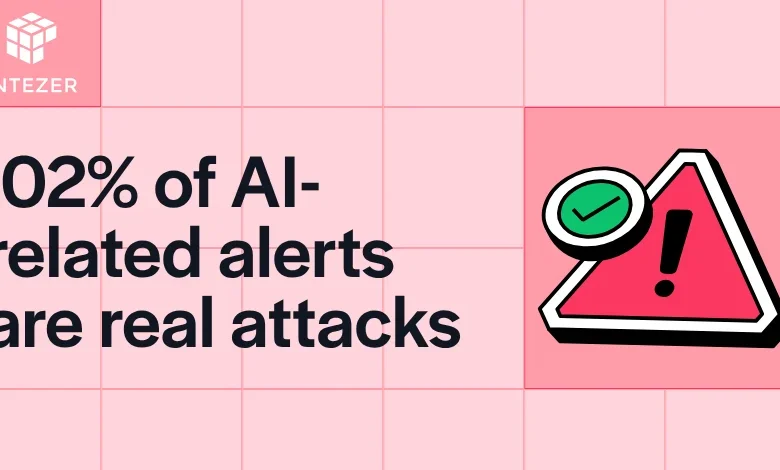
To understand the impact of this trend, it is essential to categorize the alerts into three distinct buckets: real attacks, security risks, and noise. According to the research data, 94.1% of all AI-triggered alerts are classified as "noise"—legitimate business activity that triggers legacy detection rules. Only 5.8% constitute genuine security risks, such as agents running with misconfigured permissions, and a mere 0.02% represent actual, verified malicious attacks.
The primary challenge for security teams lies in the "noise" category. Modern detection engines were built to identify anomalous behavior patterns, such as the sudden spawning of a shell, unauthorized network tunneling, or the reading of credential stores. When a developer utilizes an AI coding agent, the tool performs these exact actions as part of its standard function. Consequently, the SOC is flooded with high-severity alerts that appear to mirror the early stages of a sophisticated cyber-intrusion, yet they are entirely benign. This creates a "cry wolf" scenario that risks desensitizing security analysts, potentially leading to the oversight of genuine threats buried within the noise.
Chronology of the Surge
The acceleration of this trend can be traced back to the widespread enterprise adoption of generative AI tools that began in earnest during the latter half of 2025. By February 2026, baseline telemetry for AI-related alerts had established a consistent, though small, footprint. By the end of May 2026, however, the growth curve turned vertical.

The surge in May is attributed to the release and adoption of more autonomous coding agents that possess the ability to perform complex, multi-step tasks without constant human oversight. As these agents began to integrate more deeply into CI/CD pipelines and developer workstations, the frequency of alerts triggered by their routine operations increased exponentially. If this trajectory continues, organizations that fail to adjust their detection thresholds will find themselves under-provisioned and overwhelmed by the sheer volume of telemetry within a single fiscal quarter.
Distinguishing Between Technical and Operational Risks
AI adoption in the workplace is characterized by two distinct behaviors that create separate security headaches. The first is technical: developers utilizing coding agents that operate at the system level. These tools interact with the host machine, download packages, and establish connections that are indistinguishable from command-and-control (C2) infrastructure used by threat actors.
The second behavior is operational: employees granting OAuth permissions to third-party AI platforms and pasting sensitive, proprietary data into generative AI interfaces. This "quiet" half of the risk spectrum rarely triggers traditional endpoint detection and response (EDR) systems, making it significantly harder to track. While the former creates a volume problem for the SOC, the latter creates a data-loss prevention (DLP) crisis that requires a different strategy of mitigation and user policy enforcement.

Real Threats: The AI-Themed Phishing Evolution
While AI-driven breaches remain rare, the research highlights that attackers are successfully exploiting the rise of AI to enhance their own operations. The most prominent example is the weaponization of AI brand names in phishing campaigns. As employees become accustomed to receiving routine notifications from platforms like OpenAI, Anthropic, or specialized coding assistants, they become increasingly susceptible to well-crafted phishing emails that impersonate these services.
These lures are effective because they capitalize on the normalcy of the AI ecosystem. When an employee sees an email notification regarding a "subscription update" or "new project access" for an AI tool they use daily, their guard is naturally lower. This represents an evolution in social engineering—attackers are not necessarily using AI to perform the hack, but are using the ubiquity of AI to gain the trust of the target.
The Danger of the "Permission-Bypass" Flag
The most critical security risk identified by researchers is the use of "permission-bypass" flags within AI agents. Many users, seeking to improve the efficiency of their workflows, configure these agents to execute commands without requiring manual confirmation. When an agent is running with these safeguards disabled, it operates with the user’s full privileges.

In the event that the agent is compromised—or, more commonly, if the agent is prompted to execute code that has been subtly manipulated—the lack of a human-in-the-loop validation creates a massive, unchecked vulnerability. This is not a hypothetical risk; it mirrors known supply-chain attack vectors where malicious code execution is facilitated by the over-privileged nature of automated scripts. The research notes that these permission-bypassed invocations are currently the single largest source of false positives, yet they represent a genuine latent risk that organizations must address through stricter configuration management.
Strategic Recommendations for Security Operations
The current operational reality requires a fundamental change in how SOCs handle triage. First and foremost, security teams must audit and tune legacy detection rules that are triggering on routine agent activity. If a specific tool, such as a verified AI installer, is triggering "Ransomware Operations" alerts, the rule must be updated to exclude the known-good behavior.
Furthermore, the industry must shift toward more sophisticated, context-aware triage. Since AI agents act on behalf of the user, traditional alerts that rely solely on user identity are no longer sufficient. Security teams should move toward isolating AI tools in sandboxed environments, such as Docker containers or virtual machines. By restricting the agent’s reach to a limited file system and network segment, organizations can effectively contain the risk of an agent performing unauthorized actions.

Ultimately, the goal is to bridge the gap between alert volume and analyst capacity. Relying on manual human review for every alert in an environment where AI agents can trigger thousands of events per hour is unsustainable. The integration of automated forensic analysis platforms—which can rapidly verify the legitimacy of a process and provide a verdict—will become a prerequisite for maintaining security in an AI-augmented enterprise.
Implications for the Future of the SOC
The data provided by researchers serves as a warning for the security industry: we are entering an era where the definition of "normal" behavior is being rewritten by machines. The sheer volume of AI-generated alerts is not just a nuisance; it is a tactical distraction. If a SOC team spends 90% of its resources investigating benign agent activity, they are, by definition, less equipped to respond to the 0.02% of activity that constitutes a real, high-impact breach.
As organizations continue to scale their use of AI, the focus of the SOC must shift from "detection" to "contextual validation." Security leaders should prioritize the implementation of automated triage workflows that can differentiate between an agent’s legitimate task-completion and a malicious actor’s exploitation of those same tools.

In summary, the rise of AI in the workplace has introduced a new layer of complexity to the security landscape. The challenge is not that AI is inherently insecure, but that its integration into the enterprise has outpaced the development of security frameworks designed to monitor it. By proactively tuning detections, implementing technical isolation, and adopting automated triage solutions, organizations can navigate this transition without sacrificing their security posture. The companies that successfully adapt will be those that learn to distinguish the "noise" of progress from the "signal" of genuine danger.