
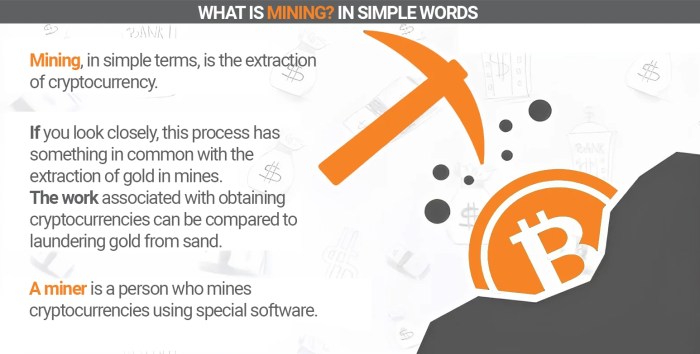
How cryptocurrency mining works is a fascinating process integral to the blockchain network. It’s more than just finding hidden treasure; it’s a complex system of computation and competition. From the historical evolution of mining to the modern energy consumption concerns, this exploration unravels the intricate details behind this essential part of the crypto world.
This in-depth guide covers everything from the hardware used to the software employed, the different mining methods, and the security considerations. We’ll also delve into the economics of mining, including mining pools and rewards. Finally, we’ll address the environmental impact and explore potential solutions to these issues.
Introduction to Cryptocurrency Mining
Cryptocurrency mining is the process of verifying and adding new transactions to a blockchain, securing the network, and creating new cryptocurrency units. It’s a crucial aspect of how cryptocurrencies like Bitcoin function, acting as a vital component of the entire ecosystem. This process relies on computational power to solve complex mathematical problems, and the successful miners are rewarded with newly created cryptocurrencies.Mining is fundamental to blockchain security.
By verifying transactions and adding them to the blockchain, miners ensure the integrity and immutability of the ledger. This process prevents fraudulent activities and ensures that the blockchain remains a trusted record of all transactions.
Proof-of-Work and Other Consensus Mechanisms
Different cryptocurrencies employ various consensus mechanisms to validate transactions and secure the network. Proof-of-Work (PoW) is the most well-known, but others exist, including Proof-of-Stake (PoS), Delegated Proof-of-Stake (DPoS), and more. These mechanisms differ significantly in their approach to achieving consensus.Proof-of-Work, the mechanism underpinning Bitcoin and many other cryptocurrencies, relies on a competitive race between miners. They compete to solve complex cryptographic puzzles.
The first miner to solve the puzzle gets to add the next block of transactions to the blockchain and is rewarded with newly created cryptocurrency. This competitive nature is designed to prevent fraud and maintain the integrity of the network. Conversely, Proof-of-Stake, for example, relies on the stake held by participants rather than computational power.
Historical Context of Cryptocurrency Mining
The history of cryptocurrency mining is intrinsically linked to the development of Bitcoin. Early Bitcoin mining was largely decentralized, with individuals using personal computers to participate. As Bitcoin’s popularity grew, so did the computational power required to solve the cryptographic puzzles. This led to the emergence of specialized mining hardware and mining pools, where miners collaborate to increase their chances of success.The increasing difficulty of mining problems, driven by the network’s growing security needs, has led to more sophisticated mining equipment.
Mining has evolved from a hobby to a complex industry, influencing the economic landscape.
Comparison of Cryptocurrency Mining Methods
| Cryptocurrency | Consensus Mechanism | Mining Method | Description |
|---|---|---|---|
| Bitcoin | Proof-of-Work | SHA-256 hashing | Bitcoin uses the SHA-256 hashing algorithm, a cryptographic hash function, to secure the network. Early miners relied on personal computers, but specialized ASICs are now dominant. |
| Ethereum (pre-Merge) | Proof-of-Work | Ethash algorithm | Ethereum employed a different hashing algorithm (Ethash) for its mining process. This algorithm was designed to be more resistant to ASIC attacks compared to SHA-256. |
| Ethereum (Post-Merge) | Proof-of-Stake | Staking | Ethereum transitioned to Proof-of-Stake, changing the mining paradigm to validator nodes staking their ETH holdings to validate transactions and secure the network. |
The table above illustrates a simplified comparison of various cryptocurrencies and their associated mining methods. Each cryptocurrency’s mining method reflects its unique design and goals, aiming to balance security, efficiency, and scalability.
Mining Hardware and Equipment
The success of cryptocurrency mining hinges significantly on the hardware used. Choosing the right equipment is crucial for profitability, as it directly impacts the mining speed and energy efficiency. Modern mining often involves specialized, high-performance devices designed for specific cryptocurrencies. This section delves into the different types of hardware, their capabilities, and how to select appropriate equipment for a given cryptocurrency.The mining process, in its essence, involves solving complex mathematical problems to validate transactions and add them to the blockchain.
The more powerful the hardware, the faster these calculations can be performed, thereby increasing the chances of successfully mining a block and earning the associated rewards.
Types of Mining Hardware
Different cryptocurrencies require different types of hardware. The most common are Application-Specific Integrated Circuits (ASICs) and Graphics Processing Units (GPUs).
- ASICs (Application-Specific Integrated Circuits) are custom-built chips optimized for specific cryptocurrencies. They excel in solving the complex algorithms associated with these cryptocurrencies. Their specialized design often results in significantly higher processing power compared to other hardware options. The significant initial investment for ASICs can be a major deterrent, but they are generally more efficient in the long run for larger-scale operations, given their optimized design for the target cryptocurrencies.
- GPUs (Graphics Processing Units), originally used for gaming, are also employed in cryptocurrency mining. GPUs have proven effective for certain cryptocurrencies, particularly in the early days of the mining process, when algorithms were not as complex. However, ASICs have largely overtaken GPUs in performance for most cryptocurrencies, primarily due to their specialization in the specific cryptographic algorithms. GPUs remain a viable option for smaller-scale operations or for mining less computationally demanding cryptocurrencies.
Cryptocurrency mining essentially involves solving complex mathematical problems to validate and add transactions to the blockchain. This process requires a lot of computational power, and while it’s often associated with powerful computers, it’s also fascinating to consider how new tech like the Kensington StudioDock, which gives the iPad Pro tons of ports, might impact the future of this industry.
Kensington StudioDock unleashes the iPad Pro with tons of ports potentially opens up new avenues for portable, yet powerful mining solutions, which could influence the efficiency and accessibility of mining operations in the future. Ultimately, the core concept of solving these complex problems to verify transactions remains the same.
Performance and Efficiency Comparison
The performance and efficiency of mining hardware differ considerably. ASICs are typically much faster and more energy-efficient for their target cryptocurrencies compared to GPUs. However, the efficiency of ASICs is highly dependent on the specific cryptocurrency being mined. The initial cost of ASICs is often substantial but can be recouped over time, especially for larger-scale operations where their performance advantage is most evident.
Role of Specialized Software
Specialized mining software manages the communication between the mining hardware and the cryptocurrency network. This software directs the hardware to solve the cryptographic problems, monitors the mining process, and manages the transactions. Examples of popular mining software include CGMiner, BFGMiner, and Claymore’s DualMiner. Choosing the right software for your mining setup is essential to ensure the efficient and reliable operation of the mining process.
Technical Specifications of Mining Hardware
The following table Artikels some technical specifications for various mining hardware options. Note that these are examples and actual specifications can vary significantly depending on the manufacturer and model.
| Hardware Type | Cryptocurrency Focus | Hash Rate (TH/s) | Power Consumption (kW) | Estimated Cost |
|---|---|---|---|---|
| ASIC Miner (Bitcoin) | Bitcoin | 50 TH/s | 1.5 kW | $10,000 |
| GPU Miner (Ethereum) | Ethereum (older algorithm) | 10 GH/s | 0.5 kW | $500 |
| ASIC Miner (Ethereum) | Ethereum (current algorithm) | 100 TH/s | 2.5 kW | $20,000 |
Selecting Suitable Mining Hardware
The selection of mining hardware should be based on the specific cryptocurrency targeted. For example, Bitcoin mining currently requires highly specialized ASICs, while mining other cryptocurrencies, such as Litecoin, may still be possible with GPUs. Researching the current algorithm used by the cryptocurrency and the performance of different hardware options is crucial for making an informed decision. It is also essential to consider the electricity costs in your region, as high energy costs can significantly impact the profitability of your mining operation.
The Mining Process
The cryptocurrency mining process is a complex dance between computational power and chance. It’s the engine that validates transactions and secures the network, ensuring the integrity and reliability of the cryptocurrency system. Understanding the steps involved and the mathematical computations behind it reveals the heart of how cryptocurrencies function.The mining process is a continuous loop of solving complex mathematical problems.
Successful completion of these problems results in the miner receiving a reward, typically in the form of newly created cryptocurrency tokens. This process is not just about solving equations; it’s a critical component of maintaining the integrity and security of the blockchain.
Steps Involved in the Mining Process
The process involves a series of steps, each crucial for the overall function of the cryptocurrency network. Miners compete to solve complex mathematical problems related to the blockchain’s current state.
- Transaction Gathering: Miners collect unconfirmed transactions from the network. These transactions are grouped into blocks, the fundamental units of data on the blockchain.
- Block Creation: The collected transactions are bundled into a new block, along with data from the previous block and other relevant information. This block is not immediately added to the blockchain.
- Hashing: A hashing algorithm is used to create a unique “hash” for the block. This hash is a fixed-size string of characters derived from the block’s content.
- Proof-of-Work: Miners use their computational power to find a hash for the block that satisfies specific criteria, often involving a predetermined difficulty level. This is the core of the Proof-of-Work (PoW) system, requiring significant computational power to solve the problem.
- Block Validation: If a miner finds a valid hash (one that meets the difficulty criteria), the block is added to the blockchain. Other miners validate the block to ensure its integrity.
- Reward: The miner who successfully finds the valid hash is rewarded with a predetermined amount of cryptocurrency.
Mathematical Computations
Miners perform complex mathematical computations to find a specific hash value for a block. These computations are not arbitrary; they’re designed to be computationally intensive and require significant processing power.
Finding a valid hash often involves trial-and-error, testing various possibilities until a match is found.
The difficulty of these computations is adjusted dynamically to maintain the security and balance of the network. As more miners join the network, the difficulty increases to prevent the time it takes to find a valid hash from decreasing.
Hashing Algorithms
Hashing algorithms are fundamental to cryptocurrency mining. They are mathematical functions that take input data (the block’s contents) and produce a unique output, the hash.
- Cryptographic Hash Functions: These functions have specific characteristics, such as producing a fixed-size output regardless of the input size, and being computationally infeasible to reverse. This ensures the integrity and security of the blockchain.
- Examples: SHA-256 is commonly used in many cryptocurrencies. Its characteristics make it suitable for mining operations.
Initiating a Mining Operation
Setting up a mining operation requires specific hardware and software. It’s a process that involves acquiring the necessary equipment, configuring the software, and joining the cryptocurrency network.
- Hardware Procurement: This includes powerful GPUs or ASICs, depending on the cryptocurrency.
- Software Installation: Specific mining software is needed to connect to the cryptocurrency network and participate in the mining process.
- Network Connection: A stable internet connection is essential for communicating with the network.
- Pool Participation: Miners often join mining pools to combine their computational power and increase their chances of finding valid blocks. This strategy is crucial for smaller miners.
Mining Process Across Cryptocurrencies
The basic mining process is similar across various cryptocurrencies. However, the specific hashing algorithms and difficulty adjustments can differ.
Cryptocurrency mining involves using powerful computers to solve complex mathematical problems. This process verifies transactions and adds them to the blockchain, securing the network. It’s a bit like those augmented reality games, like pokemon go ar games walking dead jurassic world , where you’re hunting for virtual creatures, but instead of virtual creatures, you’re hunting for new blocks to add to the chain, which is essential for the cryptocurrency to function properly.
The more computational power you have, the better your chances of finding these blocks and earning rewards.
| Cryptocurrency | Hashing Algorithm | Mining Difficulty |
|---|---|---|
| Bitcoin | SHA-256 | High, adjusted dynamically |
| Ethereum | Ethash | High, adjusted dynamically |
| Litecoin | Scrypt | Variable, adjusted dynamically |
Different cryptocurrencies have different mining requirements, and miners must adapt to the specific characteristics of each network.
Energy Consumption and Environmental Impact: How Cryptocurrency Mining Works

Cryptocurrency mining, while revolutionizing finance, has drawn significant attention for its energy consumption and environmental impact. The computational power required to validate transactions and secure the blockchain necessitates substantial energy, raising concerns about its sustainability. This section delves into the environmental footprint of mining, exploring potential solutions to mitigate its impact on global energy resources.The energy demands of cryptocurrency mining are often substantial, surpassing the power consumption of entire countries in some cases.
This high energy demand is a major concern, as it contributes to greenhouse gas emissions and exacerbates the strain on existing energy infrastructure. Furthermore, the decentralized nature of mining operations often makes it difficult to track and regulate their energy usage.
Energy Consumption of Different Mining Operations
The energy consumption of cryptocurrency mining operations varies significantly based on the specific cryptocurrency, the mining algorithm employed, and the hardware used. Different mining operations can vary widely in their energy consumption. Factors like location, electricity costs, and the availability of renewable energy sources all play a role. To understand the scale of this impact, a comparison is presented.
| Cryptocurrency | Estimated Annual Energy Consumption (in terawatt-hours) | Description |
|---|---|---|
| Bitcoin | ~150 TWh (estimates vary widely) | Bitcoin mining, with its Proof-of-Work consensus mechanism, is notorious for its high energy consumption. |
| Ethereum (pre-Merge) | ~110 TWh (estimates vary widely) | Prior to the Merge, Ethereum’s Proof-of-Work consensus mechanism was highly energy intensive. |
| Other cryptocurrencies | Varying amounts | Many other cryptocurrencies utilize different consensus mechanisms, leading to significantly lower or higher energy consumption. |
Environmental Concerns
The substantial energy consumption associated with cryptocurrency mining contributes to significant environmental concerns. The burning of fossil fuels to generate electricity for mining operations releases large amounts of greenhouse gases into the atmosphere. This contributes to global warming, impacting ecosystems and human health. Furthermore, the disposal of mining equipment poses a separate environmental challenge, as many components contain hazardous materials.
Alternative Methods to Reduce Energy Consumption
Several alternative methods can reduce the energy consumption of mining operations. Transitioning to renewable energy sources, such as solar and wind power, is crucial. Mining operations can also optimize their hardware and software to improve energy efficiency. Additionally, exploring alternative consensus mechanisms, such as Proof-of-Stake, can significantly reduce the energy required for validation.
- Renewable Energy Integration: Utilizing renewable energy sources, like solar and wind power, to power mining operations can drastically reduce carbon emissions. This approach requires careful planning and investment, but it aligns with broader sustainability goals.
- Hardware Optimization: Implementing more energy-efficient mining hardware and algorithms can reduce the energy footprint of mining operations significantly. Innovations in semiconductor technology play a crucial role in achieving this goal.
- Alternative Consensus Mechanisms: Shifting from energy-intensive Proof-of-Work (PoW) consensus mechanisms to more energy-efficient alternatives, like Proof-of-Stake (PoS), is a promising approach. The adoption of PoS in cryptocurrencies like Ethereum demonstrates a potential path towards more sustainable mining practices.
Potential Impact on Global Energy Resources
The high energy demand of cryptocurrency mining could strain global energy resources, potentially impacting the ability to meet the needs of other sectors, such as residential and industrial use. In some regions with limited energy resources, this strain could be particularly pronounced. The potential impact is considerable, necessitating careful consideration and planning.
Mining Pools and Rewards

Mining cryptocurrency solo is challenging, requiring significant computational power and energy. This often makes it difficult for individual miners to compete effectively, especially with the ever-increasing difficulty of blockchain networks. Mining pools offer a solution, enabling individual miners to pool their resources and share in the rewards.Mining pools are essentially collaborative networks of miners who join forces to increase their chances of solving blocks and earning rewards.
This collective effort provides a significant advantage over solo mining, especially for those with limited computational resources.
Pooling Resources for Increased Success, How cryptocurrency mining works
The core benefit of mining pools is the ability to combine computational power. By joining forces, miners significantly enhance their probability of successfully solving blocks and earning rewards. This collective effort allows for faster block solves, even when individual miners have less powerful hardware.
Reward Distribution in Mining Pools
The distribution of rewards in a mining pool is a crucial aspect. It is typically proportional to the hashing power contributed by each miner. This means that miners who contribute more computational power to the pool receive a larger share of the rewards.
Security Considerations in Mining Pools
Mining pools require robust security measures to protect the interests of all participants. Security issues can arise from malicious actors attempting to manipulate the reward distribution or gain unauthorized access to pool resources. Mining pools often implement advanced security protocols, including robust authentication and authorization mechanisms, to prevent such threats.
Mining Pool Reward Calculation and Distribution
| Miner Contribution (Hash Rate) | Proportion of Block Reward | Example (Simplified) |
|---|---|---|
| 50% of the total pool hash rate | 50% of the block reward | If a pool has 100 miners and one miner contributes 50% of the hash power, they receive 50% of the reward for the block they solved. |
| 25% of the total pool hash rate | 25% of the block reward | A miner contributing 25% of the pool’s hash rate receives 25% of the block reward. |
| 10% of the total pool hash rate | 10% of the block reward | A miner with 10% of the pool’s hash rate receives 10% of the reward for the block solved. |
This table illustrates a simplified example of how reward distribution is calculated based on the miner’s hash rate contribution. The actual formula and calculations may vary slightly among different mining pools.
Understanding Risks in Mining Pools
Joining a mining pool carries inherent risks. One potential risk is the possibility of losing access to rewards if the pool experiences technical difficulties or malfunctions. Additionally, there’s a risk of security breaches if the pool’s security measures are inadequate. Another risk is that pool operators may not be transparent about their policies and practices, making it challenging for miners to understand how rewards are distributed.
Furthermore, changes in the hash rate or network difficulty could affect a miner’s profitability within the pool. Finally, a miner could face issues if they have inadequate communication or lack understanding of the pool’s operational mechanics.
Mining Software and Tools
Mining cryptocurrency isn’t just about the hardware; the software plays a crucial role in managing the entire process. Sophisticated mining software handles the complex tasks of connecting to the network, validating transactions, and securing the blockchain. This software is often optimized for specific cryptocurrencies, taking advantage of the unique characteristics of each coin’s network.Mining software acts as the brain of the operation, enabling miners to effectively harness their hardware’s computational power.
It translates raw processing power into meaningful contributions to the blockchain, allowing miners to earn rewards. Different software packages cater to varying needs, from solo miners to those participating in mining pools.
Purpose and Function of Mining Software
Mining software is the essential bridge between your mining hardware and the cryptocurrency network. Its primary functions include connecting to the network, finding and solving cryptographic puzzles, and communicating transaction data. Efficient software optimizes the use of available processing power, maximizing the chances of finding valid blocks and earning rewards. Crucially, it also manages the communication and data exchange with the network, ensuring the mining process is seamless and secure.
Different Mining Software Platforms and Their Features
Various software platforms cater to different needs and preferences. Some popular platforms include CGMiner, BFGMiner, and Claymore’s dual-miner. CGMiner, a versatile open-source option, is renowned for its flexibility and extensive cryptocurrency support. BFGMiner is known for its speed and efficiency, especially for ASIC miners. Claymore’s dual-miner, on the other hand, is often praised for its advanced features and optimization for certain coins, like Ethereum.
Cryptocurrency mining involves using powerful computers to solve complex mathematical problems, rewarding the solver with newly minted coins. It’s a fascinating process, but the latest news about the Pixel 7a Tensor G2, specifically its alleged packaging details as seen in pixel 7a tensor g2 alleged packaging , makes me wonder if these devices are powerful enough to handle the intensive computations needed for profitable mining.

Regardless, the underlying principle of mining remains the same: a race against time and computational might.
These platforms often feature different user interfaces, configuration options, and support for various mining algorithms.
Comparison and Contrast of Mining Software Solutions
Comparing mining software solutions involves considering factors such as performance, ease of use, and the specific cryptocurrencies they support. CGMiner’s strength lies in its adaptability and community support, making it a great choice for miners with a wide range of needs. BFGMiner’s focus on speed makes it an attractive option for miners aiming for maximum throughput. Claymore’s dual-miner, with its targeted optimization, can offer significant performance gains for specific coin mining.
The choice of software often depends on the specific cryptocurrency being mined and the miner’s technical expertise.
Setup Process for Various Mining Software Packages
The setup process for mining software varies based on the chosen platform. Typically, it involves downloading the software, installing it on the mining rig, configuring the connection to the cryptocurrency network, and selecting the target cryptocurrency. Detailed instructions are often available on the software’s website or through online forums. Different packages may have varying degrees of complexity in their configuration, so careful reading of the documentation is essential.
Some require specific hardware configurations or drivers to function correctly.
Commonly Used Mining Software with Pros and Cons
| Software | Pros | Cons |
|---|---|---|
| CGMiner | Open-source, versatile, supports many cryptocurrencies, flexible configuration. | Steeper learning curve for beginners, may require more manual configuration. |
| BFGMiner | High performance, optimized for specific algorithms, generally efficient. | Limited cryptocurrency support compared to CGMiner, potentially less flexible. |
| Claymore’s Dual Miner | Advanced features, often optimized for specific coins, high performance in targeted scenarios. | Can be more complex to set up, might not be suitable for all miners. |
Mining Difficulty and Adjustments
Mining difficulty in cryptocurrency is a crucial mechanism that ensures the security and fairness of the network. It dynamically adjusts the computational power required to solve the cryptographic puzzles and generate new blocks, preventing the network from becoming too easy or too hard to mine. This adjustment process maintains a consistent block generation rate, safeguarding the integrity and overall performance of the blockchain.Understanding how mining difficulty changes is vital for miners to assess the profitability of their operations.
This dynamic adjustment, based on the collective computational power of the network, directly impacts the time it takes to mine new blocks and the rewards miners receive. It’s a critical factor in maintaining a healthy and stable cryptocurrency ecosystem.
Mining Difficulty Adjustment Mechanisms
The mining difficulty is adjusted periodically, typically every 2016 blocks (approximately every two weeks). This regular adjustment ensures that the block generation time remains roughly constant, maintaining the network’s stability and preventing drastic fluctuations in the rate of new block creation. This consistent block generation time is a key factor in maintaining the network’s overall health.
Impact on Block Generation Time
Mining difficulty and block generation time are inversely proportional. As the mining difficulty increases, the time required to solve the cryptographic puzzle and generate a new block increases. Conversely, a decrease in mining difficulty results in a decrease in the time needed to mine a new block. This dynamic relationship is a critical component of the network’s self-regulation.
Example of Difficulty Adjustment
Let’s consider a hypothetical scenario. Imagine a cryptocurrency network with an initial mining difficulty of 1. As more miners join the network, their combined computational power increases, and the network’s hash rate grows. After 2016 blocks, the difficulty adjustment algorithm calculates the average hash rate during that period. If the hash rate has increased significantly, the difficulty will be adjusted upward to maintain a target block generation time, typically around 10 minutes.
Conversely, if the hash rate has decreased, the difficulty will be adjusted downward to compensate and keep the block generation time around the target. This continuous feedback loop maintains the stability of the network.For example, if the average hash rate over the last 2016 blocks is 2 times higher than the previous average, the mining difficulty will be adjusted upwards by approximately 2 times.
This adjustment ensures that the time taken to mine a new block remains consistent and roughly 10 minutes, making the network secure and fair.
Impact on Mining Profitability
Mining profitability is directly affected by the mining difficulty. A higher mining difficulty translates to a higher computational power requirement. This, in turn, results in a lower probability of a miner finding a block and receiving the associated reward. Conversely, lower mining difficulty leads to a higher probability of finding a block, potentially increasing the profitability of mining.
Miners need to constantly monitor and adapt to these changes to maintain profitability.For example, a miner with a low-powered mining rig might be profitable at a low difficulty, but less so at a high difficulty. Conversely, a high-powered mining rig will remain profitable even at a high difficulty, because the higher processing power will be able to handle the increase in the required computation.
Therefore, miners need to assess their own computational capabilities and market conditions when making decisions about mining profitability.
Security Considerations in Cryptocurrency Mining
Cryptocurrency mining, while offering potential rewards, presents unique security challenges. Protecting mining infrastructure and assets from various threats is crucial for the long-term viability and security of any mining operation. A robust security posture is not just a good practice, but a necessity in this digital landscape.
Potential Security Risks in Mining Operations
Mining operations face a range of threats, both external and internal. These threats can jeopardize the integrity of the mining process, compromise the security of sensitive data, and ultimately lead to financial losses. Malicious actors often exploit vulnerabilities in software and hardware to gain unauthorized access or disrupt operations.
- Hardware Attacks: Physical access to mining equipment can lead to theft or damage, directly impacting the mining operation’s capacity and profitability. Compromised hardware can also be used as a launchpad for further attacks on other systems within the network. For instance, a miner’s rig could be tampered with to mine cryptocurrencies without the owner’s knowledge.
- Software Vulnerabilities: Software bugs or exploits can allow malicious actors to gain unauthorized access to mining software, potentially leading to unauthorized cryptocurrency theft or the hijacking of mining resources.
- Network Attacks: Distributed Denial-of-Service (DDoS) attacks can overwhelm the network infrastructure, disrupting the mining process and causing significant downtime. Furthermore, malware infections within the network can compromise individual mining rigs, leading to data breaches and theft.
- Social Engineering: Phishing attacks targeting employees or administrators can lead to the disclosure of sensitive information, including login credentials and network access, opening the door for further security breaches.
Strategies for Mitigating Security Risks
Implementing effective security strategies is paramount for protecting mining operations from the aforementioned threats. A multi-faceted approach that combines technical safeguards, operational procedures, and proactive monitoring is essential.
- Robust Access Controls: Restricting access to mining equipment and software to authorized personnel through multi-factor authentication and strong passwords is critical. Regular audits and reviews of access permissions can further enhance security.
- Regular Security Audits: Conducting regular security audits of both hardware and software can identify vulnerabilities and address potential weaknesses before they are exploited. Proactive vulnerability assessments are essential for staying ahead of potential threats.
- Firewalls and Intrusion Detection Systems: Implementing robust firewalls and intrusion detection systems (IDS) can help prevent unauthorized access to the network and detect malicious activity in real-time. These systems can monitor network traffic for suspicious patterns and alert administrators to potential threats.
- Security Awareness Training: Educating employees about security best practices, including identifying phishing attempts and reporting suspicious activities, is essential to prevent social engineering attacks. Regular training sessions can reinforce security awareness and prevent costly errors.
Importance of Secure Hardware and Software
Secure hardware and software are the foundation of any robust mining security strategy. Investing in high-quality, secure equipment and regularly updating software to patch vulnerabilities is crucial.
- Hardware Security: Choosing hardware with built-in security features, such as encryption and access controls, can significantly reduce the risk of physical tampering or unauthorized access. Consider dedicated hardware security modules (HSMs) for enhanced security.
- Software Security: Utilizing regularly updated and vetted software from reputable vendors is vital. Always keep software patched to address known vulnerabilities. Employing strong, unique passwords and adhering to strong password policies are essential.
Role of Encryption in Mining Operations
Encryption plays a vital role in securing the integrity and confidentiality of data in mining operations. Using strong encryption algorithms protects sensitive information from unauthorized access and ensures the security of the mining process.
Encryption algorithms such as AES-256 are essential for safeguarding sensitive data, ensuring the integrity of transactions, and protecting against unauthorized access to mining operations.
Preventing and Responding to Attacks on Mining Systems
Proactive measures are crucial to prevent and effectively respond to attacks on mining systems. Having a comprehensive incident response plan in place is essential for minimizing the impact of security breaches.
- Incident Response Plan: Developing and regularly testing an incident response plan can help organizations effectively respond to security breaches. This plan should Artikel procedures for detecting, containing, and recovering from attacks.
- Regular Backups: Maintaining regular backups of critical data is essential for restoring operations in the event of a security breach or data loss. Regular backups are crucial for disaster recovery and data protection.
Last Word
In conclusion, cryptocurrency mining is a dynamic and evolving field. Understanding its workings, from the technical aspects to the environmental implications, is crucial for anyone interested in the crypto space. While mining presents challenges, its role in maintaining the security and integrity of blockchain networks is undeniable. The future of cryptocurrency mining is likely to be shaped by the solutions developed to address the growing energy concerns.