
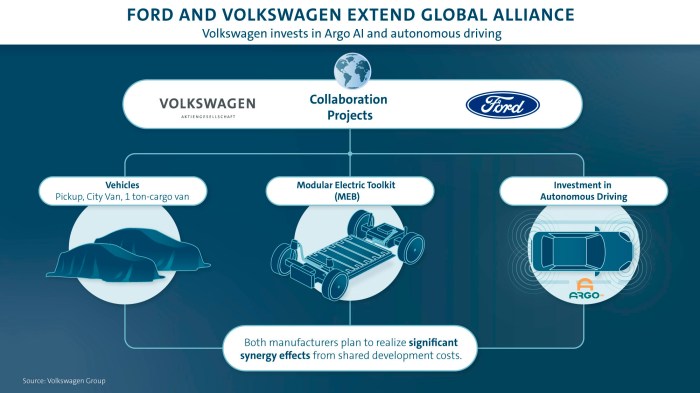
Ford VW alliance self driving argo investment valuation is a complex topic, and this exploration dives deep into the strategic partnership between Ford and VW, examining the potential of self-driving technology integration, and analyzing the investment in Argo AI. We’ll look at the historical context of the alliance, assess the current state of self-driving tech, and dissect the valuation of Argo AI within the broader competitive landscape.
This analysis will cover market trends, potential ROI, and financial projections for this ambitious venture, ultimately exploring the future of transportation.
This analysis examines the key factors influencing the valuation, including the strengths and weaknesses of Ford and VW, the current state of self-driving technology, and the competitive landscape. The interplay of these factors creates a unique and potentially lucrative opportunity. We’ll also look at the financial projections and the long-term implications of this partnership on the automotive industry.
Ford-VW Alliance
The Ford-VW alliance, a potential game-changer in the automotive industry, presents a compelling case study in strategic partnerships. This collaboration, if realized, could reshape the landscape of electric vehicle production, autonomous driving technology, and global supply chains. The potential for innovation and cost-efficiency is significant, and the initial steps taken by both companies suggest a commitment to achieving ambitious goals.The stated intentions of the alliance highlight the companies’ desire to pool resources and expertise to navigate the complexities of the rapidly evolving automotive sector.
This approach allows for a more efficient allocation of capital, talent, and technological advancements, ultimately aiming to enhance competitiveness in the face of increasing market pressures and technological advancements.
Historical Overview of the Ford and VW Alliance
Ford and Volkswagen have a history of limited, more specific collaborations in the past, rather than a full-fledged alliance. These collaborations have often focused on specific technologies or projects, but have not resulted in a significant, comprehensive alliance of the kind currently being discussed. This historical pattern underscores the complexities involved in creating and maintaining a successful long-term partnership of this scale.
Understanding these past interactions provides context for evaluating the current proposed alliance.
Stated Goals and Objectives of the Partnership
The primary goals of the proposed Ford-VW alliance revolve around cost reduction through shared production facilities and economies of scale, development of cutting-edge technologies like autonomous driving and electric vehicles, and an expansion of market reach by leveraging each other’s existing networks. The aim is to create a more formidable competitor in the global automotive market, potentially challenging established players like Tesla and other major automotive brands.
Strengths and Weaknesses of Ford and VW
Ford and Volkswagen, despite their similar positions in the automotive sector, possess distinct strengths and weaknesses. Ford excels in the North American market with a strong presence in the traditional internal combustion engine segment. VW, on the other hand, has a substantial global footprint, particularly in Europe and emerging markets, and is making significant strides in electric vehicle technology.
However, Ford’s North American expertise might be a significant asset in a joint venture to compete against Tesla in the United States. VW’s global presence could help Ford expand beyond North America.
Potential Synergies and Benefits
A successful alliance could yield substantial synergies, including shared research and development costs for new technologies like electric vehicles and autonomous driving, optimized production and distribution networks, enhanced supply chain management, and potentially reduced production costs. The combination of Ford’s North American expertise and VW’s global reach could lead to a formidable global competitor in the automotive sector.
Such a combined effort could also lead to the development of new, cutting-edge technologies and create significant cost efficiencies.
Comparison of Ford and VW Market Positions, Ford vw alliance self driving argo investment valuation
| Characteristic | Ford | Volkswagen |
|---|---|---|
| Market Share (estimated) | Approximately 7-8% | Approximately 10-12% |
| Product Portfolio | Broad, encompassing a range of vehicles from compact cars to trucks, including traditional gasoline-powered vehicles and some EVs | Extensive, spanning various vehicle segments globally, with a significant emphasis on both gasoline-powered and electric vehicles |
| Brand Image | Strong in North America, associated with reliability and practicality, while newer electric offerings are being positioned towards the future | Strong globally, especially in Europe, associated with high-performance and luxury vehicles; currently transitioning to a more sustainable image |
This table summarizes the estimated current market share, product portfolios, and brand image for Ford and Volkswagen. It’s important to note that these figures are approximate and can vary depending on the specific region and reporting period. This comparison serves as a starting point for evaluating the strengths and weaknesses of each company within the context of a potential alliance.
Ford, VW, and the Alliance’s self-driving Argo investment valuation is a complex beast. Understanding the potential risks is crucial, and a good place to start is by looking at the various attack vectors at a glance. Attack vectors at a glance highlight potential vulnerabilities in the systems, from software flaws to physical security breaches. Ultimately, this knowledge helps in better evaluating the overall investment risk and ensuring a more secure future for the autonomous vehicle industry.
Self-Driving Technology Integration
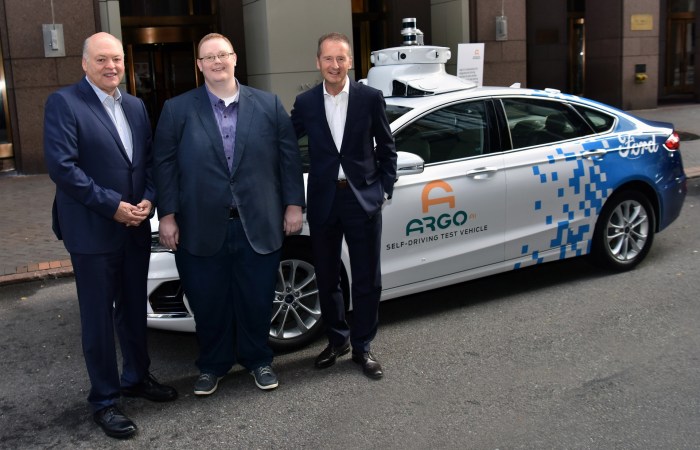
The Ford-VW Alliance, with its combined resources and market reach, is poised to be a significant player in the rapidly evolving self-driving car market. Integrating this technology into existing product lines will require careful planning, substantial investment, and a strategic approach to navigate the complexities of the sector. This exploration delves into the current state of self-driving technology, its potential impact on the alliance, and the challenges and opportunities it presents.The automotive industry is undergoing a transformative shift, with self-driving technology at the forefront.
Numerous advancements are driving this progress, from sophisticated sensor fusion systems to advanced algorithms for decision-making. However, challenges remain, including the development of robust and reliable systems capable of operating in diverse and unpredictable environments.
Current State of Self-Driving Technology
Significant advancements have been made in various aspects of self-driving technology. Sensor technology, including LiDAR, radar, and cameras, has improved dramatically, providing vehicles with more comprehensive and detailed environmental awareness. Sophisticated algorithms now allow vehicles to process this data and make decisions autonomously, leading to increased safety and efficiency.
Impact on Ford-VW Alliance Operations
The integration of self-driving technology into the Ford-VW Alliance’s operations could revolutionize their production and distribution strategies. Autonomous vehicles could potentially streamline logistics, reduce operating costs, and create new revenue streams through ride-sharing services. This shift could also require significant investment in research and development, infrastructure upgrades, and workforce retraining.
Technological Challenges in Integration
Integrating self-driving features into Ford and VW’s existing product lines presents significant technological hurdles. Ensuring seamless integration with existing vehicle architectures, developing robust safety systems, and addressing regulatory compliance requirements will be crucial. Additionally, the complex interplay of software and hardware will require rigorous testing and validation to ensure reliable performance in diverse conditions.
New Market Opportunities
Self-driving technology opens up exciting new market opportunities for the alliance. The development of autonomous ride-sharing services could tap into a substantial market demand. Furthermore, the possibility of using autonomous vehicles for logistics and delivery services presents significant potential for new revenue streams. Personalized mobility solutions, such as self-driving taxis and shuttles, could also attract new customer segments.
Autonomous Driving Levels
Understanding the different levels of autonomous driving technology is crucial for evaluating the current state of development and the potential impact on the alliance. Different levels of automation provide varying degrees of driver assistance, and different vehicles support these levels.
| Level | Description | Ford Example | VW Example |
|---|---|---|---|
| 0 | No Automation | Most traditional vehicles | Most traditional vehicles |
| 1 | Driver Assistance | Ford’s lane keeping assist | VW’s adaptive cruise control |
| 2 | Partial Automation | Ford’s automatic emergency braking | VW’s lane assist |
| 3 | Conditional Automation | (No readily available examples yet) | (No readily available examples yet) |
| 4 | High Automation | (No readily available examples yet) | (No readily available examples yet) |
| 5 | Full Automation | (No readily available examples yet) | (No readily available examples yet) |
Argo AI Investment & Valuation
Argo AI, a leader in self-driving technology, has garnered significant attention and investment from major automotive players like Ford and Volkswagen. Understanding the intricacies of Argo AI’s business model, the motivations behind the investment, and the factors influencing its valuation is crucial for assessing the future of autonomous vehicle technology. This analysis delves into these aspects, providing a comprehensive overview of the company’s current position and potential.Ford and Volkswagen’s investment in Argo AI reflects a strategic move to gain a competitive edge in the rapidly evolving autonomous vehicle market.
Their commitment to this technology highlights their anticipation of the transformative potential of self-driving vehicles and their desire to be at the forefront of this revolution.
Argo AI’s Business Model
Argo AI’s core business revolves around developing and deploying self-driving technology. Their primary focus is on creating a complete self-driving system, encompassing perception, planning, and control functionalities. This involves leveraging advanced sensor technology, sophisticated algorithms, and extensive data sets for training and refining their systems. Their services encompass the provision of autonomous driving capabilities to various platforms, including commercial and passenger vehicles.
This approach emphasizes the potential for widespread integration of autonomous driving into the transportation landscape.
Ford, VW, and the Alliance’s self-driving Argo investment valuation is definitely a hot topic right now, but it got me thinking about something else entirely. Like, how much space junk is out there, constantly circling our planet? It’s a lot, isn’t it? Check out this fascinating piece on thats a lot of space junk for a deeper dive.
Regardless, the valuation of Argo still seems quite a gamble, given the hurdles in the self-driving car industry.
Ford and VW’s Investment Strategy
Ford and Volkswagen’s investment in Argo AI was driven by a strategic alignment with their long-term vision for the automotive industry. Their aim was to acquire a leading-edge self-driving technology platform, rather than building one from scratch. This strategy allowed them to leverage Argo AI’s existing expertise and research, accelerating their own development timelines. Their investment aimed to reduce development risks and costs, while simultaneously gaining access to a robust and proven self-driving system.
Factors Influencing Argo AI’s Valuation
Several factors contribute to Argo AI’s valuation, including market trends, technological advancements, and financial projections. The increasing adoption of autonomous vehicle technologies by both consumers and businesses is a key market trend driving demand for such services. The pace of technological advancements in areas like sensor technology, artificial intelligence, and machine learning directly impacts the efficiency and capabilities of self-driving systems.
Financial projections, considering factors such as revenue generation timelines and operating costs, also significantly influence the valuation.
Valuation Methods and Potential Outcomes
Different valuation methods can provide varying estimates for Argo AI’s worth. These methods can consider the company’s current market capitalization, future revenue projections, and comparable company valuations. A crucial element is the specific market scenario assumed in the valuation process.
| Valuation Method | Potential Outcome (High/Medium/Low) | Market Scenario |
|---|---|---|
| Discounted Cash Flow (DCF) | High | Rapid adoption of autonomous vehicles, high revenue projections |
| Comparable Company Analysis | Medium | Stable market adoption, similar company valuations |
| Precedent Transactions | Low | Limited market adoption, slower revenue growth |
The table above provides a simplified illustration of how different valuation approaches might lead to various outcomes. The actual valuation of Argo AI will likely be a complex calculation considering various factors and scenarios.
Comparison with Similar Companies
Comparing Argo AI’s valuation to similar companies in the self-driving technology sector reveals a dynamic landscape. Companies like Cruise (owned by GM), Waymo (owned by Alphabet), and others are often used for benchmarking, though direct comparisons can be challenging due to differences in business models, operational strategies, and financial projections. A critical aspect of these comparisons is the stage of development and market penetration of each company.
Ford, VW, and the Alliance’s self-driving Argo investment valuation is fascinating, but honestly, I’m more intrigued by the tech advancements in consumer electronics. For example, the new Nothing Ear (1) earbuds, as detailed in the nothing ear and ear a earbuds promise better battery and super clear streaming , suggest a potential shift in audio tech that could impact future car audio systems.
Ultimately, though, the long-term valuation of the Argo investment still hinges on the successful development and market adoption of autonomous driving technology.
Market Analysis & Competitive Landscape: Ford Vw Alliance Self Driving Argo Investment Valuation
The Ford-VW Alliance’s foray into self-driving technology through Argo AI necessitates a comprehensive understanding of the competitive landscape and market trends. This analysis examines the key players, their strategies, and the potential challenges and opportunities facing the alliance. Navigating the complex regulatory environment and technological hurdles is crucial for success.
Competitive Landscape Overview
The self-driving technology sector is a highly competitive space, populated by established automotive manufacturers, tech giants, and specialized startups. Direct competitors to the Ford-VW Alliance include Waymo, Cruise, Tesla, and numerous smaller companies focusing on specific aspects of self-driving technology. Each company employs different strategies, ranging from in-house development to partnerships and acquisitions. This diverse approach reflects the evolving nature of the industry and the ongoing search for the optimal path to commercialization.
Market Trends Influencing Growth
Several key trends are shaping the growth of the self-driving market. Consumer adoption is a significant factor, with increasing interest and willingness to utilize autonomous vehicles. Simultaneously, regulatory changes are crucial, as governments worldwide establish frameworks for the testing, deployment, and eventual widespread adoption of self-driving technology. Technological advancements, such as improvements in sensor technology, machine learning algorithms, and vehicle infrastructure, are continuously driving progress.
These developments are pivotal in the evolution of autonomous vehicle capabilities.
Major Players in the Autonomous Vehicle Market
| Company | Current Product Offerings |
|---|---|
| Waymo | Extensive testing programs in select cities, with limited commercial services available for select passengers and deliveries. |
| Cruise | Focused on developing and testing its autonomous vehicle technology in major US metropolitan areas, with pilot programs under development. |
| Tesla | Integrating advanced driver-assistance systems (ADAS) into its vehicles, with an ongoing development plan for full self-driving capabilities. |
| Ford-VW Alliance (Argo AI) | Developing and integrating self-driving technology into future vehicles, leveraging Argo AI’s technology and expertise. |
| Other Companies | Numerous startups and specialized companies focusing on specific components of self-driving technology, such as sensor technology, mapping, or machine learning algorithms. |
Potential Risks and Challenges
The Ford-VW Alliance’s self-driving technology endeavors face several potential risks and challenges. Regulatory hurdles, including varying regulations across different jurisdictions and the need for standardized safety protocols, pose a significant obstacle. Technological uncertainties, such as the unpredictable nature of real-world driving conditions and the need for continuous algorithm refinement, remain a concern. Financial constraints, including the substantial capital investment required for research, development, and deployment, could also impact the alliance’s progress.
These challenges necessitate careful planning and execution to mitigate their potential negative impact.
Potential Return on Investment (ROI) for Argo AI Investment
Predicting the ROI for the Ford-VW Alliance’s investment in Argo AI is complex. A key factor is the successful integration of Argo AI’s technology into the alliance’s vehicles.
“A successful ROI hinges on the speed of market penetration, adoption rates, and the eventual cost reductions from economies of scale.”
The timeline for widespread adoption of self-driving technology is uncertain, making projections challenging. Real-world examples, like the gradual rollout of advanced driver-assistance systems (ADAS) into various vehicle models, provide a framework for understanding the potential benefits and limitations of integrating new technologies into the automotive industry. This successful rollout of ADAS into many models demonstrates that the integration of new technologies into the automotive industry is achievable.
Financial Projections & Future Outlook
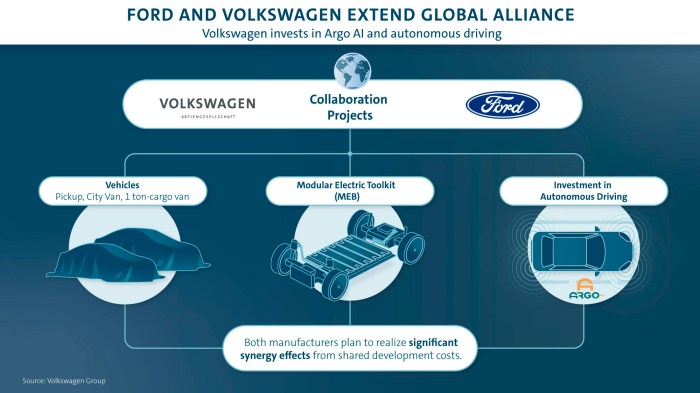
The Ford-VW Alliance’s foray into self-driving technology via Argo AI presents a compelling, yet complex, financial landscape. Successful integration hinges on meticulous planning, accurate projections, and strategic risk mitigation. This section delves into the potential revenue streams, cost structures, and overall impact on the automotive industry, considering the long-term implications for transportation.
Potential Revenue Streams and Cost Projections
The alliance’s revenue will likely originate from multiple sources, primarily tied to the deployment and integration of self-driving features. These revenue streams are expected to evolve as the technology matures and gains broader market adoption. Cost structures will also be dynamic, reflecting development expenses, manufacturing adaptations, and regulatory compliance.
| Year | Potential Revenue Streams | Estimated Costs |
|---|---|---|
| 2025 | Limited production, early adopter programs, licensing fees for advanced sensor technology. | Significant R&D investment, pilot program costs, potential litigation expenses. |
| 2026 | Scaled production of vehicles incorporating partial self-driving features, subscription services for autonomous driving. | Manufacturing adaptation costs, increased personnel costs, regulatory compliance and safety testing. |
| 2027 | Full self-driving vehicles in select markets, data licensing agreements with third-party providers, increased subscription fees for autonomous services. | Infrastructure development for autonomous vehicle testing and operation, integration of advanced safety systems, increased marketing and sales costs. |
| 2028 | Expansion to broader markets, premium pricing for fully autonomous vehicles, potentially autonomous ride-sharing services. | Scaling production to meet demand, cybersecurity upgrades, potential legal challenges related to liability. |
Projected revenue growth is contingent upon successful product development, market adoption, and the ability to navigate evolving regulations.
Impact on the Global Automotive Industry
The alliance’s self-driving initiatives could significantly reshape the automotive industry. Advancements in vehicle design, incorporating more sophisticated sensor systems and advanced driver-assistance systems, are likely. Manufacturing processes may also be altered to accommodate the integration of autonomous systems. Furthermore, the transportation sector itself will undergo transformations, potentially leading to changes in urban planning and infrastructure development. Autonomous vehicles could also impact public transportation systems and ride-sharing models.
Long-Term Implications for Transportation
The long-term impact of this technology extends beyond the automotive sector. Increased efficiency in transportation could reduce congestion, fuel consumption, and emissions. This could lead to a more sustainable and connected transportation system. Potential implications include changes in urban design, and potentially a shift towards a more shared mobility model.
Risk Mitigation and Return Maximization Strategies
The Ford-VW alliance needs to implement strategies to mitigate potential risks and maximize returns from its Argo AI investment. This involves continuous monitoring of technological advancements in the sector, developing robust safety protocols and security measures, maintaining close collaboration with regulatory bodies, and conducting thorough market research to anticipate future trends. Strategic partnerships with technology companies and research institutions could also enhance their ability to address unforeseen challenges and capitalize on emerging opportunities.
Adapting to changing consumer preferences and regulatory frameworks will be crucial for success.
Wrap-Up
In conclusion, the Ford-VW alliance’s investment in Argo AI represents a significant bet on the future of autonomous vehicles. While challenges like regulatory hurdles and technological uncertainties exist, the potential rewards are substantial. This investment presents a complex interplay of strategic partnerships, technological innovation, and market dynamics. The success of this venture will depend on the ability of the alliance to navigate these challenges and capitalize on emerging market opportunities.
The future of transportation hinges on such bold ventures, and this analysis provides a comprehensive framework for understanding the potential impact.