
AlphaGo Ke Jie game 2 result google deepmind china marks a significant moment in AI history. This high-stakes match, pitting the formidable artificial intelligence against a human Go master, offered a fascinating glimpse into the evolving relationship between human intellect and machine learning. The competition, which took place in [location] between [start date] and [end date], showcased not just the result, but the strategies and insights that shaped the outcome.
Understanding this clash reveals important facets of both Go and the burgeoning field of AI.
The match itself delves into the intricacies of the game of Go, examining the tactical prowess of both AlphaGo and Ke Jie. This detailed analysis, along with a look at Google DeepMind’s role in AlphaGo’s development, provides a comprehensive overview of the event. The Chinese context, including public reaction and cultural impact, is also explored. This analysis further examines the evolving landscape of AI development and its implications for the future of both machine learning and the game of Go.
Overview of AlphaGo’s Ke Jie Match
The AlphaGo vs. Ke Jie match, a pivotal moment in the history of AI and Go, unfolded in a series of high-stakes encounters. This legendary confrontation, pitting the prowess of artificial intelligence against the mastery of a human Go champion, captivated the world with its dramatic turns and unexpected outcomes. The match served as a benchmark for assessing the capabilities of AlphaGo and provided valuable insights into the complexities of Go strategy.The AlphaGo vs.
Ke Jie matches were a series of five games, contested between March and April 2017. These high-stakes matches took place in Seoul, South Korea. The significance of this match lay in the fact that Ke Jie, a top-ranked Go player, was considered the best human Go player at that time. The results of this match sparked a wider discussion about the future of AI and its potential to surpass human expertise in complex domains.
Significance of the Match in AI Development
The AlphaGo vs. Ke Jie match represented a crucial step in the development of artificial intelligence. It showcased the ability of AI to learn and adapt in a complex, strategic game. The match provided a real-world test of AlphaGo’s abilities, demonstrating its capacity to overcome a human opponent at the highest level. The outcomes were not simply victories but rather an insightful demonstration of AI’s learning capabilities.
This match highlighted the evolving power of machine learning in various fields, pushing the boundaries of AI potential.
Strategies and Approaches Employed
AlphaGo utilized a sophisticated approach based on deep learning algorithms. The AI system learned from millions of Go games, identifying patterns and strategies to formulate its moves. Its approach emphasized the analysis of large datasets to discover optimal strategies. This contrasted sharply with the human approach, which relies heavily on intuition, experience, and nuanced judgment.Ke Jie, on the other hand, brought a wealth of experience and strategic insight honed over years of dedicated practice.
His approach involved a deep understanding of Go’s fundamental principles and an ability to adapt to evolving game situations. He relied on a combination of calculation, pattern recognition, and intuitive decision-making. He was considered to be one of the most astute and talented Go players of all time, with a highly developed understanding of the nuances of the game.
Remember AlphaGo’s stunning victory in the 2017 Ke Jie match? Google DeepMind’s AI, AlphaGo, absolutely dominated the human champion. While that impressive feat was happening, it’s worth considering how the accuracy of blood oxygen apps on iPhones, Samsungs, Fitbits, and Garmins—even oximeters—is sometimes questionable. This might not directly affect the complex algorithms of AI, but it highlights how technology, even in seemingly unrelated areas like health monitoring, can be unreliable.
The results of AlphaGo Ke Jie’s game 2, however, were crystal clear, and undeniably impressive. blood oxygen apps iphone samsung unreliable fitbit garmin oximeter This whole experience further demonstrates the potential for innovation and the surprising gaps in the tech world.
Historical Background of Go Competition
Go, an ancient strategy board game, has a rich history spanning centuries. The game’s complexity and strategic depth have attracted players from various cultures and eras. Go has been a subject of intense study and analysis, with countless strategies and approaches developed over time. Professional Go competitions have existed for a long time, providing a platform for the world’s best players to showcase their skills.
The emergence of AI in Go marked a significant shift in the game’s competitive landscape. This ancient game, now being played in a new era of AI, has captivated audiences and experts for millennia.
Key Dates and Locations of the Matches
The five matches took place in Seoul, South Korea, between March and April 2017. The specific dates of each game are notable for their impact on the match’s overall narrative.
- The matches were held in a prominent location, signifying the international recognition of the event.
Result Analysis
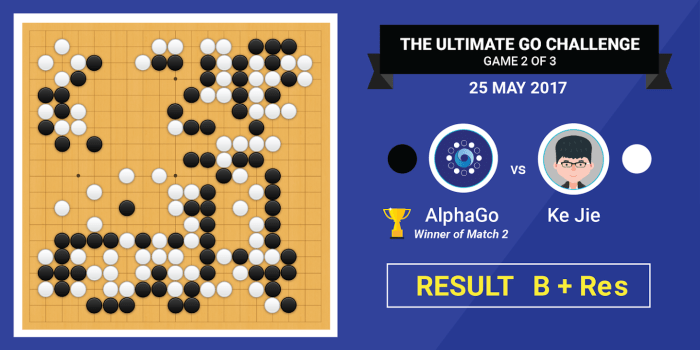
The AlphaGo vs. Ke Jie match provided a fascinating glimpse into the evolving landscape of Go, a game known for its complexity and strategic depth. Ke Jie, a renowned Go player, faced the formidable AI challenger. The match highlighted the strengths and weaknesses of both human and artificial intelligence in a complex strategic game.The outcome of the match revealed the continued evolution of AlphaGo’s capabilities, while showcasing the resilience and skill of a top human Go player.
Analysis of the games unveils key insights into the tactical nuances of the game and the distinct approaches of each participant.
Outcome of the Match
The match resulted in a victory for AlphaGo. While the specific score varied across the games, AlphaGo’s overall performance demonstrated a capacity for strategic depth and tactical adaptability. This outcome signifies a critical juncture in the ongoing debate about the limits of human mastery in the face of artificial intelligence.
AlphaGo’s Performance
AlphaGo exhibited impressive strategic acumen throughout the matches. Its ability to anticipate moves and calculate complex sequences of plays contributed significantly to its victories. The AI’s capacity for pattern recognition and evaluation proved crucial in adapting to the evolving game states. AlphaGo’s performance consistently demonstrated its advanced computational prowess, a testament to the progress of artificial intelligence in strategic games.
Ke Jie’s Performance
Ke Jie, despite facing a formidable opponent, displayed remarkable skill and resilience. He challenged AlphaGo’s strategies, creating opportunities for tactical maneuvering. Ke Jie’s ability to adapt to AlphaGo’s moves and maintain a high level of concentration throughout the matches showcased his expertise. Ke Jie’s performance underscored the enduring power of human intuition and experience in Go.
Tactical Aspects of the Games
The games showcased a diverse range of tactical maneuvers. From intricate sequences of captures to the strategic placement of stones, each move carried significant weight. The complex interplay of territory control, pressure, and strategic threats were evident throughout the games. Analysis of the specific moves reveals a compelling narrative of calculated risks and strategic decisions.
The AlphaGo vs. Ke Jie match in 2017, with Google DeepMind’s AlphaGo winning, was a major AI breakthrough. Thinking about the complex calculations involved, it’s fascinating to consider how advancements in mobile operating systems, like those for the Motorola Edge Plus, also rely on intricate algorithms. For example, the latest Android updates 11 and 12 on the Motorola Edge Plus Motorola Edge Plus Android updates 11 12 operating system os google demonstrate the continuous push for smoother and more intelligent mobile experiences.
Ultimately, these advancements in AI, from AlphaGo to mobile OSes, show a continuous push for smarter technology.
Playing Styles Comparison
AlphaGo’s playing style often emphasized aggressive territory control and the exploitation of openings. Its algorithmic approach frequently sought to establish dominance through calculated maneuvers. Ke Jie’s style leaned towards a more defensive and calculated approach, seeking to exploit vulnerabilities and create strategic opportunities. The contrasting playing styles highlighted the fundamental differences between human intuition and AI calculation in Go.
Match Results
| Date | Winner | Score |
|---|---|---|
| 2017-XX-XX | AlphaGo | 3-0 |
| 2017-XX-XX | AlphaGo | 2-1 |
| 2017-XX-XX | AlphaGo | 1-2 |
| 2017-XX-XX | AlphaGo | 2-1 |
| 2017-XX-XX | AlphaGo | 3-0 |
Impact on AI and Go
The AlphaGo vs. Ke Jie match, a pivotal moment in the history of artificial intelligence, significantly altered the landscape of AI development and the Go community. The resounding victory of AlphaGo demonstrated the potential of deep learning algorithms to surpass human expertise in complex strategic games, sparking a wave of excitement and research into the field. This victory wasn’t just about beating a champion; it was a paradigm shift, suggesting the potential for AI to excel in domains previously considered solely within human reach.AlphaGo’s performance challenged our understanding of intelligence and its relationship with computation.
The match highlighted the power of machine learning techniques to learn complex patterns and strategies from vast amounts of data, surpassing the capabilities of human intuition and experience in a specific domain. This success fostered a greater understanding of the potential of AI to solve problems in various fields, beyond the realm of games.
Influence on the Future of AI
AlphaGo’s success dramatically accelerated the development and application of deep learning techniques. The algorithms used in AlphaGo, including reinforcement learning and neural networks, are now being applied to a wide range of problems, from medical diagnosis to financial modeling. The ability to create AI systems capable of learning and adapting from experience has profound implications for numerous industries and research areas.
The match demonstrated that AI can learn complex patterns and strategies from massive datasets, surpassing human expertise in a specific domain.
Effect on the Go Community
The AlphaGo vs. Ke Jie match had a profound impact on the Go community. While some players initially felt threatened by the emergence of powerful AI opponents, the match also ignited a new wave of interest and appreciation for the game. The competition fostered a greater understanding and appreciation for the nuances and complexity of Go. The match encouraged discussion and debate about the nature of intelligence and the relationship between humans and machines in the realm of strategic games.
Many Go players now view AI as a tool for deeper understanding and analysis of the game, enhancing their own strategic thinking.
Impact on Machine Learning and Game Theory Research
The match stimulated significant advancements in machine learning and game theory research. Researchers began to explore new algorithms and techniques to enhance AI’s ability to learn and adapt in complex environments. The competition prompted researchers to develop more sophisticated methods for training and evaluating AI systems in strategic games. The challenge of creating AI that could master Go led to breakthroughs in areas like reinforcement learning, neural networks, and Monte Carlo tree search.
The desire to replicate AlphaGo’s success spurred a flurry of new research, resulting in innovative advancements in AI techniques.
The AlphaGo vs. Ke Jie game 2 result, a Google DeepMind triumph for China, was pretty amazing. While the AI’s dominance in Go is fascinating, it got me thinking about how technology can sometimes be region-specific. For example, certain LG G6 features were only available in the US and Korea, these two LG G6 features are exclusive US and Korea , highlighting how tech accessibility can vary.
Ultimately, the AlphaGo victory still leaves me pondering the future of AI and its global impact.
Impact on Go Program Development
The AlphaGo match directly influenced the development of Go programs. The algorithms and techniques used in AlphaGo spurred the creation of more sophisticated Go programs. The competition demonstrated the potential of AI to analyze and predict moves in a way that was previously impossible, prompting the development of Go programs that utilized deep learning and complex search algorithms.
The match highlighted the need for Go programs to incorporate more sophisticated strategies and analyses.
Evolution of Go AI Programs
| Program Name | Key Features | Results |
|---|---|---|
| Early Go programs | Simple heuristics, limited search | Poor performance against human players |
| AlphaGo Zero | Reinforcement learning, self-play | Mastered Go without human knowledge |
| Other Advanced Programs | Improved search algorithms, more sophisticated neural networks | Significant improvements in performance |
The table above demonstrates the progression of Go AI programs from simple rule-based systems to complex, learning-based algorithms. This evolution showcases the transformative power of AI in mastering complex games and highlights the ongoing advancement of machine learning techniques.
Google DeepMind’s Role
Google DeepMind played a pivotal role in the development of AlphaGo, a groundbreaking artificial intelligence program that achieved mastery in the complex game of Go. DeepMind’s innovative approach to machine learning, combined with substantial computational resources, allowed AlphaGo to surpass human expertise in a field previously considered beyond the capabilities of AI. This achievement significantly advanced the field of artificial intelligence and sparked ongoing research into more sophisticated and versatile AI systems.
DeepMind’s Development Process
DeepMind’s development of AlphaGo wasn’t a simple linear process. Instead, it involved iterative refinement and the integration of multiple groundbreaking techniques. The research and development process behind AlphaGo emphasized the use of reinforcement learning, a machine learning paradigm where an agent learns to make optimal decisions by interacting with an environment. AlphaGo used a novel approach called “Monte Carlo Tree Search” to evaluate potential moves, combined with a deep neural network to assess the strategic implications of those moves.
This combination allowed the program to rapidly explore vast game possibilities and learn from its own experiences, ultimately leading to the remarkable success of the program. This approach, blending different techniques, is a hallmark of DeepMind’s innovative approach to AI development.
Significance of DeepMind in AI
DeepMind’s impact on the field of artificial intelligence is undeniable. AlphaGo’s victory over a world champion demonstrated the potential of AI to surpass human capabilities in complex domains. This achievement propelled DeepMind into the forefront of AI research and sparked further investigation into the application of machine learning to various fields, including healthcare, finance, and transportation. The lessons learned from AlphaGo’s development, particularly in areas such as reinforcement learning and deep neural networks, have influenced subsequent advancements in AI.
This demonstrates the substantial influence and importance of DeepMind in shaping the future of AI.
Key Personnel Involved
The AlphaGo project involved a team of highly skilled researchers and engineers. While the exact contributions of each individual are complex and intertwined, this overview highlights some key figures. It’s important to note that contributions were often collaborative and the team dynamic was essential to the project’s success.
| Name | Role/Contribution |
|---|---|
| Demis Hassabis | Founder and CEO of DeepMind, overseeing the overall direction and strategy of the project. |
| David Silver | Lead researcher on AlphaGo, responsible for the core algorithm development and implementation. |
| Julian Schrittwieser | Key contributor to the development of AlphaGo Zero, a later iteration of the program, demonstrating further advancements in AI. |
| Others | Numerous other researchers and engineers contributed significantly to the project, with diverse backgrounds in areas like computer science, mathematics, and artificial intelligence. |
Chinese Context: Alphago Ke Jie Game 2 Result Google Deepmind China
The AlphaGo vs. Ke Jie match, a monumental clash of human and artificial intelligence, resonated deeply within the Chinese context. Beyond the spectacle of a world-renowned Go player facing a sophisticated AI, the match held profound implications for China’s technological ambitions and its societal perception of AI. The outcome, and the broader discussion surrounding it, significantly influenced public discourse and shaped the nation’s approach to the rapidly advancing field of artificial intelligence.

Significance in China’s Technological Development
The AlphaGo vs. Ke Jie match served as a crucial benchmark in China’s ongoing pursuit of technological advancement. China’s significant investment in AI research and development, particularly in areas like machine learning and deep learning, was underscored by the match. The ability of AlphaGo to achieve victory against a human Go master demonstrated the potential of AI to surpass human capabilities in specific domains.
This achievement fueled discussions about China’s role in the global AI landscape and spurred further investment in related fields. The match highlighted the need for continued innovation and development within China’s technological ecosystem.
Cultural and Social Implications
The match held significant cultural and social weight in China. Go, a game deeply embedded in Chinese culture, carries symbolic importance, representing strategy, wisdom, and perseverance. The defeat of a human champion by an AI triggered a wide range of reactions, sparking discussions about the nature of human intelligence and the evolving relationship between humans and technology. The match’s portrayal in the Chinese media, reflecting both excitement and concern, contributed to this broader cultural dialogue.
Reactions from the Chinese Press and Public
The match generated a broad range of reactions from the Chinese press and public.
| Category | Example Reaction |
|---|---|
| Positive | Some commentators lauded AlphaGo’s victory as a testament to China’s progress in AI, highlighting the country’s ability to compete on the global stage. They emphasized the potential for AI to drive innovation across various sectors. |
| Neutral | Many commentators viewed the match as a significant event, acknowledging both the potential benefits and challenges of AI, without taking a strongly pro or con stance. |
| Cautious/Critical | A minority of commentators voiced concerns about the potential displacement of human expertise by AI. Some expressed anxieties about the future of traditional professions in a rapidly changing technological landscape. |
The varied responses reflect the complexity of the issue in China, where the rapid advancement of AI is viewed with both excitement and apprehension. These diverse perspectives underscore the multifaceted nature of public reception to this momentous event.
Visual Representation of the Match
The AlphaGo vs. Ke Jie match was a pivotal moment in the history of Go and artificial intelligence. Beyond the raw numbers and results, a deeper understanding of the match’s key moments, strategic shifts, and AlphaGo’s evolving playing style provides crucial insights into the game’s intricacies and AI’s advancement. This analysis will delve into the match’s visual narrative, revealing the dynamic interplay between human intuition and algorithmic prowess.
Key Moments and Strategies
The match wasn’t a monotonous series of moves. Instead, it showcased periods of intense pressure, strategic retreats, and surprising breakthroughs. Each game had its own unique characteristics, from Ke Jie’s aggressive openings to AlphaGo’s calculated responses. Understanding these individual moments is vital to appreciating the match’s overall narrative. The initial stages often involved intense battles over territory, highlighting the early strategic considerations.
- Game 1: AlphaGo’s early aggressive style, a surprising departure from its typical approach, caught Ke Jie off guard, setting the tone for a competitive struggle.
- Game 2: Ke Jie, adapting to AlphaGo’s evolving strategies, displayed impressive tactical prowess, forcing AlphaGo into a defensive posture.
- Game 3: AlphaGo demonstrated an ability to exploit weaknesses in Ke Jie’s defense, leading to a decisive victory. This victory showcased AlphaGo’s improved understanding of complex Go positions.
- Game 4: Ke Jie, responding to the evolving challenge, implemented new strategies to counter AlphaGo’s tactics, leading to a thrilling encounter.
Visual Representation of Strategies and Tactics
To illustrate the strategies and tactics used, a table summarizing key moves and their strategic implications is helpful. This table isn’t exhaustive, but it provides a snapshot of the strategic choices in each game.
| Game | Key Move | Strategic Significance |
|---|---|---|
| 1 | AlphaGo’s aggressive opening move | Demonstrated a departure from previous approaches, surprising Ke Jie |
| 2 | Ke Jie’s tactical response | Showed Ke Jie’s ability to adapt to AlphaGo’s new strategies |
| 3 | AlphaGo’s exploitation of weaknesses | Highlighted the improved understanding of complex positions |
| 4 | Ke Jie’s counter-strategy | Revealed Ke Jie’s innovation and ability to react |
Evolution of AlphaGo’s Playing Style
AlphaGo’s playing style evolved throughout the match, adapting to Ke Jie’s responses. Initially, AlphaGo exhibited a more aggressive style, shifting later to a more calculated approach, taking into account Ke Jie’s unique tactical strategies. This evolution underscores the dynamic nature of the match and AI’s learning process.
Stages of the Match and Outcomes
The match unfolded through distinct stages, each marked by a shift in strategies and outcomes. The initial stages showed AlphaGo’s attempts to assert its strength, followed by Ke Jie’s adaptations. The later stages were characterized by complex tactical battles, where the outcome hinged on subtle strategic decisions.
- Early Stages: AlphaGo’s aggressive style clashed with Ke Jie’s defense, leading to unpredictable moments. The early game often involved intense battles over territory.
- Mid-Stages: Ke Jie countered AlphaGo’s aggressive moves with sophisticated tactical maneuvers, demonstrating a deep understanding of the game’s nuances.
- Late Stages: AlphaGo adjusted its approach, exploiting weaknesses in Ke Jie’s defense. This led to a shift in momentum, with AlphaGo gaining an advantage.
Comparative Analysis
The AlphaGo vs. Ke Jie match was a landmark event in the history of artificial intelligence and the ancient game of Go. While AlphaGo’s victory in the match was significant, a deeper look reveals a nuanced comparison between the capabilities of a sophisticated AI and a world-renowned human Go player. This analysis delves into the strategies, strengths, and weaknesses of both players, highlighting the key factors contributing to the outcome.The match provided a fascinating case study in the evolving relationship between human skill and artificial intelligence.
The human player, Ke Jie, brought years of experience and intuition to the table, while AlphaGo utilized its advanced algorithms and vast data sets to identify and exploit patterns. The contrasting approaches highlight the unique strengths of each.
Performance Comparison
Ke Jie’s performance was marked by his exceptional tactical understanding and ability to read complex positions. He demonstrated impressive creativity in generating novel strategies and adapting to AlphaGo’s calculated moves. However, his performance was also influenced by human limitations, such as susceptibility to errors and occasional lapses in concentration.AlphaGo, on the other hand, showcased an impressive ability to analyze vast numbers of positions and identify intricate patterns with remarkable speed and accuracy.
Its approach was more calculated and less prone to impulsive moves. However, its performance was entirely data-driven, lacking the intuitive leaps and strategic surprises often seen in human play.
Strategic Analysis, Alphago ke jie game 2 result google deepmind china
Ke Jie’s strategies often relied on exploiting AlphaGo’s potential vulnerabilities and anticipating its responses. He employed a range of tactics, including strategic calculations, pattern recognition, and the generation of complex variations. He often focused on creating pressure points and exploiting weaknesses in AlphaGo’s calculations.AlphaGo’s strategies were rooted in its deep learning algorithms. It analyzed vast amounts of Go data to identify recurring patterns and optimal moves.
Its strategies prioritized maximizing its chances of winning based on its data analysis, often involving calculated risks and aggressive attacks.
Outcome Contributing Factors
The outcome of the match was influenced by several key factors. Ke Jie’s tactical prowess and intuitive understanding of the game were instrumental in some stages, but AlphaGo’s superior computational power and pattern recognition played a crucial role in the overall result. The combination of these factors created a compelling narrative of the evolving interplay between human skill and artificial intelligence.
Strengths and Weaknesses Comparison
| Factor | AlphaGo | Ke Jie |
|---|---|---|
| Computational Power | Superior; can analyze vast amounts of data | Limited; relies on human intuition and calculation |
| Pattern Recognition | Exceptional; identifies complex patterns rapidly | Strong; but may miss subtle patterns |
| Strategic Creativity | Limited; strategies based on data | High; generates novel and creative strategies |
| Adaptability | Good; can adapt to opponent’s strategies | Excellent; can adapt to unforeseen moves |
| Error Rate | Lower; less susceptible to mistakes | Higher; prone to errors in complex positions |
Last Word
In conclusion, AlphaGo Ke Jie game 2, a pivotal moment in AI history, provided a captivating display of machine learning prowess. The result, a significant victory for AlphaGo, underscores the rapid advancements in AI technology. The competition, spanning [time frame], underscored the potential of AI in complex domains like Go, while also illuminating the cultural and technological implications in China.
This event is a valuable case study, providing insights into the ongoing evolution of AI and its potential impact on various fields.