AWS Announces General Availability of DevOps Agent for Automated Incident Investigation

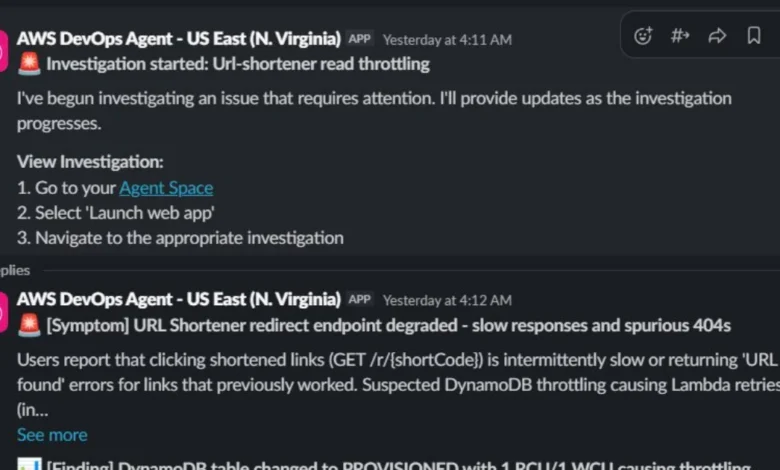
Amazon Web Services (AWS) has officially announced the general availability of DevOps Agent, a sophisticated generative AI-powered assistant engineered to empower developers and operators in diagnosing complex issues, meticulously analyzing deployments, and autonomously orchestrating operational tasks across a diverse spectrum of AWS, hybrid cloud, and on-premises environments. This milestone marks a significant leap in the evolution of operational intelligence, promising to redefine incident response and proactive system management.
The Evolving Landscape of DevOps and Site Reliability Engineering
The modern digital landscape is characterized by increasingly complex, distributed systems, often comprising microservices, serverless functions, and a myriad of interconnected components. This complexity has amplified the challenges faced by DevOps and Site Reliability Engineering (SRE) teams. Manual incident response, traditionally involving the correlation of disparate data points from logs, metrics, traces, and deployment records, has become an arduous and time-consuming endeavor. Engineers are frequently confronted with alert fatigue, an overwhelming volume of telemetry, and the pressure to quickly resolve issues that directly impact business continuity and customer experience. The mean time to resolution (MTTR) for critical incidents often stretches into hours, leading to significant financial losses and reputational damage. Studies consistently show that the cost of downtime for enterprises can range from hundreds of thousands to millions of dollars per hour, underscoring the urgent need for more efficient and automated operational tools.
Prior to the advent of specialized AI agents, teams often leveraged general-purpose AI coding tools or basic AI/ML insights from monitoring systems. While helpful for specific tasks, these tools frequently lacked the comprehensive operational context, deep understanding of application relationships, and the necessary controls to manage complex production environments at scale. This gap highlighted the pressing need for an intelligent, autonomous teammate capable of not just assisting, but actively participating in operational workflows.
From re:Invent Preview to General Availability: A Chronology
The journey of AWS DevOps Agent began with its initial introduction in preview at re:Invent 2025, AWS’s flagship annual conference. At that time, it was unveiled as a promising new frontier in AI-driven operations, built upon the robust foundation of Amazon Bedrock AgentCore. The preview phase allowed AWS to gather crucial feedback from early adopters, refine its capabilities, and ensure its readiness for widespread enterprise adoption. This iterative development process is typical for major AWS service launches, emphasizing a commitment to stability, scalability, and practical utility.
The general availability, announced in March 2026, signifies that the service is now fully supported, production-ready, and backed by AWS’s service level agreements. This transition from preview to GA is not merely a change in status but often entails significant improvements in performance, feature completeness, regional availability, and enterprise-grade support.
Under the Hood: Generative AI and Amazon Bedrock AgentCore
At its core, AWS DevOps Agent leverages the power of generative AI, a subset of artificial intelligence capable of producing novel content, in this case, actionable insights and automated responses. The agent is built on Amazon Bedrock AgentCore, a foundational technology within AWS’s broader strategy for empowering developers to build generative AI applications. Amazon Bedrock itself is a fully managed service that offers access to foundation models (FMs) from Amazon and leading AI startups via an API, making it easy to build and scale generative AI applications. AgentCore specifically provides the framework for creating "agents" that can take actions, plan complex tasks, and securely connect FMs to company data sources and applications.
This architecture allows DevOps Agent to move beyond simple data aggregation. It is designed to understand the semantic meaning of operational data, reason about potential causes of incidents, and formulate strategies for resolution. By learning the intricate relationships between various application components, services, and infrastructure, the agent can construct a holistic view of the operational landscape. This deep contextual understanding is paramount for accurate incident triage and effective automation.
Key Features and Enhancements at General Availability
The general availability release introduces several critical enhancements that significantly expand the agent’s utility and reach:
- Cross-Environment Investigation: A major improvement is the ability to investigate applications not only within AWS environments but also in Microsoft Azure and on-premises infrastructures. This hybrid cloud capability is crucial for many enterprises operating across multi-cloud and traditional data center setups, ensuring a unified operational intelligence layer regardless of where workloads reside. This expanded scope addresses a key challenge for large organizations, enabling consistent incident management across their entire IT footprint.
- Support for Custom Agent Skills: The agent’s capabilities are now extensible through custom agent skills. This allows organizations to tailor the agent’s functionality to their specific operational playbooks, proprietary tools, or unique troubleshooting methodologies. Developers can define new actions and integrate them with the agent, enabling it to perform highly specialized tasks relevant to their environment, thus greatly enhancing its adaptability and value.
- Custom Charts and Reports: For improved visibility and post-incident analysis, the DevOps Agent now supports the creation of custom charts and reports. This feature allows teams to visualize incident trends, agent performance metrics, resolution times, and other key operational indicators in a format that aligns with their specific reporting needs. Such detailed reporting is vital for continuous improvement and demonstrating the agent’s impact on operational efficiency.
Madhu Balaji, a senior solution architect at AWS, underscored the transformative potential of the agent, noting, "A SRE responding to a 2 AM page must manually correlate telemetry from multiple sources, trace dependencies across services, and form hypotheses — a process that routinely takes hours. As systems grow in complexity, the need for an AI-powered operational teammate — an SRE agent — has become increasingly clear."
Operational Autonomy: Beyond Passive Q&A
A distinguishing characteristic of the AWS DevOps Agent is its autonomous nature. Balaji further elaborated, stating, "DevOps Agent is not a passive Q&A tool, it is an autonomous teammate. When an incident triggers via a CloudWatch alarm, PagerDuty alert, Dynatrace Problem, ServiceNow ticket, or any other event source you configure through the webhook, the agent begins investigating immediately without human prompting." This proactive engagement sets it apart from conventional monitoring or analytical tools. Upon receiving an alert, the agent springs into action, autonomously triaging issues, correlating data, and even recommending or executing resolution steps, significantly reducing MTTR. This level of autonomy represents a paradigm shift from reactive human intervention to proactive, AI-driven incident management.
Ecosystem Integration: A Holistic View
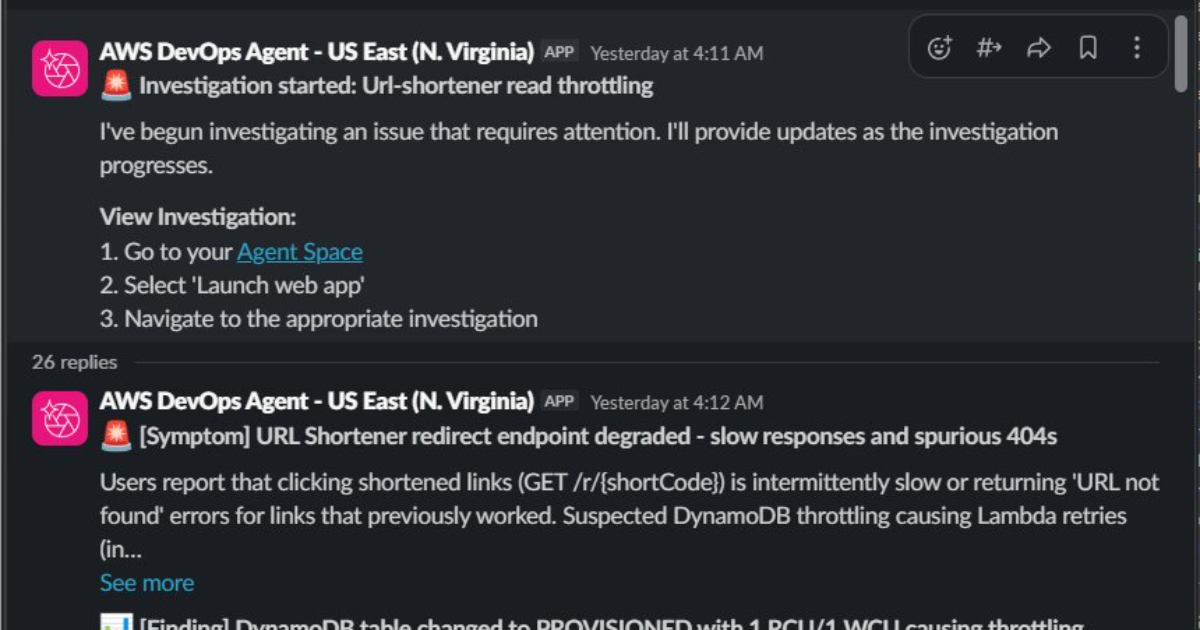
The effectiveness of any operational tool hinges on its ability to integrate seamlessly with an organization’s existing technology stack. DevOps Agent excels in this regard, integrating with a broad array of observability tools, runbooks, code repositories, and CI/CD pipelines. This comprehensive integration allows it to pull signals from virtually wherever an operational team’s data resides.
As explained by Janardhan Molumuri, Bill Fine, Joe Alioto, and Tipu Qureshi in a separate AWS blog post demonstrating the agent with a serverless URL shortener application, "Extensibility through the MCP [Multi-Cloud Platform] and built-in integrations with CloudWatch, Datadog, Dynatrace, New Relic, Splunk, Grafana, GitHub, GitLab, and Azure DevOps ensures the agent can pull signals from wherever the team’s operational data lives." This wide array of integrations—covering major cloud providers, leading observability platforms, and popular development tools—enables the agent to correlate telemetry, code, and deployment data across the entire software development lifecycle. This holistic data perspective is critical for pinpointing root causes and understanding the full impact of incidents. By consolidating information from diverse sources, the agent constructs a rich contextual understanding that far surpasses what a human operator could quickly achieve.
Industry Reception and Early Metrics
The introduction of DevOps Agent has garnered significant attention across the industry, with early metrics proving compelling. Sebastian Korfmann, co-creator of Agentic Hamburg, highlighted some impressive figures, noting, "The early numbers are compelling: up to 75% lower MTTR and 94% root cause accuracy in preview. Integrates with Datadog, Grafana, Splunk, PagerDuty, ServiceNow, and more." These statistics, if sustained, represent a profound improvement in operational efficiency and reliability, translating directly into reduced downtime costs and improved service quality. A 75% reduction in MTTR means that an incident that previously took hours to resolve could now be addressed in minutes, dramatically impacting business continuity.
However, the innovation also brings discussions about its broader impact. Corey Quinn, chief cloud economist at The Duckbill Group, offered a characteristically sharp perspective: "You’re paying for the privilege of having AI do what your 2 AM on-call engineer does, except it won’t passive-aggressively Slack the team about it afterward. MTTR drops from hours to minutes; invoices go from minutes to hours." Quinn’s comment humorously points to the potential cost implications of leveraging such advanced AI, while also acknowledging its significant operational benefits.
The Human Element: SREs and the AI Teammate
The emergence of autonomous AI agents like AWS DevOps Agent naturally raises questions about the future role of human SREs and DevOps professionals. While the agent promises to automate many tedious and time-consuming tasks, it is not designed to fully replace human expertise. Instead, it aims to augment human capabilities, freeing up engineers to focus on more strategic, complex problem-solving, architectural improvements, and innovation.
The Reddit community, a common forum for candid discussions among developers, reflected some of these concerns. In a popular thread, users questioned the lack of an explicit accountability model for autonomous agents. User The_Flexing_Dude provocatively asked, "Is that the same one that dropped a production environment last month?" This highlights a critical challenge for any autonomous system: trust and accountability. As AI agents gain more control over production environments, establishing clear guidelines for their operation, mechanisms for human oversight, and robust rollback capabilities becomes paramount. Organizations will need to develop strategies to build confidence in these systems, understanding their limitations, and ensuring human intervention is possible when necessary. The "human in the loop" will likely evolve from being the primary responder to an overseer, auditor, and ultimate decision-maker, particularly for high-stakes changes.
Pricing Model and Availability
With its general availability, the AWS DevOps Agent transitions from a free preview service to a paid offering. The pricing model is structured around the cumulative time the agent spends on operational tasks, billed per second. This pay-per-use model aligns with AWS’s standard cloud service pricing, allowing customers to only pay for the resources they consume.
To support existing customers, AWS Support customers receive monthly DevOps Agent credits. The amount of these credits is based on their previous month’s support spending, with the percentage of credits available varying based on the customer’s support level (e.g., Developer, Business, Enterprise). This incentive aims to encourage adoption among organizations already invested in AWS’s support ecosystem.
The service is currently available across six key AWS regions globally, including Northern Virginia (us-east-1), Ireland (eu-west-1), and Frankfurt (eu-central-1), ensuring broad geographic reach for enterprises operating in these major cloud hubs. AWS typically expands regional availability over time based on customer demand and infrastructure readiness.
Broader Implications and Future Outlook
The general availability of AWS DevOps Agent signals a significant shift in the operational technology landscape. It underscores AWS’s strategic commitment to integrating generative AI deeply into its core services, moving beyond foundational models to deliver highly specialized, intelligent agents. This move will likely intensify competition among cloud providers and observability vendors, prompting further innovation in AI-powered operations. Companies like Datadog, Dynatrace, New Relic, and Splunk, while currently integrating with DevOps Agent, may also accelerate their own autonomous AI capabilities.
The implications extend beyond just operational efficiency. By dramatically reducing MTTR and improving root cause accuracy, DevOps Agent contributes to enhanced system reliability, improved developer productivity, and ultimately, better customer experiences. It can help organizations scale their operations without proportionally scaling their human SRE teams, addressing the ongoing shortage of skilled professionals in this domain. However, organizations adopting such technologies will need to invest in training their teams to work effectively alongside AI agents, shifting focus from reactive firefighting to proactive system design, governance, and AI management.
A Related Development: Security Agent
In a separate but complementary announcement, AWS also made Security Agent on-demand penetration testing generally available. This AI-powered agent is designed to continuously analyze application design, code, and runtime behavior to automatically perform on-demand penetration testing and identify exploitable security vulnerabilities. The parallel release of DevOps Agent and Security Agent highlights a broader strategy by AWS to leverage generative AI for both operational resilience and security posture management, offering a comprehensive suite of AI-driven tools to manage the complexities of modern cloud environments. These two agents, working in tandem, represent a powerful combination for building and maintaining secure, reliable, and high-performing applications.
Related posts: