Amazon Web Services (AWS) has officially announced the general availability of AWS Interconnect, a groundbreaking managed private connectivity service designed to bridge the gap between Amazon Virtual Private Cloud (Amazon VPC) environments and those hosted on other major cloud providers, as well as to streamline connections from on-premises locations. This dual-pronged offering, encompassing AWS Interconnect – multicloud and AWS Interconnect – last mile, aims to eliminate the traditional complexities and manual efforts associated with establishing secure, high-speed, and reliable network links in today’s increasingly hybrid and multicloud IT landscape.
The move addresses a growing challenge faced by enterprises worldwide: the fragmented nature of cloud adoption. Many organizations are strategically deploying workloads across multiple cloud platforms to leverage specialized services, comply with stringent data residency regulations, or accommodate diverse team preferences. Historically, connecting these disparate environments has been a laborious undertaking, involving intricate VPN tunnel management, complex colocation facility arrangements, and the orchestration of third-party network fabrics. This often diverts valuable IT resources from strategic initiatives to what AWS terms "undifferentiated heavy lifting."
AWS Interconnect promises to fundamentally alter this paradigm by offering a fully managed, turnkey solution. The service provides dedicated bandwidth for private, high-speed network connections to and from AWS, catering to both hybrid and multicloud scenarios. The configuration process has been simplified to a few clicks within the AWS Console, allowing users to select their desired location, partner, or cloud provider, preferred AWS Region, and bandwidth requirements. This streamlined approach aims to significantly reduce the friction associated with partner discovery and the intricate configurations typically demanded by traditional network setups.

Two Pillars of Connectivity
AWS Interconnect is built upon two distinct yet complementary capabilities:
-
AWS Interconnect – multicloud: This feature establishes a private, managed Layer 3 connection between an organization’s AWS environment and other leading cloud providers. Initially supporting Google Cloud, with Microsoft Azure and Oracle Cloud Infrastructure (OCI) slated for later in 2026, this service ensures that traffic flows exclusively over the robust AWS global backbone and the partner cloud’s private network. Crucially, this bypasses the public internet, thereby delivering predictable latency, consistent throughput, and isolation from internet congestion without the burden of managing any physical infrastructure.
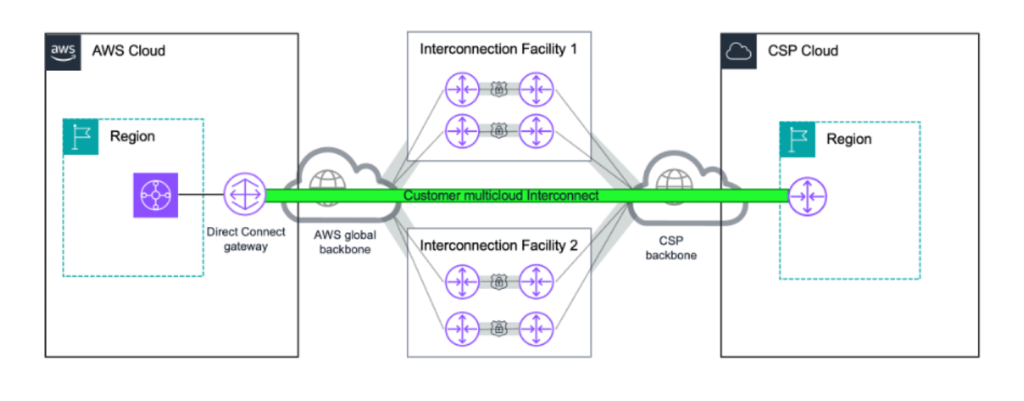
Security is a core tenet of AWS Interconnect – multicloud. All connections are fortified with IEEE 802.1AE MACsec encryption on the physical links between AWS and partner cloud provider routers at interconnection facilities. This encryption is automatically configured, relieving users of separate setup obligations. While each cloud provider independently manages encryption on its own backbone, users are advised to consult their specific cloud provider’s documentation to ensure compliance with their security requirements. Resiliency is also embedded, with each connection spanning multiple logical links distributed across at least two physical facilities, mitigating the risk of single points of failure.
For performance monitoring, AWS Interconnect – multicloud seamlessly integrates with Amazon CloudWatch. A Network Synthetic Monitor is included with every connection, providing crucial metrics for round-trip latency, packet loss, and bandwidth utilization, which are invaluable for capacity planning and proactive issue identification.
In a move that fosters collaboration and transparency, AWS has published the underlying specification for AWS Interconnect – multicloud on GitHub under the Apache 2.0 license. This open approach invites any cloud service provider to collaborate with AWS and become an Interconnect partner, provided they meet stringent AWS operational requirements, including resiliency standards, support commitments, and service level agreements.
-
AWS Interconnect – last mile: Leveraging the same architectural principles as its multicloud counterpart, this capability focuses on extending high-speed, private connections from AWS to an organization’s branch offices, data centers, and remote locations. It achieves this by integrating with participating network providers’ last-mile infrastructure, offering a simplified path to establish private connectivity directly from the AWS Management Console.
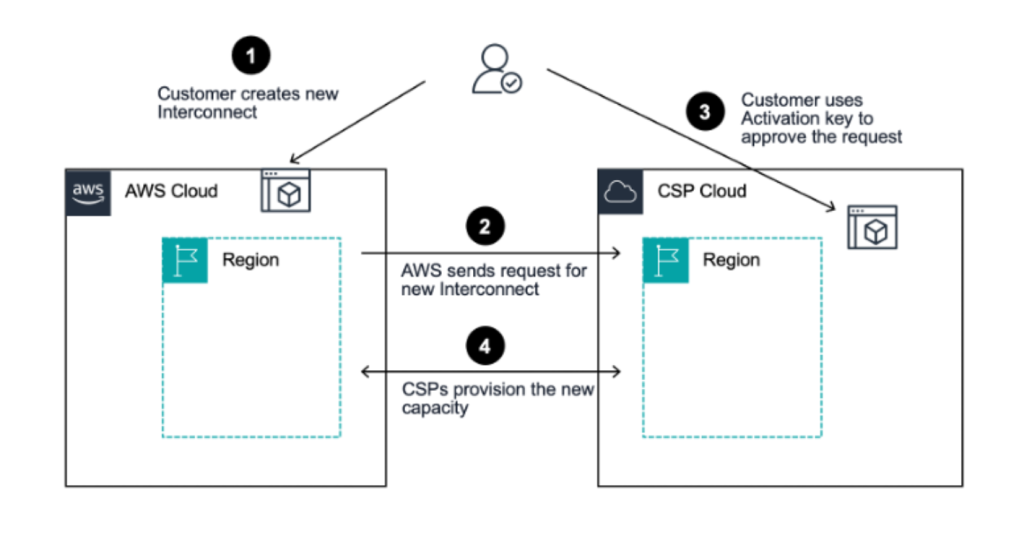
The onboarding process for last-mile connectivity mirrors the multicloud experience. Users select a provider, authenticate, and specify their connection endpoints and desired bandwidth. AWS then generates an activation key, which is used within the provider’s console to finalize the configuration. AWS Interconnect – last mile automatically provisions four redundant connections across two physical locations, configures BGP routing, and enables MACsec encryption and Jumbo Frames by default. This automated setup ensures a resilient private connection to AWS that adheres to best practices, eliminating the need for manual network component configuration.
The service supports bandwidths ranging from 1 Gbps to 100 Gbps, with the flexibility to adjust bandwidth via the console without requiring a full reprovisioning process. AWS Interconnect – last mile includes a 99.99% availability SLA up to the Direct Connect port and bundles CloudWatch Network Synthetic Monitor for comprehensive connection health monitoring. Similar to the multicloud offering, it attaches to a Direct Connect Gateway, which then connects to the user’s Virtual Private Gateway, Transit Gateway, or AWS Cloud WAN deployment.
Simplifying Multicloud Connectivity: A Step-by-Step Demonstration
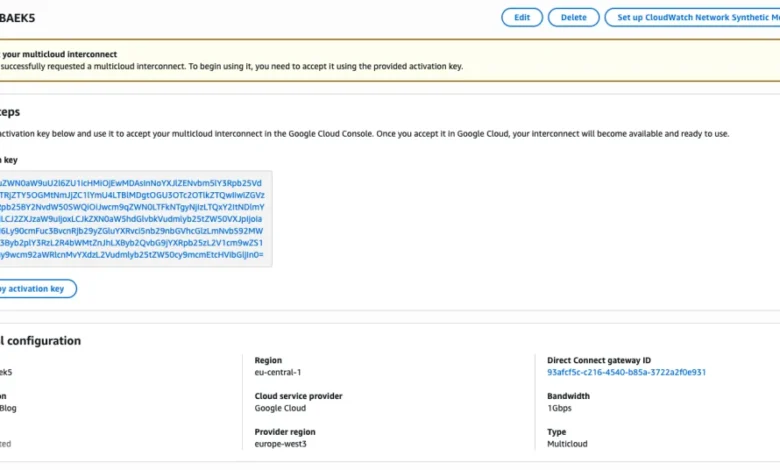
To illustrate the ease of use, AWS provided a detailed walkthrough of provisioning an AWS Interconnect – multicloud connection to Google Cloud. The process is designed to be completed in minutes:
-
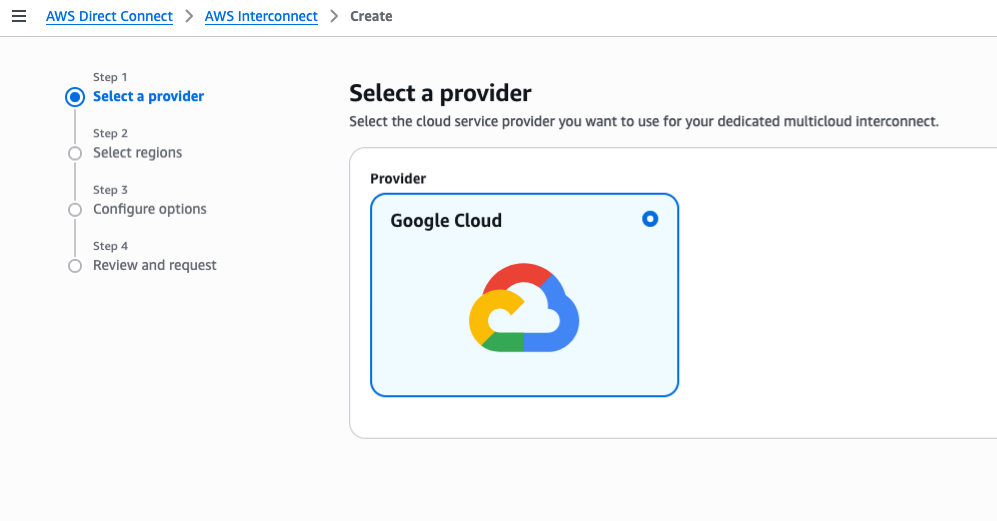
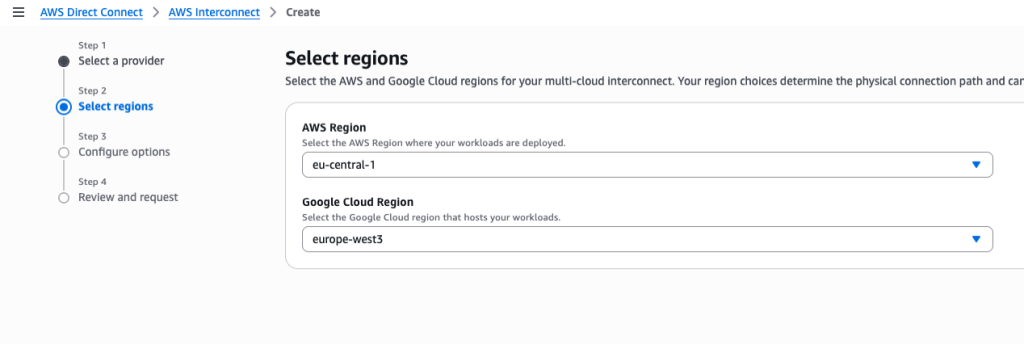
Initiating the Interconnect Request: The process begins in the AWS Management Console, specifically within the AWS Direct Connect section, under the AWS Interconnect tab. Users select "Create" and then choose their desired cloud provider, in this demonstration, Google Cloud. The next step involves specifying the source and destination AWS Regions and the corresponding Google Cloud Regions.
-
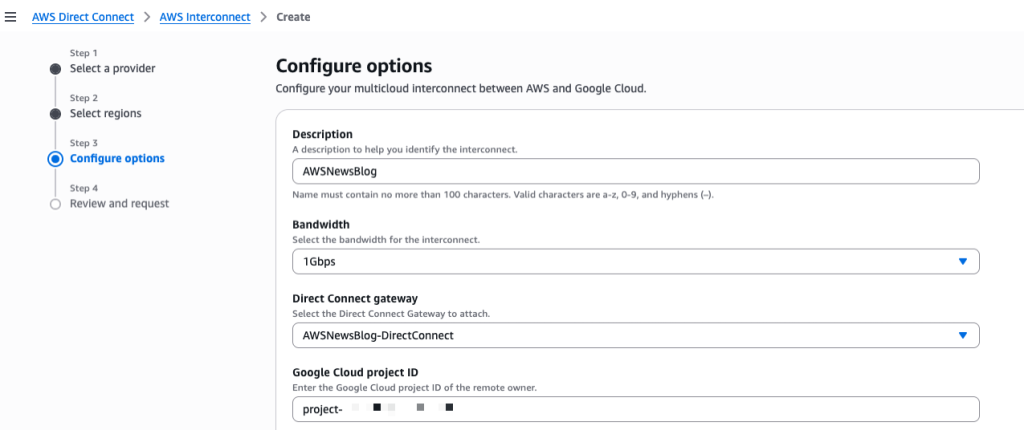
Configuring Connection Details: Following region selection, users provide essential details such as a description for the connection, the desired bandwidth, the Direct Connect Gateway to which the interconnect will attach, and their Google Cloud project ID. Upon confirmation, AWS generates an activation key, a critical component for the subsequent validation on the Google Cloud side.
-
Establishing the Transport and Peering on Google Cloud: With the activation key in hand, the process shifts to the Google Cloud Platform (GCP). While a web-based console option was not available at the time of the announcement, the demonstration utilized the GCP command-line interface (CLI). After noting the CIDR range of the GCP VPC subnet, a
gcloud network-connectivity transports createcommand is executed, incorporating the activation key and other specified parameters.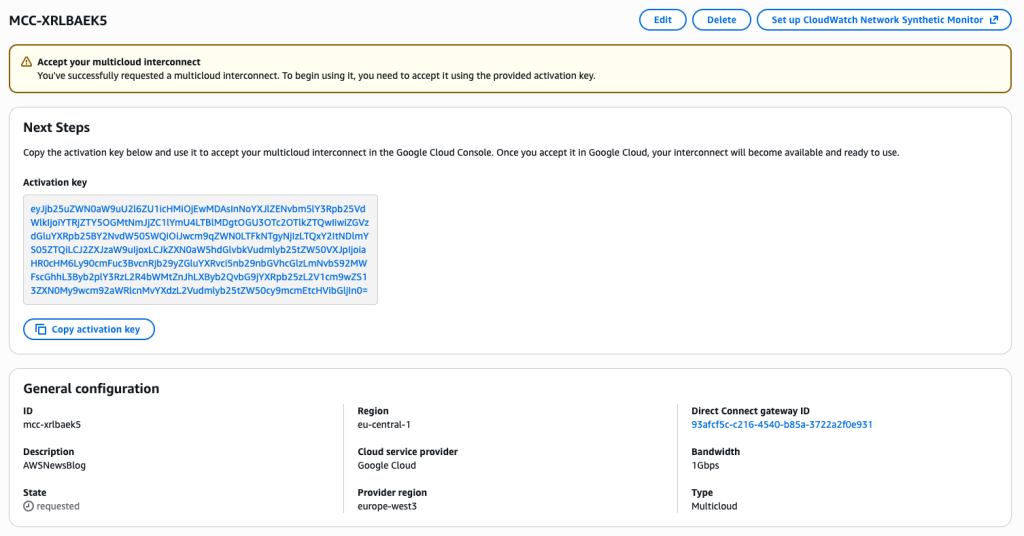
Following the successful creation of the transport, a peering connection is established between the GCP VPC and the newly created transport. This can be done via the GCP console or, as demonstrated, using the
gcloud compute networks peerings createcommand, linking the GCP VPC to the transport network identified in the previous command’s output. -
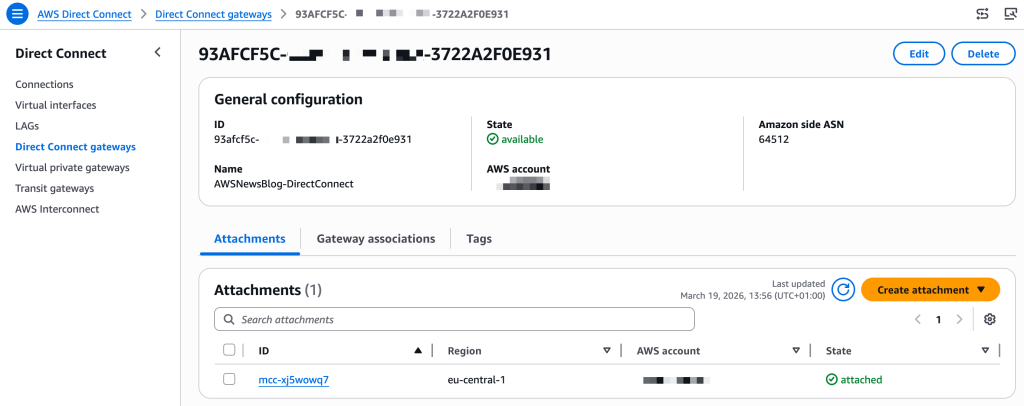
AWS-Side Configuration and Verification: Once the GCP configuration is complete, users return to the AWS Interconnect console to verify the connection status, which should update to "available." Within the AWS Direct Connect console, under "Direct Connect gateways," the attachment to the new interconnect is visible.

-
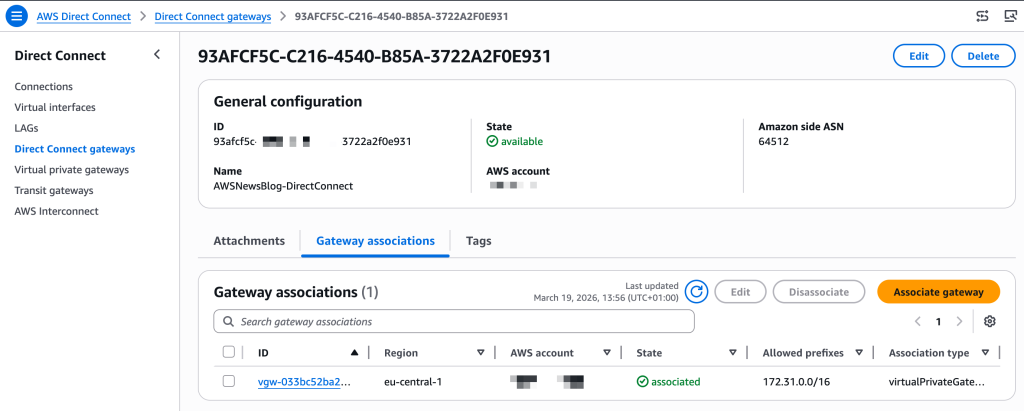
Associating the Gateway: The final AWS-side step involves associating the Virtual Private Gateway (VGW) with the Direct Connect gateway. It is crucial that the VGW resides in the same AWS Region as the interconnect.
-
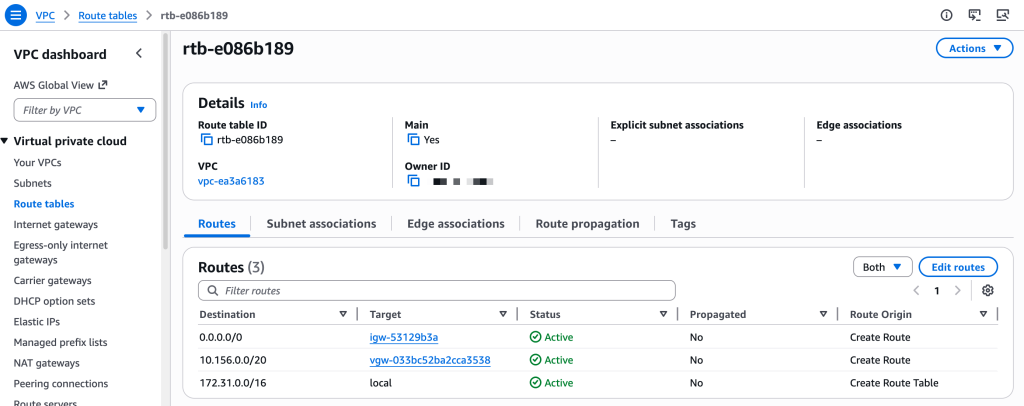
Route Table Configuration: To enable communication, a route entry must be added to the VPC’s route tables, directing all traffic destined for the GCP IP address range through the Virtual Gateway.

-
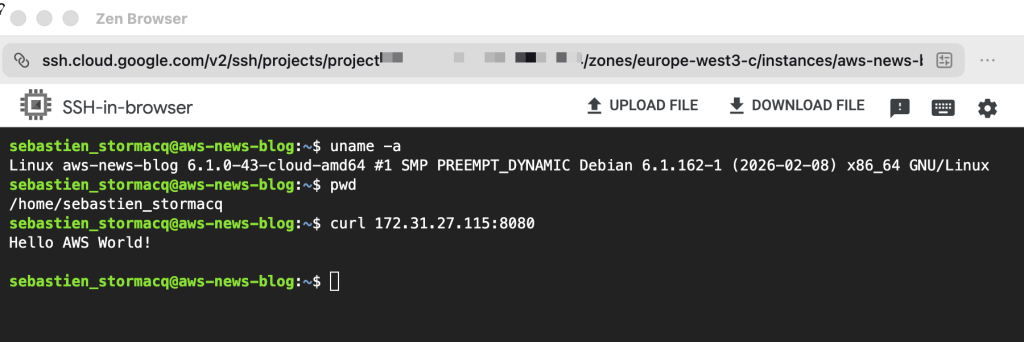
Testing the Connection: The final stage involves testing the established private connection. This is achieved by launching compute instances in both AWS and GCP. A simple web server is initiated on the AWS instance, configured to listen on TCP port 8080. From the GCP instance, a
curlcommand is used to access the AWS web server via its private IP address. A successful response confirms the private network route between the two cloud environments, managed entirely by AWS and Google Cloud.
Broader Implications and Architectures
The introduction of AWS Interconnect is poised to significantly impact how organizations architect their cloud strategies. For deployments scaling within a single region with multiple VPCs, AWS Transit Gateway can serve as a centralized routing hub, connecting them through a single Interconnect attachment. This enables traffic segmentation, consistent routing policy enforcement, and seamless integration with AWS Network Firewall for traffic inspection.
At a global scale, where workloads are distributed across multiple AWS Regions and other cloud environments, AWS Cloud WAN extends this unified connectivity model worldwide. This allows any region within an organization’s network to reach any Interconnect attachment globally, supported by centralized policy management and segment-based routing that is consistently applied across all operational locations. Detailed reference architectures for these scenarios have been documented in a companion blog post by AWS.
Partner Ecosystem and Future Expansion
The success of AWS Interconnect hinges on a robust partner ecosystem. For AWS Interconnect – multicloud, cloud providers must implement the published specification and meet AWS operational requirements. This open approach signals AWS’s commitment to fostering an interconnected cloud landscape.
For AWS Interconnect – last mile, the service is launching with Lumen Technologies as the initial partner, offering a streamlined path to AWS for their customers. AT&T and Megaport are also in the process of integrating their services, with additional partners and regions planned for the future. Scott Yow, SVP Product at Lumen Technologies, commented, "By combining AWS Interconnect – last mile with Lumen fiber network and Cloud Interconnect, we simplify the last-mile complexity that often slows cloud adoption and enable a faster, and more resilient path to AWS for customers."
Pricing and Availability
The pricing model for both AWS Interconnect – multicloud and AWS Interconnect – last mile is based on a flat hourly rate for the requested capacity, billed pro-rata. Users select the bandwidth tier that best suits their workload requirements.
AWS Interconnect – multicloud pricing varies by region pair. For instance, a connection between US East (N. Virginia) and Google Cloud N. Virginia will have a different cost than a connection to a more distant region. The use of AWS Cloud WAN can also influence total cost due to global routing. Detailed pricing information is available on the respective AWS Interconnect – multicloud and AWS Interconnect – last mile pricing pages.
As of the announcement, AWS Interconnect – multicloud is available in five region pairs: US East (N. Virginia) to Google Cloud N. Virginia, US West (N. California) to Google Cloud Los Angeles, US West (Oregon) to Google Cloud Oregon, Europe (London) to Google Cloud London, and Europe (Frankfurt) to Google Cloud Frankfurt. Support for Microsoft Azure is anticipated later in 2026, with Oracle Cloud Infrastructure (OCI) also slated for integration.
AWS Interconnect – last mile is initially launching in US East (N. Virginia) with Lumen. Further partner integrations and regional expansions are planned.
Organizations eager to leverage these new connectivity solutions can get started by visiting the AWS Direct Connect console and selecting AWS Interconnect from the navigation menu. AWS encourages users to share their experiences and feedback through the AWS re:Post community. This launch marks a significant step forward in simplifying and enhancing the interconnectedness of cloud and on-premises environments, empowering businesses to build more agile, resilient, and efficient IT infrastructures.