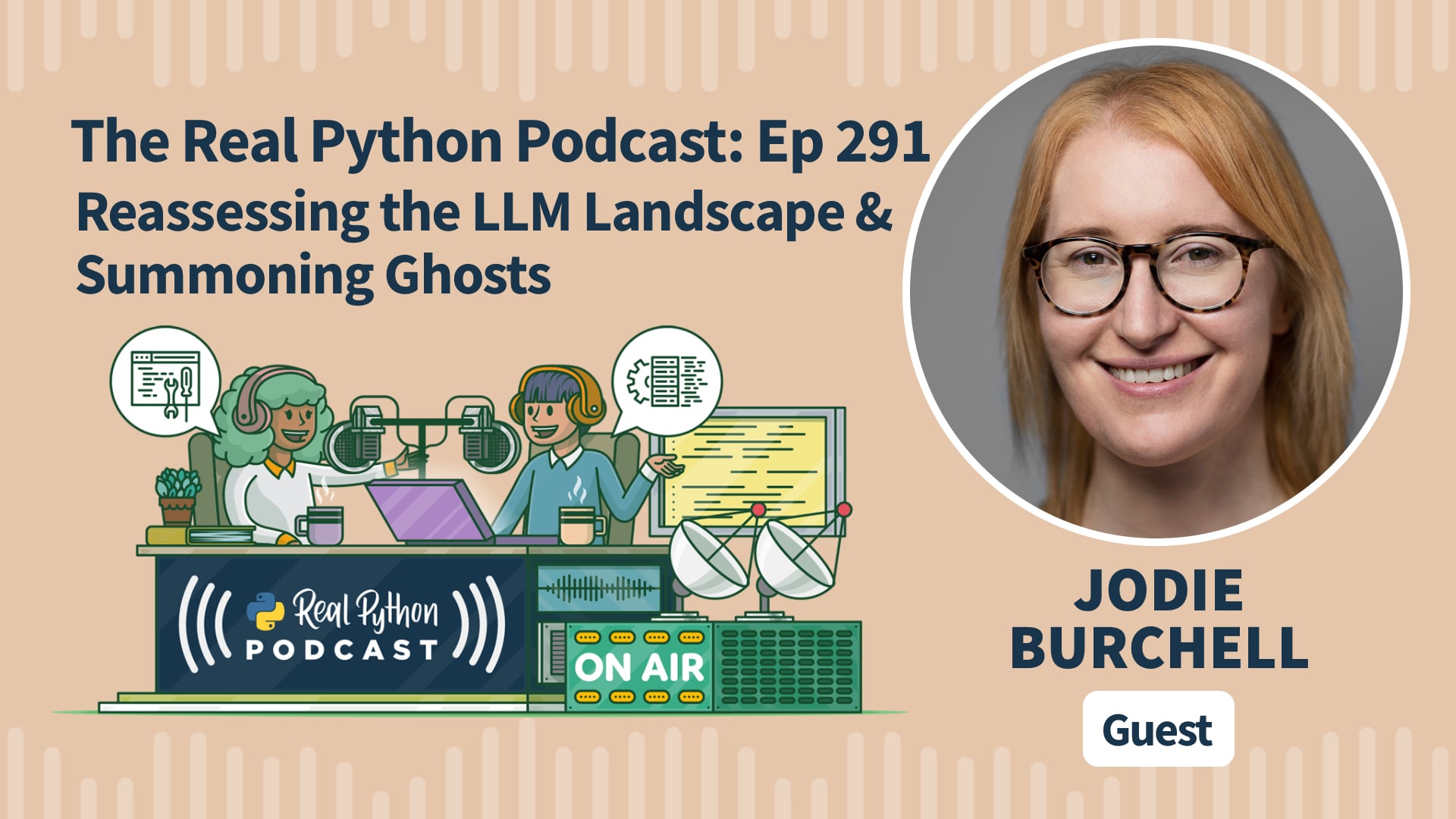
The latest episode of The Real Python Podcast, released on April 17, 2026, delves into the rapidly evolving world of Large Language Models (LLMs) and their practical applications, featuring insights from AI expert Jodie Burchell. This comprehensive discussion, spanning one hour and fifteen minutes, navigates the shift in AI development from purely post-training enhancements to more sophisticated context engineering and multi-agent orchestration. The episode is categorized under intermediate, AI, and editors, suggesting its relevance to developers looking to integrate AI capabilities into their workflows.
This installment marks Burchell’s return to the podcast, following a previous appearance where she explored the then-emerging trends in LLM scaling laws. In this new episode, the conversation revisits the significant focus of the past year on reasoning models and a technique known as "reinforcement learning from verifiable rewards" (RLVR). A key area of exploration is "test-time compute," a paradigm where LLMs dedicate more processing power during inference to meticulously reason through problems, considering multiple potential solutions before arriving at a final output. This approach represents a significant departure from earlier models that prioritized speed over depth of reasoning.
The podcast also tackles the burgeoning concepts of Agent Context Protocol (ACP) and agent orchestration layers, highlighting how these frameworks are enabling more complex and autonomous AI agents. Context engineering, the art of carefully crafting the input provided to LLMs to elicit desired outputs, is presented as a critical skill in the current AI landscape. However, the episode does not shy away from acknowledging potential pitfalls, raising concerns about the current "hype cycle" surrounding AI, the challenges of maintaining the vast amounts of code that LLMs can generate, and the practicalities of running increasingly powerful local LLM models.
The Shifting Sands of LLM Development
The AI industry has witnessed a dramatic acceleration in LLM capabilities over the past few years. From early iterations focused on generating coherent text, the field has progressed to models capable of complex reasoning, code generation, and even rudimentary problem-solving. Episode #291 of The Real Python Podcast arrives at a pivotal moment, as the industry grapples with the limitations of traditional scaling approaches and explores new frontiers.
Last year, a significant amount of research and development was dedicated to enhancing LLM performance through post-training techniques. RLVR, for instance, aimed to improve model alignment and safety by rewarding outputs that met specific verifiable criteria. This approach was seen as a crucial step towards building more trustworthy and reliable AI systems. However, the podcast suggests a notable pivot away from relying solely on these methods.
"The industry is moving beyond simply tweaking models after they’ve been trained," explains a spokesperson for a leading AI research firm, who wished to remain anonymous due to ongoing internal strategy discussions. "The real gains now are coming from how we architect the interactions with these models, how we provide them with the right information at the right time, and how we orchestrate multiple AI agents to work together. It’s a more systems-level approach."
From Scaling Laws to Context Engineering
Burchell’s previous discussion on LLM scaling laws highlighted the diminishing returns of simply increasing model size and training data. While these factors remain important, they are no longer the sole drivers of progress. The current emphasis on context engineering signifies a deeper understanding of how LLMs process information. Instead of expecting a model to inherently "know" everything, developers are learning to guide its reasoning by providing precise, relevant context. This can involve feeding it specific documents, examples, or structured data that primes it for a particular task.
"Think of it like providing a very knowledgeable consultant with a detailed brief before a meeting," suggests Dr. Anya Sharma, a computational linguist at a prominent university. "The consultant has immense general knowledge, but the brief focuses their expertise on the specific problem at hand, leading to a much more efficient and accurate outcome. Context engineering is the digital equivalent of that well-crafted brief."
The implications of this shift are profound. It suggests that highly capable AI systems might be achievable with smaller, more specialized models if they are equipped with superior context management. This could democratize access to advanced AI, reducing the reliance on massive, proprietary models.
The Rise of Multi-Agent Orchestration and Test-Time Compute
Beyond individual model performance, the podcast explores the burgeoning field of multi-agent orchestration. This concept involves deploying multiple LLM agents, each potentially specialized in different tasks, and coordinating their efforts to achieve a larger objective. This could range from a team of AI assistants drafting a complex legal document to a swarm of AI agents collaborating on a scientific research project.
"The idea is to leverage the strengths of different models or different instances of the same model for specific sub-tasks," says Mark Chen, lead AI engineer at a Silicon Valley startup. "One agent might be excellent at summarizing information, another at creative writing, and a third at debugging code. Orchestrating them effectively can lead to emergent capabilities that a single agent wouldn’t possess."
Parallel to this, the concept of "test-time compute" is gaining traction. Traditionally, LLMs perform inference rapidly, often with a fixed computational budget. Test-time compute allows for more iterative and deliberate reasoning. During the inference phase, the model can engage in a more extended computational process, exploring different logical pathways, re-evaluating its understanding, and refining its output. This is particularly relevant for tasks requiring high accuracy and complex logical deduction, moving LLMs closer to human-like deliberation.
The podcast touches upon frameworks like the Agent Context Protocol (ACP), which aims to standardize how these agents communicate and share context, facilitating more seamless collaboration. The development of such protocols is crucial for building robust and scalable multi-agent systems.
Navigating the Hype and Practical Challenges
Despite the rapid advancements, the episode also injects a dose of realism by addressing the inherent challenges and potential pitfalls of the current AI boom. The "hype cycle" often leads to inflated expectations, and it’s crucial to distinguish between genuine progress and speculative enthusiasm.

One significant concern raised is the maintainability of AI-generated code. As LLMs become more adept at writing code, the volume of generated code will increase. Ensuring the quality, security, and long-term maintainability of this code presents a substantial engineering challenge. Developers will need new tools and methodologies to manage, test, and refactor AI-generated code effectively.
Furthermore, the growing interest in running powerful LLMs locally poses significant hardware and computational hurdles. While the benefits of local execution – such as enhanced privacy and reduced latency – are attractive, the sheer computational resources required for many state-of-the-art models remain a barrier for most individual users and even many organizations. This dynamic is likely to spur innovation in model compression, quantization, and more efficient hardware architectures.
"We’re seeing a bifurcation," notes a hardware analyst from Gartner. "On one end, massive cloud-based AI infrastructure will continue to push the boundaries. On the other, there’s a strong push for more efficient, smaller models that can run on edge devices or local machines. The challenge is bridging that gap and making cutting-edge AI accessible without astronomical costs."
The episode’s mention of "summoning ghosts" in its title is a metaphorical nod to the often-unpredictable nature of LLMs and the ongoing effort to understand and control their behavior, especially as they become more sophisticated and potentially capable of exhibiting emergent, unexpected characteristics.
Looking Ahead: The Evolving AI Landscape
The Real Python Podcast’s episode #291 offers a valuable snapshot of the current AI landscape, emphasizing a strategic shift from brute-force scaling to intelligent orchestration and context management. As the industry moves forward, the focus on practical applications, robust engineering practices, and a clear-eyed assessment of challenges will be paramount. The insights provided by Jodie Burchell and the podcast’s hosts serve as a crucial guide for developers and enthusiasts navigating this dynamic and rapidly transforming field. The conversation underscores that the future of AI development lies not just in building more powerful models, but in learning to wield them more effectively and responsibly. The ongoing advancements in areas like context engineering and multi-agent systems suggest a future where AI is not just a tool, but an integrated partner in a wide array of human endeavors.